

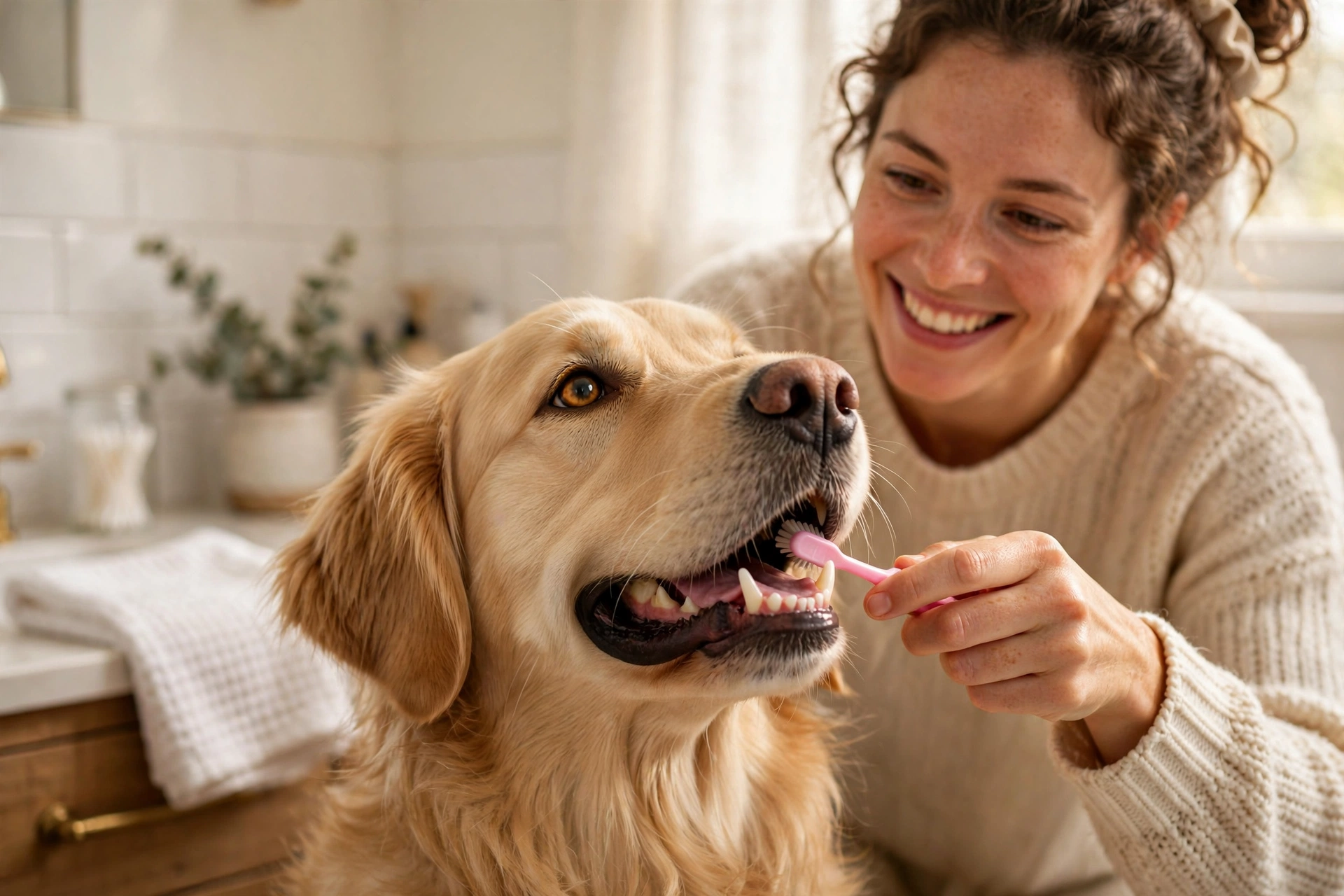
Your dog’s breath could strip paint off a barn door. You are not alone in noticing — and you are not alone in dreading what it means for their health. Dental disease is the single most common health problem in dogs, yet tooth brushing is the one grooming task most owners skip entirely.
The good news: brushing a dog’s teeth is simpler than trimming nails and far less dramatic than ear cleaning. Most dogs learn to accept — some even enjoy — a two-minute nightly brushing once the routine is introduced the right way. This guide walks you through the tools you need, the exact technique, how to handle a dog that resists, and the warning signs that mean it is time to see the vet.
Direct answer: Brush your dog’s teeth with a dog-safe toothbrush (or finger brush) and enzymatic dog toothpaste — never human toothpaste, which can contain xylitol or fluoride that are toxic to dogs. Brush in gentle circles along the outer surfaces of the teeth, especially the gum line, for about two minutes, ideally daily. Introduce the routine gradually over a week so your dog learns to accept it, reward calm behavior throughout, and watch for red, bleeding gums or broken teeth, which mean a vet visit is needed.
Why Does My Dog’s Dental Health Actually Matter?
Because bad teeth are not just a cosmetic problem — they are a health problem that reaches far beyond the mouth.
According to the American Veterinary Medical Association (AVMA), periodontal disease is the most commonly diagnosed disease in dogs, and by age three, more than 80 percent of dogs show signs of it. That means the odds are overwhelming that your dog has some degree of dental disease right now.
Periodontal disease starts with plaque — the same sticky bacterial film that forms on human teeth. In dogs, plaque hardens into tartar within about 72 hours. Tartar cannot be brushed away; it needs a professional cleaning under anesthesia. But here is what matters: the inflammation from gum disease can let bacteria enter the bloodstream, and veterinary dentists consistently link advanced dental disease to problems with the heart, kidneys, and liver. The Veterinary Oral Health Council (VOHC), which certifies dental products for effectiveness, notes that regular at-home care is the foundation of preventing this cascade.
Dogs rarely show dental pain the way you might expect. They keep eating — even with broken teeth or advanced gum disease — because survival instinct tells them not to show weakness. So do not wait for your dog to stop chewing before taking dental care seriously.
When in doubt, ask your vet — especially if your dog already has thick tartar, bleeding gums, or bad breath that is suddenly much worse.
What Do I Need to Brush My Dog’s Teeth?
Gathering the right tools first makes the whole process smoother. You do not need much, and the total cost is less than a single professional cleaning by orders of magnitude.
- Dog toothpaste. Enzymatic toothpaste formulated for dogs is the standard. It comes in flavors dogs accept — poultry, peanut butter, malt — and it is designed to be swallowed safely. Never use human toothpaste: it contains fluoride and often xylitol, both of which are dangerous to dogs.
- A toothbrush sized for your dog. For small dogs, a finger brush (a soft rubber sleeve that slides over your index finger) gives you the most control. For medium and large dogs, a long-handled brush with a soft head works well. Double-headed brushes with a large and small end are handy if you have more than one dog.
- A treat your dog loves. Tiny, soft, high-value treats for rewarding each step of training. Peanut butter (xylitol-free, always) on a lick mat also works brilliantly as a distraction tool during longer sessions.
- A dental wipe or gauze (optional backup). If your dog absolutely will not accept a brush at first, a wet gauze square wrapped around your finger can remove plaque almost as effectively as a brush on smooth surfaces.
Look for the VOHC seal of acceptance on toothpastes and chews — it means the product has demonstrated a real reduction in plaque or tartar, not just claimed one.
For the rest of your dog’s grooming routine, our guide on how to trim your dog’s nails without stress pairs well with dental care — both are low-stress handling skills your dog will thank you for learning.
How Do I Teach My Dog to Accept Tooth Brushing?
Do not just grab your dog, pry open their mouth, and start scrubbing. That is how you get a dog that runs when it sees the toothbrush. The introduction should take about a week, and each step should feel like a game with treats.
Step 1: Teach your dog that hands near the mouth earn treats (Days 1–2)
Lift your dog’s lip gently, touch their gums for two seconds, and immediately give a treat. Repeat five or six times per session, twice a day. You are teaching a simple association: human hands in mouth = good things happen.
Step 2: Introduce the taste of the toothpaste (Days 3–4)
Let your dog lick a pea-sized dab of dog toothpaste off your finger as a treat. Do not do any brushing yet. If your dog likes the flavor, half your training is already done.
Step 3: Touch the teeth with the paste (Days 5–6)
Put toothpaste on your finger and rub it gently along the outside of your dog’s upper teeth and gums. Reward generously. Then try the same with the finger brush or toothbrush, still without real brushing.
Step 4: Start actual brushing (Day 7 and beyond)
Begin with just the front teeth, ten seconds per side, then reward. Over the following week, gradually extend the time and work your way to the back molars — where tartar builds fastest. If your dog pulls away, you moved too fast; drop back one step for a day.
Key rules for every session: keep sessions short and end on a win. Always reward. Never restrain your dog forcefully — brushing should never be a wrestling match, because you will lose the long game even if you win the day.
Dogs that learn calm cooperative handling for one task usually accept others more easily too. The same patient approach underlies our guide to cleaning your dog’s ears safely — slow introductions, rewards, and stopping before the dog loses patience.
What Is the Correct Brushing Technique?
Once your dog accepts the brush, technique is simple. You do not need to do everything a dentist would do — consistency matters far more than perfection.
- Angle the bristles at 45 degrees to the gum line on the outer (cheek-facing) surfaces of the teeth. This is where plaque and tartar accumulate fastest, because the tongue naturally cleans the inner surfaces somewhat.
- Use small, gentle circles. Light pressure is enough — you are not scrubbing grout. Harder brushing damages gums and makes your dog dread the next session.
- Spend the most time on the upper back teeth. The big premolars and molars along the upper jaw collect tartar fastest because the salivary ducts empty right there. These teeth deserve at least half your brushing time.
- Do not forget the canines (the “fangs”) and the front incisors. They are easy to reach and prone to tartar too.
- Aim for two minutes, ideally every day. Daily brushing is the gold standard and what veterinary dentists recommend. But be honest with yourself: brushing three or four times a week is enormously better than never. The plaque that causes gum disease hardens into tartar in roughly three days, so anything more frequent than that is actively protective.
What about the inside surfaces? If your dog will allow it, great — brush them. If not, do not stress: most vets say the outer surfaces are the priority, and a dog that cooperates happily for outer surfaces keeps its teeth far healthier than one that fights you over the full works.
What If My Dog Refuses to Let Me Brush?
Some dogs, especially adults that have never had their mouths handled, genuinely struggle. You still have options — brushing is the best tool, but it is not the only one.
- Slow the training down further. Some dogs need three weeks, not one. That is fine. Shaving thirty seconds off your timeline is not worth making your dog fearful.
- Try the wipe method. A damp gauze square or a VOHC-accepted dental wipe around your finger, rubbed along the outer tooth surfaces, removes soft plaque effectively. It is the best fallback when a brush is a non-starter.
- Add VOHC-accepted dental chews. These are not a replacement for brushing — the mechanical action of a chew cannot reach the gum line the way a brush does — but VOHC-certified chews genuinely reduce plaque and tartar buildup between brushings.
- Water additives and dental diets exist. VOHC-accepted water additives are low-effort and harmless, though their effect is modest compared to brushing. Dental diets with larger, fibrous kibble provide a mild scrubbing action.
- Consider professional help. If your dog guards their mouth aggressively, talk to your vet or a certified animal behaviorist before forcing anything. Fear-based mouth handling can create a bite risk.
And if your dog’s dental situation is already advanced — thick brown tartar, gums that bleed when touched, teeth that move — home care alone will not fix it. That dog needs a professional dental cleaning under anesthesia first, and home brushing maintains the results afterward.
What Are the Warning Signs of Dental Disease?
Catch problems early, and treatment is simple. Catch them late, and it is surgery. Learn what to look for when you lift that lip.
- Persistent bad breath. Normal dog breath is not minty, but it should not make you recoil from across the room. Foul breath is often the first sign of infection.
- Red, swollen, or bleeding gums. Healthy gums are pink and firm. Gums that bleed during brushing — or on their own — are inflamed.
- Yellow-brown tartar buildup, especially along the gum line of the upper back teeth.
- Changes in eating habits. Dropping food, chewing on one side, pawing at the mouth, or suddenly preferring soft food can all signal mouth pain.
- Loose, broken, or discolored teeth, or visible swelling under the eyes or around the muzzle — which can indicate a tooth root abscess and needs a vet visit promptly.
- Excessive drooling or blood in the saliva.
Small breeds and brachycephalic (flat-faced) dogs like Pugs and French Bulldogs are genetically prone to worse dental disease because their crowded teeth trap more plaque. If you own one of these breeds, dental care deserves to be at the very top of your grooming priorities.
If you notice any of these signs, do not try to brush harder — book a vet dental check. When in doubt, ask your vet.
How Often Does My Dog Need a Professional Dental Cleaning?
This is the question every owner asks, and the honest answer is: it depends on the dog. Genetics, breed, age, and how consistently you brush all matter. Some dogs with daily brushing need a professional cleaning every couple of years; some without home care need one annually.
What a professional cleaning involves: your dog is anesthetized, the vet scales tartar above and below the gum line (the below-gum-line part is the critical part — it is also why “anesthesia-free” dental cleanings are controversial and not recommended by the American Veterinary Dental College), takes X-rays to check tooth roots, polishes the teeth, and extracts anything unsalvageable.
Between cleanings, your daily brushing is what determines how long the results last. Think of it the same way as your own dental routine: the dentist visit handles what you cannot reach, and your daily brushing handles everything else.
Our guide to how often you should bathe your dog follows the same philosophy — a steady at-home routine that reduces how often professional services are needed.
Frequently Asked Questions
Can I really use human toothpaste on my dog in a pinch?
No. Human toothpaste contains fluoride and frequently xylitol (also called birch sugar), both of which are toxic to dogs. Xylitol can cause a rapid, life-threatening drop in blood sugar and liver failure. Dog toothpaste is cheap, widely available, and safe to swallow — there is no reason to risk a substitute.
How often should I actually brush my dog’s teeth?
Daily is ideal and is what veterinary dentists recommend, since plaque hardens into tartar within about 72 hours. Realistically, three to four times per week still provides meaningful protection. The one schedule that does not work is “occasionally” — sporadic brushing does very little.
My dog’s teeth already have brown tartar. Will brushing remove it?
No. Once plaque has mineralized into hard tartar, no amount of brushing or chewing will remove it — it requires professional scaling, usually under anesthesia. Home brushing prevents new buildup and protects the results after a professional cleaning, but it cannot undo existing tartar.
Do dental chews really work, or are they just expensive treats?
VOHC-accepted dental chews genuinely reduce plaque and tartar — the seal means independent review of the evidence. They are a useful supplement, especially on days you skip brushing. But they do not reach the gum line as effectively as a brush, so they are a complement to brushing, not a replacement.
Final Thoughts
Two minutes a day. That is the whole secret. The dogs with the healthiest teeth are not the ones with the fanciest products — they are the ones whose owners built a calm, consistent brushing habit and stuck with it. Start slow, reward generously, and meet your dog where they are. Your vet will notice the difference at the next checkup, and your dog’s breath might stop being a weapon.