

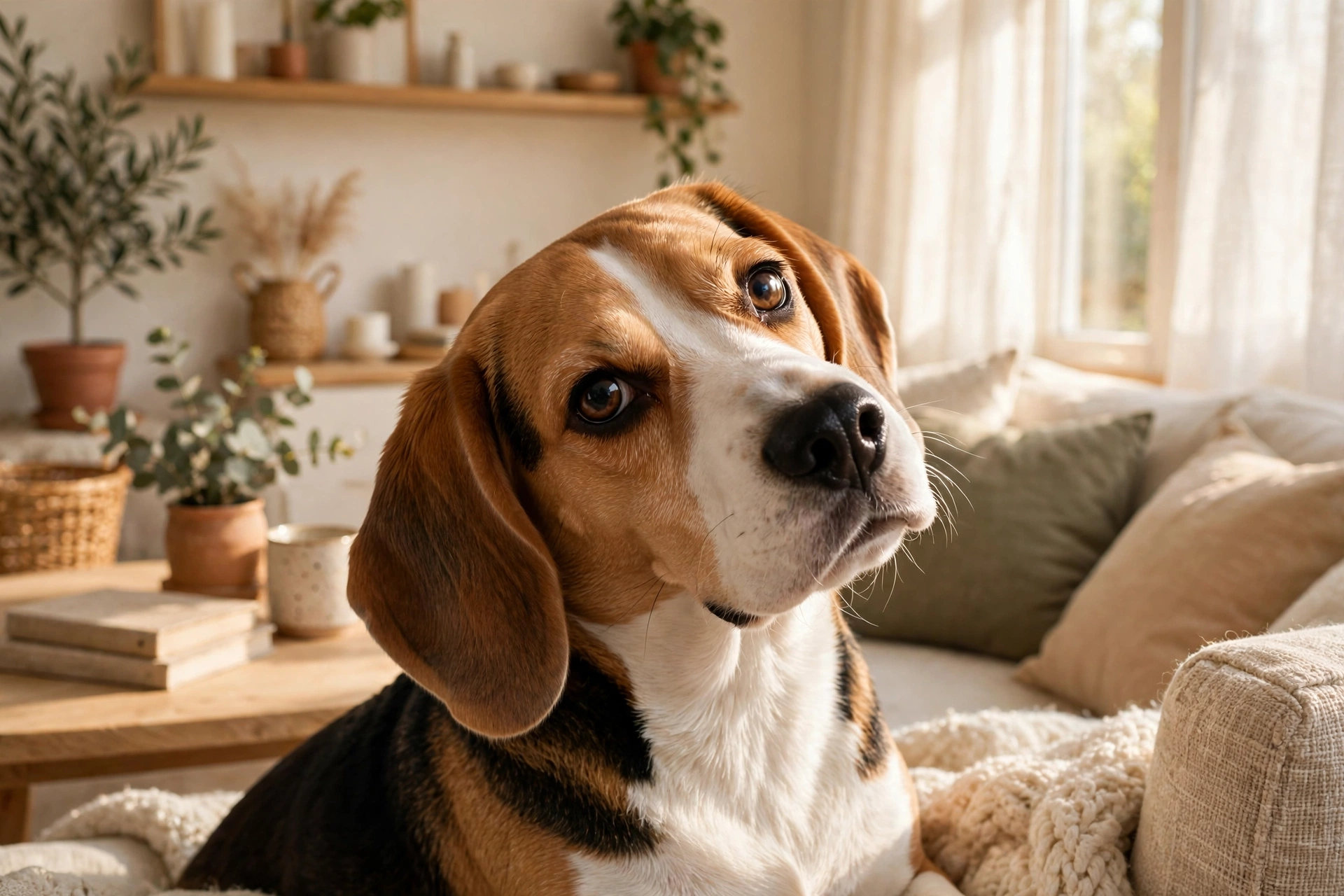
You say something odd — “wanna go for a ride?” — and your dog cocks their head to the side, ears perked, eyes locked on you. It is one of the most beloved dog behaviors on the planet, and it melts every human heart. But why do dogs tilt their heads in the first place? Is your dog confused, concentrating, or just performing for treats because it works every time?
Scientists have actually studied this, and the answers are more interesting than you might expect. Here is what researchers know about the head tilt — and the rare cases when it signals something worth a vet visit.
Direct answer: Dogs tilt their heads mainly to concentrate — adjusting their ears to pinpoint sounds and shifting their muzzle to read your facial expressions more clearly. A 2021 study at Hungary’s Eötvös Loránd University found that dogs tilted their heads significantly more when focusing hard on remembering a word, suggesting the tilt is linked to attention and memory processing. Occasional tilting is normal and healthy; a constant or sudden tilt can indicate an ear or balance problem.
Why do dogs tilt their heads at sounds?
The oldest explanation is also the most intuitive: dogs tilt their heads to hear better. By cocking the head, a dog changes the position of their ears relative to a sound source, which may help them pinpoint exactly where a sound is coming from and judge its distance. Dogs can detect sound frequencies far beyond human range, and small head adjustments help them triangulate.
Head tilting also seems tied to concentration. When you speak to your dog in an unusual tone — a question, a new word, a funny voice — the tilt often appears right at the moment of peak attention. The dog is essentially saying, “That was interesting — say it again.” Many owners notice the tilt happens most with words the dog half-recognizes, like their name mixed into an unfamiliar sentence.
Canine researcher Dr. Stanley Coren, professor emeritus of psychology at the University of British Columbia, has proposed another layer: a dog’s muzzle can partially block their view of our lower face, so tilting the head shifts the snout out of the way and lets the dog read our facial expressions and mouth movements more clearly. Since dogs are exquisitely tuned to human faces — reading our emotions better than any other animal — it makes sense they would adjust their angle for a better look. This remains a theory rather than proven fact, but it fits what we know about how closely dogs watch us.
Do smarter dogs tilt their heads more?
This is where the science gets genuinely fascinating. In 2021, researchers at Eötvös Loránd University in Budapest — led by Dr. Shany Dror with colleagues including Dr. Ádám Miklósi and Dr. Claudia Fugazza — published a study in the journal Animal Cognition examining head-tilting in dogs, and the results surprised everyone.
The team studied “gifted word learner” dogs — rare dogs that can learn the names of dozens of toys — alongside typical dogs, while the dogs listened to their owners ask them to fetch specific toys. The gifted dogs tilted their heads in 43% of trials, compared to just 2% for typical dogs. The researchers concluded that head-tilting appears linked to concentration and memory recall: the dogs tilted their heads when they were focusing hard on matching a word they heard to a toy they remembered.
Does this mean a head-tilting dog is a genius? Not exactly — the study looked at a specific skill, not general intelligence. But it does suggest the tilt is a visible signal of a dog thinking hard. So the next time your dog cocks their head at “squirrel?”, they may genuinely be searching their memory for what that word means. That is considerably more impressive than just looking cute — though it is that too.
When is head tilting a sign of a health problem?
Here is the important distinction: an occasional, brief head tilt during conversation is normal. A persistent, constant, or sudden head tilt is not — and it warrants a prompt veterinary visit.
A head tilt that does not go away, especially one accompanied by other symptoms, can indicate:
- Ear infection: One of the most common causes of a persistent tilt. Dogs with ear infections often tilt toward the affected ear and may scratch at it, shake their head, or show redness, odor, or discharge. If your dog’s tilting started alongside head-shaking or ear scratching, check out our guide on how to clean your dog’s ears safely — but see your vet for diagnosis and treatment, since infections need proper medication.
- Vestibular disease: The vestibular system controls balance, and disorders of it — from inner-ear infections to idiopathic vestibular disease in older dogs — classically cause a pronounced head tilt, often with wobbliness, circling, or rapid eye movements. The Merck Veterinary Manual lists head tilt among the hallmark signs of vestibular dysfunction.
- Foreign body or growth in the ear: A foxtail, tick, or mass deep in the ear canal can cause a dog to hold their head tilted to one side persistently.
Red flags that mean “call the vet now, not next week”: a tilt that appeared suddenly and does not resolve, loss of balance or falling over, rapid involuntary eye flicking, vomiting alongside the tilt, or a tilt paired with facial drooping on one side. When in doubt, ask your vet — a quick exam can distinguish a quirky habit from something that needs treatment.
Do some breeds tilt their heads more than others?
Anecdotally, yes — though no large study has ranked breeds by tilt frequency. Owners and trainers consistently report that breeds with longer muzzles and upright ears seem to tilt more dramatically, which fits Dr. Coren’s theory: a longer snout blocks more of the face, so the head must angle further for a clear view. Beagles, with their expressive faces and prominent muzzles, are famously enthusiastic head-tilters.
Dogs bred for close human cooperation — herding breeds like border collies and Australian shepherds, retrievers, and other “velcro” breeds — also seem especially prone to the tilt. That makes sense: these dogs spend their lives reading subtle human cues, so any behavior that sharpens their read on our faces and voices would be useful. Brachycephalic (flat-faced) breeds like pugs and bulldogs tilt too, though their head shape changes the mechanics.
Ultimately, though, the biggest factor is the individual dog and their relationship with you. Dogs tilt most at the humans they are most bonded with — yet another reason to take the tilt as the compliment it is.
Should you encourage the head tilt?
Absolutely — within reason. When your dog tilts their head and you laugh, gasp, or shower them with affection, you are rewarding the behavior, which means your dog will do it more. There is nothing wrong with that. It is harmless, it strengthens your bond, and it is a lovely feedback loop: your dog concentrates on you, you delight in it, your dog feels rewarded for paying attention.
Some trainers even use the tilt deliberately. Because the tilt signals focused attention, you can capture the moment — say your dog’s name, wait for the tilt, then reward. You are reinforcing engagement, which is the foundation of all training. Just keep it light and fun; the moment it feels like a trick you are drilling rather than a conversation, you have missed the point.
One caveat: do not reward a new, persistent tilt the way you would the conversational kind. If your dog suddenly starts holding their head tilted all the time, that is a vet question first and a cute photo second. Knowing the difference is part of being an observant owner — and learning to read the rest of your dog’s body language helps too, as our guide to 10 signs your dog is happy explains.
FAQs
Why does my dog tilt its head when I talk to them?
Your dog is concentrating — adjusting their ears to locate the sound and angling their muzzle to see your face better. Research suggests the tilt is linked to attention and memory processing, so a mid-conversation tilt likely means your dog is genuinely trying to understand you.
Is head tilting in dogs a sign of intelligence?
Partially. A 2021 study in Animal Cognition found that gifted word-learner dogs tilted their heads far more often than typical dogs when concentrating on a task. The tilt signals focused attention rather than general IQ — but a dog who tilts while listening is a dog who is thinking, which is always a good sign.
Why does my dog tilt its head to one side constantly?
A constant tilt to one side is different from the occasional conversational tilt and should be checked by a veterinarian. Common causes include ear infections, vestibular (balance) disorders, or something lodged in the ear canal. If the tilt came on suddenly or comes with balance problems, eye flicking, or head-shaking, seek veterinary care promptly.
Do all dogs tilt their heads?
Most do, but frequency varies enormously by individual. Some dogs tilt dramatically at every other sentence; others rarely do it at all. Both are normal. A dog who never tilts is not broken or inattentive — they simply express their focus differently, perhaps through ear position, eye contact, or body stillness.
The bottom line
Your dog’s head tilt is a small window into a remarkable mind: ears adjusting, eyes focusing, memory searching — all to understand you a little better. Science says it is concentration made visible, and experience says it is one of the purest compliments a dog can pay. Enjoy every tilt, reward the attention behind it, and simply remember the one exception: a tilt that never goes away belongs at the vet’s office, not on camera. When in doubt, ask your vet — they would much rather reassure you about a quirky habit than treat a problem caught late.