

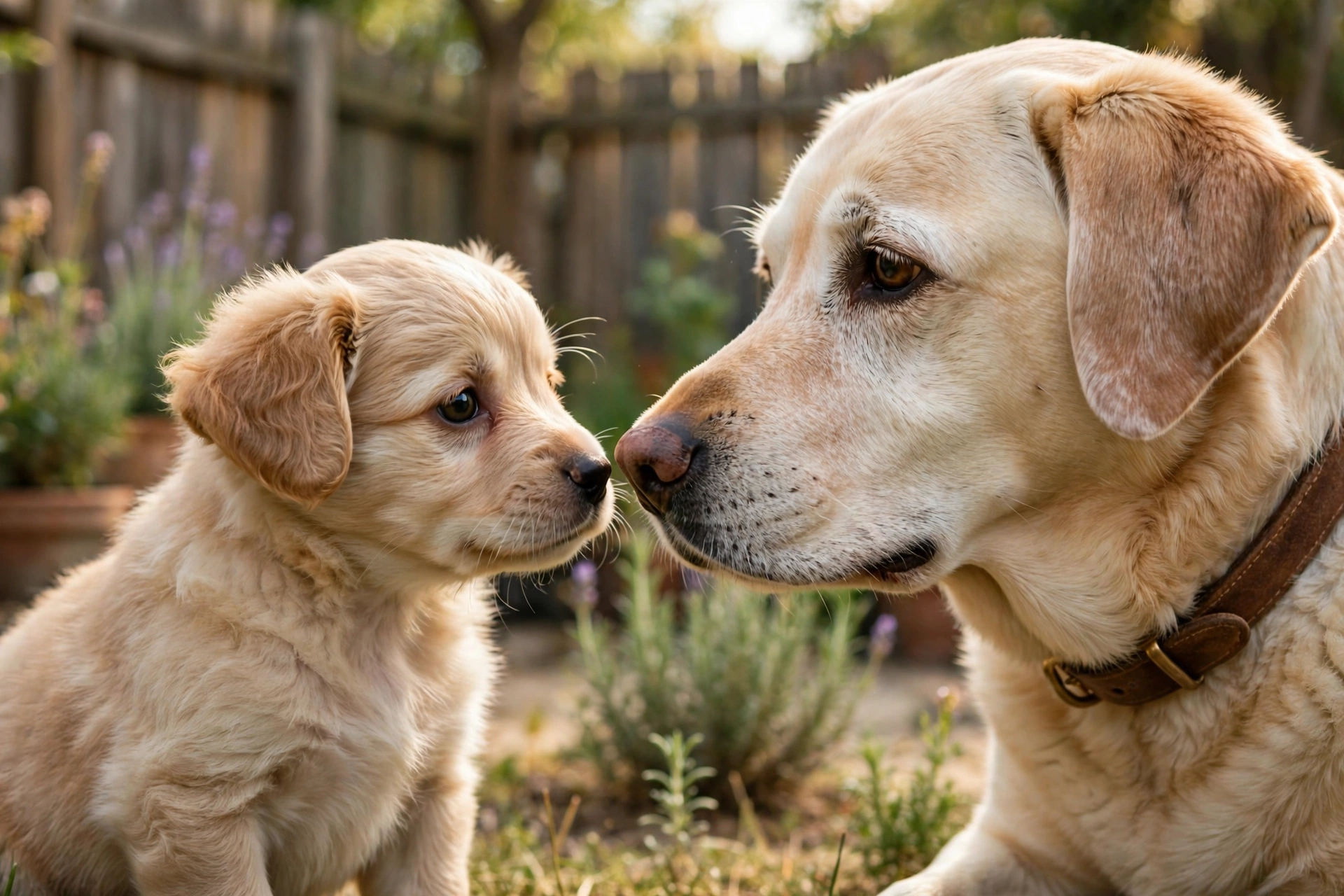
Bringing home a new puppy when you already have an older dog is exciting — and delicate. Done well, it can give your senior a new lease on life. Done badly, it can stress your older dog and turn your home into a referee zone. The good news: a smooth introduction is mostly about preparation, not luck. This guide covers every stage — prep work, the first meeting on neutral ground, home setup, first-week rules, body language, and realistic timelines.
Direct answer: Introduce a new puppy to an older dog on neutral ground, both leashed with one handler per dog, keeping the first greeting short. Swap scents via bedding beforehand, and set up separate bowls, beds, and a retreat space for the older dog. Supervise all interactions for weeks, feed separately, and expect the relationship to take weeks to months to settle.
Should You Introduce Them at Home or on Neutral Ground?
Direct answer: Always introduce them on neutral ground first — a quiet walk or a low-traffic area — because dogs can be territorial about their home and yard.
Your older dog’s home is their territory — walking a bouncy puppy straight through the front door can trigger a defensive reaction that has nothing to do with the puppy and everything to do with location. A neutral setting removes the “this is MY house” factor. Blue Cross (bluecross.org.uk) advises introducing dogs on a walk or in a low-traffic area where neither dog feels cornered. One handler per dog is non-negotiable: two adults, each focused entirely on one dog.
How Do You Prepare Before the First Meeting?
Direct answer: Start scent swapping days before they meet — exchange bedding or a cloth rubbed on each dog so both learn the other’s smell with zero pressure.
Dogs live through their noses, so the introduction can start before they ever meet. A few days out, place a blanket the puppy has slept on near (not in) your older dog’s resting area, and vice versa — or rub a cloth on the puppy’s cheeks and let your older dog sniff it with a treat, building a positive association with the new smell. On introduction day, exercise your older dog beforehand and give the puppy a short play session too, so the greeting happens at 70% energy instead of 110%. Set up your home’s separate spaces before the puppy arrives, so day one isn’t a scramble.
Also: make sure your older dog’s vaccinations are current, and confirm the puppy’s schedule with your vet. Puppies under about 8 weeks haven’t finished vaccinations, so keep early meetings controlled and avoid busy dog areas until your vet gives the all-clear.
How Should the First Meeting Go?
Direct answer: Walk the dogs parallel at a distance first, allow a brief 3–5 second greeting, and end calm — short and positive beats long and overwhelming.
Here’s the step-by-step for introduction day:
- Start with a parallel walk. Walk the dogs in the same direction, 10–20 feet apart — no direct approach. Just being near each other lets both dogs notice, sniff the air, and relax.
- Narrow the distance gradually. Over 5–10 minutes, let the gap shrink as both dogs stay calm. If either stiffens or fixates, widen the gap again. No rush.
- Allow a brief greeting. When both are relaxed, let them approach for a 3–5 second sniff, then cheerfully call them apart and reward calm behavior. Short greetings that end well beat long ones that deteriorate.
- End on a high note. Finish with a few more minutes of parallel walking, then separate. Fifteen to twenty minutes total is a perfect first session — quit while you’re ahead.
Loose, wiggly body language is great. Intense staring, a stiff frozen posture, or raised hackles mean calmly increase distance and try again later. A single grumble from the older dog isn’t a disaster — it’s communication. Respect it.
How Do You Set Up Your Home for Two Dogs?
Direct answer: Give each dog their own bowls, bed, toys, and water — and give the older dog a puppy-free retreat space behind a baby gate where they can decompress.
Before the puppy comes home, arrange your space like a good roommate situation: everything duplicated, nothing contested.
- Separate food and water bowls, placed apart. Food is the number one trigger for conflict between dogs — this is the most important setup step.
- Separate beds and resting spots in different areas. Each dog needs a place that is unambiguously theirs.
- Separate toys. Don’t expect them to share on day one. Some dogs share beautifully; others never do. Let it develop naturally.
- A retreat space for the older dog. A room or gated area where the older dog can escape puppy energy. Puppies are relentless, and seniors need breaks — a baby gate lets the older dog see what’s happening but opt out.
- A crate for the puppy. A safe den for naps (puppies need 18–20 hours of sleep) and guaranteed puppy-free time for your older dog.
- Remove high-value shared items temporarily. That bone your older dog has loved for three years? Put it away until the relationship is stable.
In the early weeks, prevent every avoidable conflict so the dogs only have positive experiences with each other. Management now means friendship later.
What Are the First-Week Rules?
Direct answer: Supervise every interaction, feed the dogs separately, give the older dog daily one-on-one time, and keep greetings with visitors and outings low-key for the first week.
The first week sets the tone. These rules feel strict, but they’re temporary — and they prevent the vast majority of new-dog problems:
- Supervise all interactions. No exceptions. If you can’t actively watch them, they’re separated — puppy in the crate, older dog in their space. Most bad incidents happen in the “I just turned away for a second” window.
- Feed separately, always. Different rooms or opposite sides of a baby gate, and pick up bowls when meals are done.
- Give the older dog one-on-one time every day. A daily walk alone with you or quiet cuddle time reassures them they haven’t been replaced. This is the rule people forget, and it matters enormously.
- Let the older dog correct the puppy — within limits. A growl or an air-snap when a puppy jumps on a sleeping senior is normal dog communication. Step in only if the correction is excessive or the puppy doesn’t back off.
- Keep the puppy’s world small. No big outings or parades of visitors. A new home is already maximum stimulation — boring is good.
- Maintain the older dog’s routine. Same walk times, same feeding schedule, same rules. Routine is security for dogs.
Expect some regression: your house-trained senior might have an accident or start attention-seeking. It’s usually temporary stress, not defiance. Stay patient, don’t punish, and it typically resolves as the new normal sets in.
How Do You Read Their Body Language?
Direct answer: Loose, wiggly bodies, play bows, and brief sniff-and-disengage mean things are going well; stiff posture, hard stares, raised hackles, and growling mean you should calmly separate them.
Learning to read the conversation happening between your dogs is the most valuable skill in this whole process. Here’s a quick reference:
| Signal | What it means | What you should do |
|---|---|---|
| Loose, wiggly body | Relaxed and friendly | Nothing — let them interact |
| Play bow (front down, rear up) | Invitation to play | Great sign, especially from the older dog |
| Brief sniff, then disengage | Polite greeting | Perfect — this is ideal manners |
| Soft, squinty eyes | Calm, comfortable | All good |
| Stiff, frozen posture | Tension, possible escalation | Calmly call dogs apart, increase distance |
| Hard, prolonged stare | Challenge or threat | Interrupt and redirect immediately |
| Raised hackles | Arousal (not always aggression) | Watch closely; separate if paired with stiffness |
| Growling | Warning / “back off” | Respect it — don’t punish growls; give space |
| Showing teeth with a hard face | Serious warning | Separate calmly and give both dogs a break |
| Whale eye (whites of eyes showing) | Stress or fear | Remove the stressed dog from the situation |
Never punish a growl — it’s your dog saying “I’m uncomfortable,” not misbehavior. Dogs punished for growling learn to skip the warning, which is how bites happen “without warning.” When the older dog growls at the puppy, calmly redirect the puppy.
Also watch for quiet stress signals: excessive lip licking, yawning when not tired, or shaking off as if wet when dry. If your older dog shows these around the puppy, honor it with gate-separated downtime. Stress can also show up physically — if your older dog starts licking their paws more than usual after the puppy arrives, it may be stress-related. Our guide on why dogs lick their paws explains the common causes and when to check with your vet.
What Should You Do If Tension Arises?
Direct answer: Stay calm, interrupt with a cheerful redirect (not yelling or grabbing collars), separate the dogs, and go back to more distance and shorter interactions.
Even with perfect preparation, there may be tense moments. How you handle them determines whether they’re a blip or a pattern:
- Don’t panic or yell. Loud, frantic energy escalates dogs. A bright, cheerful “let’s go!” with a treat works better than shouting.
- Never grab collars in a scuffle. Reaching into a dog disagreement is how humans get bitten. Use your voice, toss treats to break focus, or use a barrier like a baby gate.
- Separate calmly, then go back a step. Give both dogs a full break (at least 30 minutes), then return to whatever distance last worked. Progress isn’t linear.
- Identify the trigger. Food? A toy? A doorway? A tired senior? Most conflicts have a specific trigger — once you know it, you can manage around it.
- Get help early if needed. If tension escalates rather than fading after a week or two, bring in a certified professional trainer or veterinary behaviorist. That’s smart, not failure.
Don’t force them to “work it out” unsupervised, don’t punish the older dog for setting boundaries, and don’t flood them with constant togetherness hoping they’ll adjust. Flooding creates learned helplessness, not friendship.
How Long Does It Take for Them to Bond?
Direct answer: Expect weeks to months — many pairs are comfortable within 2–4 weeks, but a truly settled relationship often takes 2–3 months.
The honest timeline most guides won’t give you: the “3-3-3 rule” used by rescues is a useful frame — three days to decompress, three weeks to learn the routine, three months to feel at home. For a puppy joining an older dog, expect a similar arc:
- Days 1–3: Novelty and mild chaos. The puppy explores everything; the older dog watches warily. Totally normal.
- Weeks 1–3: The relationship’s real shape emerges — curious, tolerant, playful, or grumpy. Adjust your management accordingly.
- Months 1–3: Routines solidify, the puppy learns the house rules (partly from you, partly from the older dog), and genuine companionship starts appearing.
Some pairs click in days; some take six months. Senior dogs with low social interest may never become playmates — and that’s okay. Peaceful coexistence, where both dogs are relaxed sharing a home, is a complete success. Judge it by both dogs’ quality of life, not by a fantasy of them cuddling on day two.
Don’t Forget the Health Basics
Direct answer: Keep the older dog’s vaccinations current, follow the puppy’s schedule with your vet, and get the senior a checkup — pain makes any dog less tolerant.
A smooth introduction isn’t only behavioral — health underpins everything:
- Vet check for the older dog. An older dog in pain — from arthritis, dental disease, or an ear infection — has a much shorter fuse. A pre-puppy checkup catches what makes seniors grumpy. Keep up with routine care like safe ear cleaning too — discomfort anywhere lowers tolerance everywhere.
- Vaccinations both ways. Your older dog’s vaccines should be current before the puppy arrives, and the puppy needs their full series on your vet’s schedule. Until it’s complete, keep the puppy away from high-traffic dog areas.
- Parasite prevention. Make sure both dogs are covered for fleas, ticks, and worms — puppies can arrive with worms, so a fecal check at the first vet visit is standard.
When in doubt, ask your vet. If the older dog’s behavior changes sharply after the puppy arrives — sudden aggression, appetite loss, withdrawal — a vet visit should come before a training plan, to rule out pain or illness first.
Frequently Asked Questions
Will my older dog be jealous of the new puppy?
Dogs don’t feel jealousy exactly like humans do, but they absolutely notice a shift in attention — and they can act out because of it. Keep the older dog’s routine sacred, give them daily one-on-one time, and make sure treats, praise, and walks still flow their way. Most “jealousy” fades once the older dog realizes the puppy isn’t replacing them.
Should I let my older dog discipline the puppy?
Within limits, yes. A growl, a bark, or walking away is how puppies learn dog manners, and lessons from another dog stick fast. Intervene if corrections are intense, prolonged, or escalating, or if the puppy is terrified rather than chastened. Always supervise — never leave them alone together until you’re confident.
What if my older dog hates the puppy after a month?
First, distinguish hate from adjustment: avoidance and grumpiness at one month is still within the normal range. Red flags are escalating aggression, the older dog stopping eating, or sustained distress. If you see those, consult a certified trainer or veterinary behaviorist — and get a vet check to rule out pain first.
Can I introduce a puppy to a senior dog with health problems?
It depends on the condition — this is a vet conversation, not a guess. A senior with well-managed arthritis can often enjoy a puppy companion with proper management. A dog in significant pain or with cognitive decline is a different story. Talk to your vet honestly about your senior’s quality of life before committing.
Introducing a new puppy to an older dog is a project measured in weeks, not hours — but it’s one of the most rewarding in dog ownership. Set the stage with neutral ground and scent swapping, manage the home like a thoughtful roommate arrangement, protect the older dog’s routine and retreat space, and let the relationship develop at the dogs’ pace. Do that, and you’re giving your older dog a companion — and yourself a front-row seat to one of the best friendships there is.
[…] Crate training isn’t a substitute for exercise, attention, or training. Think of it as one tool that makes everything else easier — especially during those first hectic weeks. For more on helping a newcomer adjust, see How to Introduce a New Puppy to an Older Dog. […]
[…] a related same-species playbook (and why this one is deliberately different), see our step-by-step guide to introducing a new puppy to an older dog — cross-species intros are slower, scent-first, and built around the cat’s escape […]