

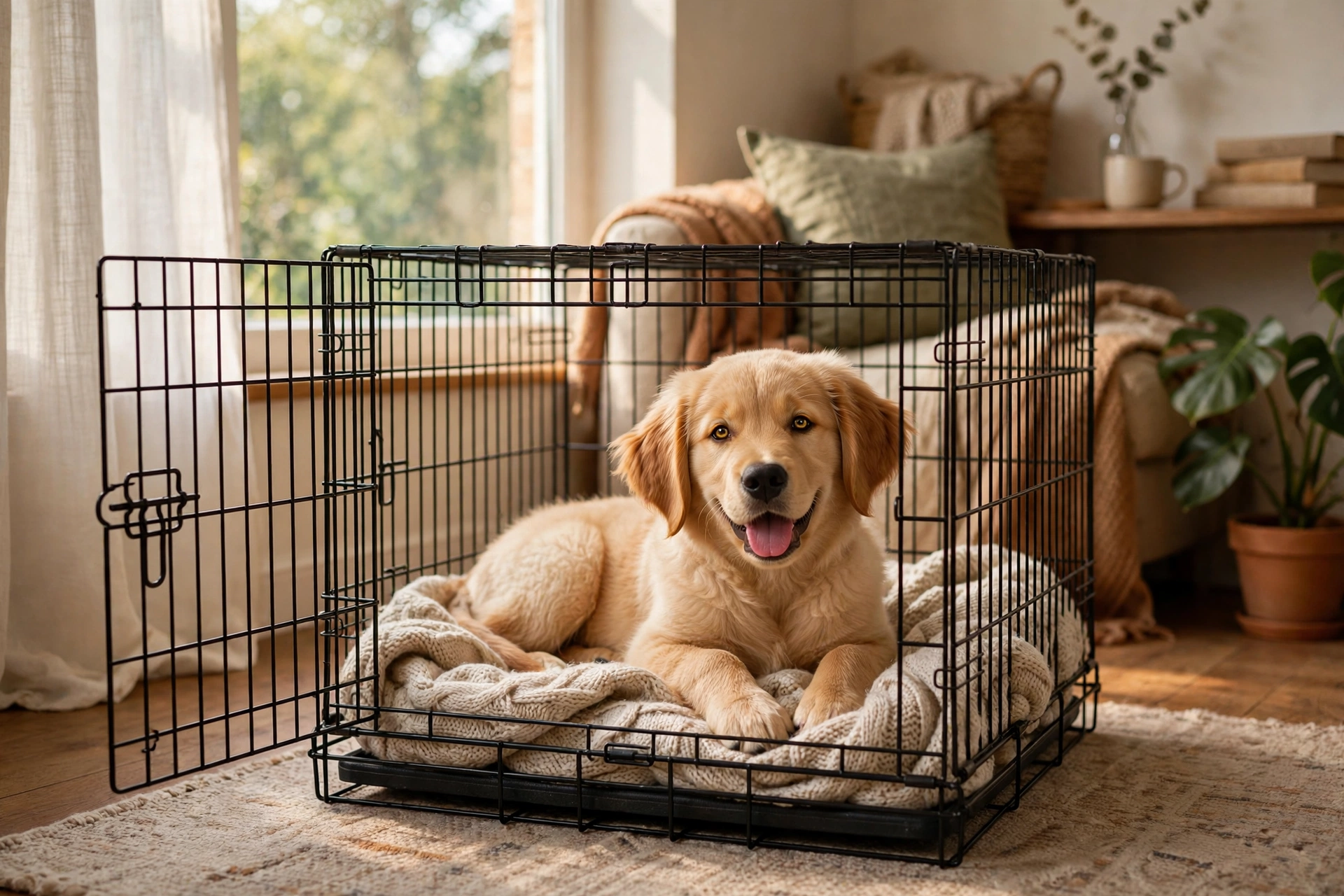
Bringing home a new puppy or rescue dog is thrilling — right up until they chew your shoes, wake you at 3 a.m., and turn housetraining into a weeks-long guessing game. Crate training solves all three at once. Done right, a crate isn’t a cage: it’s your dog’s bedroom, a quiet den where they sleep deeply, decompress, and stay safe when you can’t supervise.
Done right, though, it’s a source of comfort for everyone. This guide walks you through the beginner-friendly way to crate train — choosing the right crate, sizing it correctly, building positive associations, and following a realistic schedule, so your dog genuinely loves their crate.
Direct answer: To crate train a dog, pick a crate just big enough for them to stand, turn around, and lie down, then introduce it gradually with treats and meals fed inside. Build closed-door time from minutes to hours over 1–3 weeks, limit daytime crating to about one hour per month of your puppy’s age, and never use the crate as punishment.
Why Should You Crate Train Your Dog?
Because your dog’s instincts are already on your side. Dogs are den animals by nature — wild canines seek out small, enclosed spaces to sleep, hide from danger, and raise their pups, and domestic dogs retain that preference. According to the American Kennel Club, dogs like crates because they mimic the close quarters of a wolf’s den, giving them a feeling of safety.
A crate that your dog associates with good things pays off in five concrete ways:
- Faster housetraining: Dogs instinctively avoid soiling their sleeping area, so the crate naturally teaches bladder and bowel control.
- Safety when unsupervised: Puppies who can’t be watched are puppies who eat socks, chew cords, and swallow things they shouldn’t.
- A calm retreat: Anxious or overstimulated dogs decompress faster in a small, quiet space than in a busy household.
- Easier travel and vet visits: A crate-trained dog walks into a carrier or recovery crate without panic.
- Better sleep — yours included: A dog that settles in a crate at night stops the 3 a.m. pacing that wrecks your sleep.
Crate training isn’t a substitute for exercise, attention, or training. Think of it as one tool that makes everything else easier — especially during those first hectic weeks. For more on helping a newcomer adjust, see How to Introduce a New Puppy to an Older Dog.
What Type of Crate Should You Buy?
There are four main crate styles, and the right pick depends on your dog, your home, and how you’ll use it.
| Crate type | Best for | Pros | Cons |
|---|---|---|---|
| Wire (metal bar) | Most puppies and medium-to-large dogs; training at home | Excellent ventilation; folds flat; usually includes a divider panel for growing puppies; easy to clean | Heavy; not very den-like unless covered; can rattle |
| Plastic (molded, airline-style) | Puppies who chew wire bars; travel and flights | Enclosed and den-like; often airline-approved; sturdy | Less ventilation; harder to see the dog; not collapsible |
| Soft-sided (fabric) | Calm adult dogs; travel and temporary setups | Lightweight; portable; comfortable feel | Not chew-proof — unsuitable for puppies or escape artists |
| Furniture-style (wood/steel) | Living rooms where looks matter | Blends with decor; doubles as an end table | Expensive; heavy; less ventilation; hard to move |
For most beginners, a wire crate with a divider panel is the best choice: the divider lets you size the space for a small puppy and expand it as they grow, so you buy one crate instead of three.
What Size Crate Does Your Dog Need?
Size matters more than almost anything else. The crate should be just big enough for your dog to stand up without hunching, turn around comfortably, and lie down with legs stretched out. That’s it. Too much extra room — especially with puppies — gives them a sleeping corner and a bathroom corner, which defeats the housetraining benefit.
If you’re unsure between two sizes, go with the larger one and use the divider to block off the extra space while your puppy is small. Most wire crate packaging lists target breeds and weight ranges; measure your dog nose-to-tail and floor-to-head when in doubt.
Where Should You Put the Crate?
Location shapes how your dog feels about the crate. Put it somewhere the family spends time — the living room or a corner of the kitchen — so the dog doesn’t feel banished.
Keep the crate away from drafts, direct heat, and heavy foot traffic. Drape a light blanket over the top and sides of a wire crate to make it feel more enclosed — just leave the front door area uncovered so air flows freely.
How Do You Introduce the Crate Without Scaring Your Dog?
Rushing this step is the number-one beginner mistake. The goal is that your dog chooses to go in the crate, not that they get shoved in. Plan for several days of short, happy sessions before you ever close the door.
Step 1: Make the crate part of the furniture. Set it up with the door propped open and bedding inside. Let your dog sniff, investigate, and wander in and out at their own pace. Ignore it yourself — act like it’s the most boring object in the world.
Step 2: Feed meals in the crate. Start with the food bowl just inside the door, and over a few meals, move it deeper until your dog happily steps all the way in to eat. Close the door while they eat, then open it as soon as they finish. This builds the link: crate = good things happen.
Step 3: Toss treats in as “jackpot” rewards. Throughout the day, toss high-value treats (small bits of cheese, chicken, or their favorite training treat) into the crate when your dog isn’t looking. Let them discover the treasure. For extra enrichment, stuff a Kong with peanut butter and let them work on it inside — a frozen Kong lasts even longer. If you want to make your own crate-time treats, try 3 Easy Homemade Dog Treat Recipes.
Step 4: Add a cue word. Once your dog is trotting in eagerly, say “crate” or “kennel” as they enter, then reward. After a week or two of repetition, the word alone will send them in.
Step 5: Close the door for short stretches. Start with a few seconds — close the door, immediately treat through the bars, and open it. Then close it for a minute while you sit nearby. Then five minutes while you move around the room. Build slowly, always staying under the threshold where your dog gets anxious.
Step 6: Leave the room. When your dog settles calmly with the door closed for 15–20 minutes while you’re home, start stepping out of the room briefly. Return before they start fussing, so leaving predicts good things, not panic.
This whole process typically takes 1–3 weeks for a puppy and can take longer for an adult rescue with no crate history. Patience here saves you months of trouble later.
How Long Can Your Dog Stay in the Crate?
This is the question that matters most for your dog’s welfare. A widely used rule of thumb, cited by ASPCA Pet Insurance’s crate training guidance, is about one hour of crate time per month of age. That means a 3-month-old puppy shouldn’t be crated much longer than 3 hours at a stretch during the day, and a 4-month-old maxes out around 4 hours. Their more detailed guideline suggests 30–60 minutes for 9–10-week-olds, 1–3 hours for 11–14-week-olds, and 3–4 hours for 15–16-week-olds.
Adult dogs can comfortably handle longer stretches — most do fine for 4–6 hours — but no dog should live in a crate. A dog crated all day and all night isn’t getting enough exercise or human contact, and that isolation can lead to anxiety and depression. If your work schedule means 8+ hours away, arrange a midday dog walker, a neighbor’s visit, or doggy daycare. The crate is a management tool, not a lifestyle.
Overnight, puppies sleep longer than they can stay awake without a bathroom break. Most young puppies need one middle-of-the-night outing; as they grow, that stretches until they’re sleeping through. Don’t punish middle-of-the-night whining — a puppy who cries at 2 a.m. usually needs to pee, not attention.
Consistency is what makes crate training click, so anchor crate time to your puppy’s natural rhythm: potty first thing, breakfast, play, then a 1–2 hour morning nap in the crate. Repeat the pattern after lunch — potty, play, afternoon crate nap — and use a short evening crate session with a stuffed Kong while you have dinner. Finish with a last potty break and bedtime in the crate. Adjust the timing to your life, but keep the pattern: crate → potty → eat/play → crate. Puppies thrive on predictability, and a routine makes housetraining dramatically faster. If nighttime noise is a problem, check out Why Does My Dog Bark at Night? for targeted solutions.
What Are the Biggest Crate Training Mistakes?
Using the crate as punishment. Never send your dog to the crate in anger or as a timeout for bad behavior. The crate must be a safe place, always. If you need your dog out of the way, calmly lure them in with a treat and close the door without drama — never after yelling.
Crating too long. A puppy left crying in a soiled crate learns two bad lessons: that the crate is distressing, and that holding it is hopeless. Set an alarm if you have to; don’t let them sit in their own mess.
Skipping exercise first. A crate session after a walk or play session is a nap waiting to happen. A crate session for a dog bursting with energy is a protest waiting to happen. Tire them out first — mentally with training, physically with play.
Letting them out when they whine. If you open the door the moment your puppy cries, you teach them that crying works. Wait for a pause — even a brief one — then open the door calmly. (The exception: a puppy who’s been crated longer than their bladder limit needs out immediately, whining or not.)
Inconsistent rules. If the crate is sometimes optional, sometimes enforced, sometimes used for the night and sometimes for punishment, your dog can’t form a clear association. Pick the routine and stick with it.
The wrong crate setup. A bare wire floor is uncomfortable. Use bedding your dog won’t shred (a crate mat or old towel for puppies who chew), and remove collars before crating — tags and collars can catch on wire bars and become a choking hazard.
How Do You Handle Whining and Crying in the Crate?
Some protest is normal, especially in the first few nights. A puppy in a new home is experiencing the crate, a new house, new smells, and separation from their littermates all at once. Expect noise for the first 3–5 nights — it fades fast if you handle it right.
First, rule out needs: take them out for a bathroom break, check water, make sure they’re not too hot or cold. If all needs are met, the crying is protest, not distress. Don’t open the door while they’re mid-bark. Sit nearby without eye contact or fussing; your calm presence teaches them that the crate isn’t abandonment.
Things that genuinely help:
- A heartbeat-style plush toy or a ticking clock wrapped in a towel, which mimics littermate warmth.
- A worn t-shirt of yours in the crate — your scent is calming.
- White noise or soft classical music to mask household sounds.
- A blanket over the crate to create a cozy, den-like feel.
What to avoid: scolding the crying (increases anxiety), removing the puppy to your bed “just this once” (creates a permanent habit), or banging on the crate to startle them into silence (destroys trust). If crying escalates into panic — drooling, clawing frantically at the door, howling for more than 20–30 minutes — slow down your training timeline. Some dogs, especially rescues, need a much gentler introduction, and shy dogs in particular benefit from shorter sessions; see How to Socialize a Shy Puppy for help building confidence in nervous dogs.
When Can You Trust Your Dog Outside the Crate?
The crate isn’t meant to be forever. Most puppies earn unsupervised freedom gradually between 12 and 24 months, depending on breed, temperament, and training progress. Start small: leave them out of the crate for 15 minutes while you take out the trash. Then an hour while you run an errand. Expand the time and space only as they prove themselves.
Even when your dog graduates, keep the crate available with the door open. Most crate-trained dogs keep using theirs as a preferred napping spot for life — the ultimate proof that you did it right.
FAQs
Can you crate train an adult dog, or is it too late?
It’s never too late. Adult dogs often crate train faster than puppies because they have better bladder control and can focus longer. Follow the same gradual introduction — some rescues with unknown histories just need extra time at the “door open” stages. When in doubt, ask your vet.
Should the crate have water in it?
For short sessions, no — water in the crate just means more bathroom breaks. For longer stretches (3+ hours) or in warm weather, attach a small spill-proof water bowl to the crate door. Always offer water immediately before and after crating.
Is it cruel to crate a dog while I’m at work?
It depends entirely on duration and context. A well-exercised adult dog napping in a comfortable crate for a few hours is fine; a dog confined 10 hours a day without a break, exercise, or companionship is not. According to the ASPCA’s guidance, avoid long continuous crating for puppies and adults alike, and arrange midday breaks when your workday runs long.
My dog hates the crate — should I give up?
Not yet. Most “crate hatred” is really rushed training. Go back to square one: door open, treats raining in, meals served inside, zero forced confinement for a week. If your dog panics even near the crate — trembling, drooling, refusing treats — talk to a certified trainer or your vet, since severe crate aversion can signal deeper anxiety that needs professional help.
Closing
Crate training is one of the highest-return investments you can make in your dog’s life: a few weeks of patient, treat-heavy work buys you years of calm nights, clean floors, and a dog who has a safe place to land when the world feels overwhelming. Start slow, keep every session positive, respect your dog’s limits on time in the crate, and never use it as punishment. Do that, and the crate stops being something you do to your dog and becomes something they choose — often curling up in it with the door wide open, just because it’s theirs.
When in doubt, ask your vet.
[…] This is the same stage where good habits around routines and rest matter most, which is why our crate training basics guide pairs well with collar […]
[…] crate-trained, the crate in that quiet room, door open, cozy inside, is an excellent retreat. Our crate training basics guide covers how to build that positive association well before the […]
[…] dog is thrown around inside it. Line it with a familiar blanket and add a chew or a safe toy. Our crate training basics guide covers how to build that positive association before the […]
[…] a familiar crate inside the safe haven can add to their sense of security — see our crate training basics for beginners for how to make the crate a positive […]
[…] attempts, that is a different problem — reactivity, not greeting excitement. Our guide to crate training basics covers the calm-settle skills that help reactive dogs too, but a dog that barks and lunges on leash […]
[…] crate-training guide — crate training basics for beginners — doubles as an independence-building tool for exactly this reason: a dog that learns its crate […]