

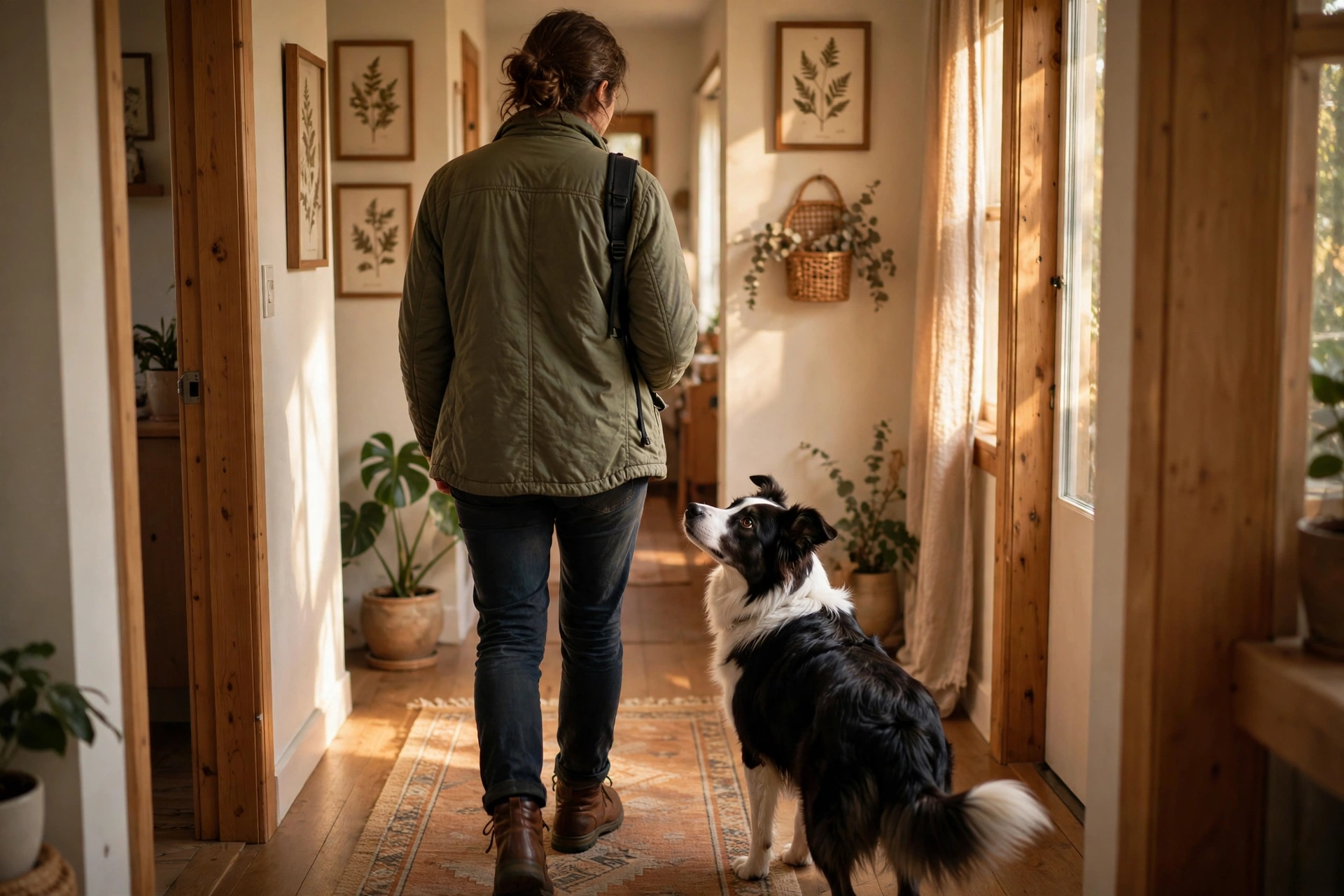
You cannot go to the bathroom alone. Your shadow has four legs, and it appears at every doorway, every room change, every trip to the kitchen — just in case. Dog owners call them “velcro dogs,” and if yours is one, you have probably wondered: is this devotion, boredom, or a sign something is wrong?
The reassuring news is that a dog following you around the house is usually completely normal behavior — a mix of bonding, curiosity, habit, and the fact that following you has paid off handsomely with treats and attention over the years. But there are red flags that change the picture. This guide explains what normal following looks like, why some dogs are clingier than others, and when clinginess warrants a vet conversation.
Direct answer: Dogs usually follow their owners from room to room because of bonding, curiosity, routine, breed tendency, and learned reinforcement — following you has paid off with attention, treats, or outings. Following alone is not separation anxiety. It is a concern only if it is sudden and new, or paired with distress signs like trembling, panting, pacing, or destruction.
Why Does My Dog Follow Me From Room to Room?
There is no single reason your dog trails you — it is usually a blend of several motivations. Understanding which ones are at play makes the behavior less mysterious.
Bonding and attachment. Dogs are social animals, and you are their person. Research by Nagasawa and colleagues, published in Science in 2015, found that mutual gaze between a dog and its owner raises oxytocin — the same bonding hormone loop seen in parent-infant relationships — in both the dog and the human. Your dog is not just tolerating you; its biology rewards closeness with you. Following you around is, in part, a dog seeking more of that connection.
Curiosity and FOMO. Dogs are professional optimists about what happens next. The kitchen might produce food. The front door might mean a walk. You getting up might mean the start of something wonderful. Dogs that have learned that your movement predicts good things follow you because, statistically, they are right.
Routine and predictability. Dogs thrive on routine, and you are the main event in theirs. Feeding, walks, play, and bedtime all run through you. AKC guidance on canine routines notes that dogs build their days around predictable patterns — and following the pattern-maker is a sensible strategy. A dog that follows you to the kitchen at 6 p.m. is not needy; it has a schedule.
Learned reinforcement. This is the big one, and owners cause it without realizing. Every time your dog followed you and got a treat, a pat, a greeting, or an exciting outing, following got stronger. Dogs repeat what works. If trailing you has produced a single good thing per day for years, your dog is a rational actor with excellent data.
Breed tendency. Some breeds are simply more inclined toward human contact. Herding breeds (Border Collies, Australian Shepherds) were bred to work in close partnership with people all day. Guarding and companion breeds — and toy breeds developed purely for human company — tend to be more people-oriented than independent-minded breeds. Your dog’s DNA may include a strong “stay near the human” setting.
Notice what is not on this list: dominance. The old “pack leader” framing has no place here — attachment and reinforcement explain velcro behavior fully, and dominance theory is outdated and misleading as an explanation for ordinary affection.
Is It Normal for My Dog to Follow Me Everywhere?
For most dogs, yes. The practical test is simple: can your dog still function independently when it matters?
Normal following looks like this: your dog trails you around the house but can settle on its own bed, nap solo while you work, play with a toy by itself, and stay relaxed when you step out briefly. A velcro dog that is perfectly comfortable alone is just a dog that prefers your company — and that is a preference, not a pathology.
Our crate-training guide — crate training basics for beginners — doubles as an independence-building tool for exactly this reason: a dog that learns its crate is a safe, comfortable place learns that being apart from you is fine.
Where normal ends and concern begins is the red-flag list below. One of the most common owner mistakes is diagnosing separation anxiety from following alone. Following is not separation anxiety. Separation anxiety is a panic response to being left alone — destruction, escape attempts, howling, house-soiling — not a dog standing outside the bathroom door. Conflating the two leads to treating a non-problem.
Are Some Breeds More Likely to Be Velcro Dogs?
Yes — though individual personality always beats breed generalizations. As a broad pattern, the breeds most often described as velcro dogs share one thing: they were developed to work closely with, or live entirely for, human company.
- Herding breeds — Border Collies, Australian Shepherds, German Shepherds — were selected for all-day partnership with a handler. Constant proximity is in the job description.
- Companion and toy breeds — Cavalier King Charles Spaniels, Pugs, Chihuahuas, Maltese — were developed to be close to people, full stop. Sitting on laps is their ancestral work.
- Some guarding breeds — Dobermans, Rottweilers — bond intensely with their family and stay near as a default.
Conversely, breeds developed for independent work — many hounds, terriers, and northern breeds like Huskies — tend to be more self-sufficient. If you adopted a terrier expecting a shadow and got an independent operator instead, that is the genetics, not a training failure.
Normal Following vs. Red Flags: A Quick Comparison
Use this table to calibrate. Normal following needs no intervention — just, occasionally, a closed door for privacy.
| Sign | Normal following | Red flag |
|---|---|---|
| Alone-time behavior | Settles, naps, plays alone happily | Panics: pacing, whining, destruction, escape attempts |
| Body language while following | Loose body, soft eyes, relaxed tail | Trembling, panting, pacing, whale eye |
| Onset | Always been this way | Sudden new clinginess in a previously independent dog |
| Reaction to your departure cues | Calm or mildly interested | Distress when you pick up keys or put on shoes |
| House-soiling/vocalizing | None when left alone | Barking, howling, or elimination when left alone |
If everything is in the left column, you have a devoted dog and nothing else. If anything in the right column shows up, it warrants a vet conversation — sudden behavior changes can signal pain or medical issues, not just emotional ones.
When Should I Worry About Clingy Behavior?
The brief version: worry when the pattern changes, or when following comes with distress.
Sudden new clinginess. A previously independent dog that starts shadowing you everywhere is telling you something. Dogs are stoic about pain and illness, and a change in attachment behavior can be one of the few visible signs. Talk to your vet before assuming it is behavioral.
Following plus distress signs. Following paired with trembling, panting when it is not hot, pacing, destruction of doors or windows, vocalizing when left alone, or house-soiling in a previously house-trained dog points toward genuine anxiety — possibly separation anxiety — and deserves professional attention, not DIY fixes.
The dog cannot function without you. If your dog will not eat, play, or rest when you are not in the room, that is beyond velcro behavior. A dog that cannot self-soothe at all needs a structured independence-building plan, and severe cases need a vet, certified trainer, or veterinary behaviorist.
When in doubt, ask your vet — a behavior change is always worth mentioning at a checkup, even if it turns out to be nothing.
How Can I Help My Dog Become More Independent?
If your dog’s following is on the heavy side of normal — healthy, but constant — you can gently build independence. The goal is not to push your dog away; it is to teach that time apart is safe and boring.
- Make your routine predictable. Fixed walk, feeding, and play times reduce the “I must watch the human constantly in case something happens” vigilance. AKC routine guidance emphasizes that predictability lowers canine anxiety across the board.
- Reward calm independence. When your dog lies on its bed while you cook, or chews a toy alone in another room, notice and reward it. You are paying for the behavior you want more of — this is the reinforcement principle working in your favor for once.
- Practice short, boring absences. Step into another room, close the door for a minute, come back calmly. No big goodbyes, no big hellos. Gradually extend. The lesson: departures are uneventful and you always return.
- Enrich alone time. Food puzzles, snuffle mats, and long-lasting chews give your dog something better to do than watch you. A Kong or lick mat turns your absence into treat time.
- Teach a settle cue. A “place” or “go to bed” cue gives your dog a job during your routines. Our crate-training guide above covers the settle-in-place foundations that transfer here.
What not to do: do not punish following, do not shut your dog out harshly, and do not promise yourself — or your dog — a timeline. Independence builds gradually, and setbacks are normal.
Frequently Asked Questions
Is it bad to let my dog follow me everywhere?
No, as long as the dog is otherwise relaxed and functional — eating, sleeping, playing, and tolerating alone time. There is nothing unhealthy about a bonded dog preferring your company. It only becomes a problem if it crosses into distress or the dog cannot cope without you.
Why does my dog follow my partner and not me?
It is usually about who has been most reinforcing — who feeds, walks, trains, and plays most, or whose movements have most often predicted good things. It is not a popularity contest you are losing; it is a reinforcement history. Want the shadow? Be the treat dispenser.
Does my dog following me mean it has separation anxiety?
Not by itself, no. Separation anxiety is a panic response to being left alone — destruction, escape attempts, vocalizing, house-soiling — not calmly standing outside the bathroom. Following alone, with a relaxed dog, is just attachment. The two get conflated often; they are different things.
Why does my dog suddenly follow me more than usual?
Pay attention to this one. Sudden clinginess in a previously independent dog can signal pain, illness, or a frightening experience (a loud noise event, a scare on a walk). If the change is abrupt and there is no obvious cause, book a vet visit before trying any training approach. When in doubt, ask your vet.
Final Thoughts
A dog that follows you everywhere is, nine times out of ten, a dog that is doing exactly what dogs were bred for: sticking close to their person. Enjoy it — and if you want to know what a truly content dog looks like, our guide on signs your dog is happy is the perfect companion read. The following is only a problem when it is sudden, distressed, or disabling. Everything else is just devotion with four legs.