

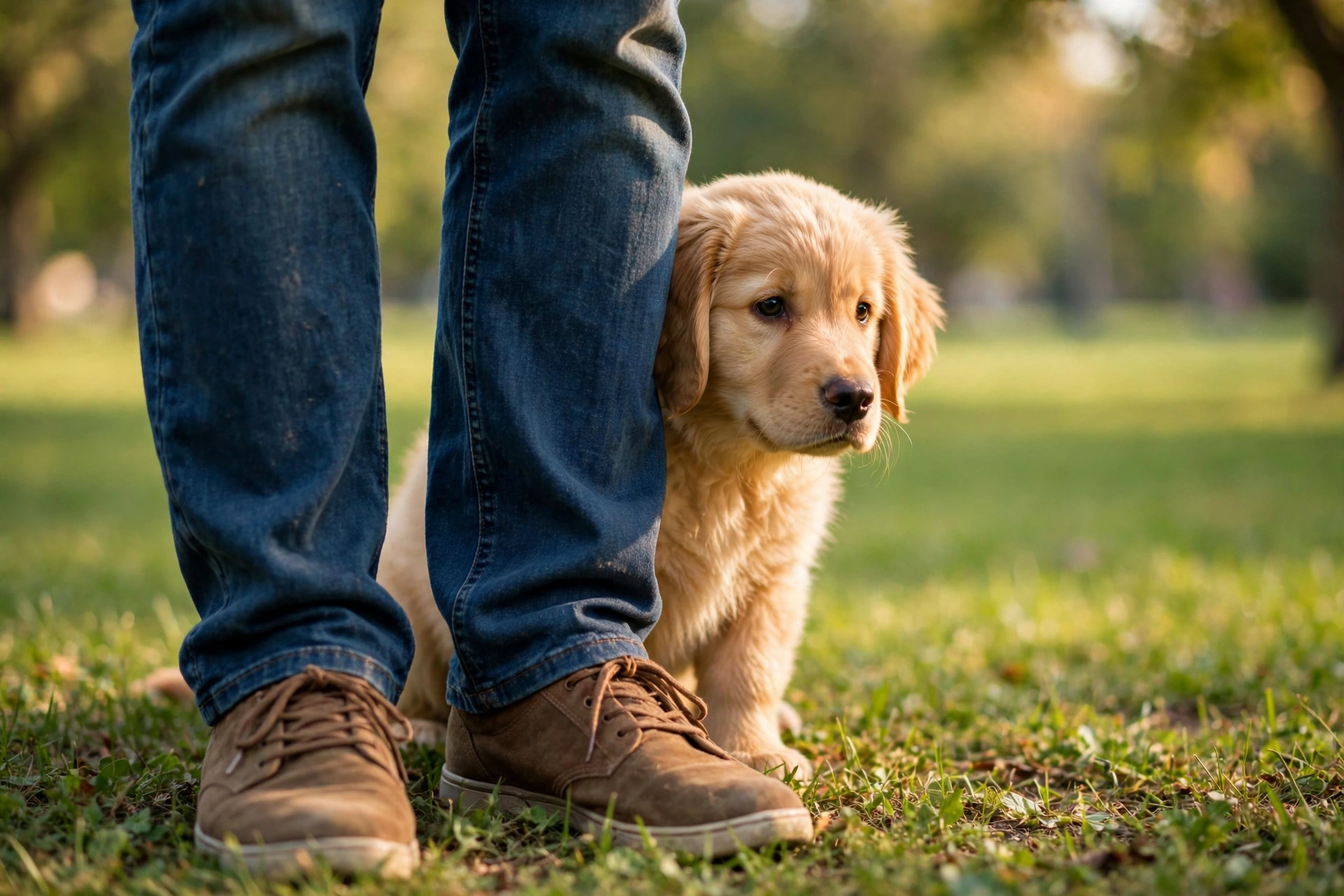
Some puppies charge into every new situation tail wagging. Others hang back, tuck their tails, and hide behind your legs — and if that sounds like your pup, you are not doing anything wrong. Shyness is common in young dogs, and with the right approach, most shy puppies grow into confident, happy adults. The secret is not forcing your puppy to “toughen up.” It is socialization done gently: short, positive exposures that teach your puppy the world is safe, one small win at a time.
This guide walks you through exactly how to socialize a shy puppy — when to start, what to do step by step, which mistakes to avoid, and how to tell when your puppy’s confidence is growing.
Direct answer: To socialize a shy puppy, expose them to new people, sounds, and places in short, low-pressure sessions paired with treats and praise. Keep encounters at a distance your puppy can handle, never force interaction, and let the puppy choose to approach. Start as early as 3 weeks of age and continue through the first year, focusing on positive experiences during the critical 3–14 week socialization window.
Is it normal for a puppy to be shy?
Yes — shyness in puppies is completely normal, and it is more common than most new owners expect. Puppies, like people, are born with different temperaments. Some are bold explorers; others are cautious observers. Genetics, breed tendencies, and early life experiences all shape how a puppy reacts to new things.
Shyness is also a developmental stage. Puppies go through fear periods — typically around 8–10 weeks and again around 6–14 months — when they suddenly become wary of things they previously ignored. A puppy who was brave at 9 weeks may startle at a trash can at 12 weeks. This is normal brain development, not a failure on your part.
What matters is how shyness is handled. A shy puppy who is gently guided through new experiences usually blossoms. A shy puppy who is flooded with overwhelming experiences — dragged into a loud dog park “to get used to it” — can become a fearful adult dog. According to the American Veterinary Society of Animal Behavior (AVSAB), behavioral problems, not infectious disease, are the number one cause of death for dogs under three years of age, largely because fear-based behavior problems lead to surrender and euthanasia. That is why getting socialization right matters so much: it is quite literally life-saving.
The goal is not to turn a shy puppy into an extrovert. It is to teach them that new things are safe — that unfamiliar people, sounds, and places predict good things, not scary ones.
When should you start socializing a shy puppy?
Start now — whatever age your puppy is today. But the earlier the better, because the socialization window is short.
The American Society for the Prevention of Cruelty to Animals (ASPCA) identifies the primary socialization window as roughly 3 to 14 weeks of age. During this period, a puppy’s brain is especially open to new experiences, and positive exposures now shape how they respond to the world for life. A shy 9-week-old puppy who meets calm, treat-giving strangers is learning a lesson that sticks.
Many owners worry about socializing before vaccinations are complete. This is a valid concern, but the AVSAB’s position statement on puppy socialization is clear: the risk of a puppy developing serious behavior problems from inadequate socialization far outweighs the small disease risk of careful, controlled socialization. The key word is controlled: socialize in clean, low-traffic environments, carry your puppy in busy areas, and let them meet healthy, vaccinated dogs in safe settings.
For a shy puppy specifically, early matters even more. Every week that passes without positive experiences is a week the puppy practices being afraid. If you adopted an older shy puppy — say 5 or 6 months — do not panic. Socialization still works; it just takes more patience and smaller steps.
What is the best way to socialize a shy puppy?
The golden rule of socializing a shy puppy: let the puppy set the pace. Your job is to create safe opportunities, reward bravery, and never force an interaction the puppy is not ready for. Follow these steps in order.
1. Start at home with the basics
Before the big wide world, make home base feel exciting. Expose your puppy to everyday household sounds and objects: the vacuum (from another room at first), the doorbell, umbrellas opening, pots clanging, people wearing hats and sunglasses. Pair each new thing with a treat. The formula is simple: new thing appears → treat happens → new thing is good.
2. Build a “bravery bank” with treats
For a shy puppy, treats are not bribery — they are communication. Every time your puppy notices something new and stays calm, or takes one step toward something scary, mark it with a “yes!” and a high-value treat (tiny pieces of chicken, cheese, or freeze-dried liver). You are literally paying your puppy for courage. Over time, the puppy starts to think: “New things mean chicken appears. New things are great.”
3. Control the distance
Distance is your best tool. A shy puppy who panics when a stranger is 10 feet away may be perfectly relaxed at 30 feet. Find the distance where your puppy notices the scary thing but can still take treats and respond to you — trainers call this “under threshold.” Reward calm behavior there, then gradually decrease the distance over days or weeks, never in a single session.
4. Let strangers be treat dispensers, not grabbers
Well-meaning people love to loom over puppies and scoop them up. For a shy puppy, that is terrifying. Instead, ask visitors to ignore the puppy at first: no eye contact, no reaching, just toss treats near (not at) the puppy and go about their business. Curiosity almost always wins — most shy puppies will creep forward to investigate within minutes when the pressure is off. Teach friends the rule: “Let the puppy come to you.”
5. Introduce other dogs carefully
One calm, friendly adult dog is worth more than a chaotic dog park. Arrange short meetings with a known gentle dog: parallel walks (walking the same direction, 10–15 feet apart) are far less intense than face-to-face greetings. Let the puppies sniff briefly, then move on while everyone is still happy. End every interaction on a good note — short and sweet beats long and stressful.
6. Take field trips, not marathons
Carry or walk your puppy through new environments in tiny doses: sit on a park bench and watch the world go by, visit a quiet pet-friendly store for five minutes, stand outside a playground at a distance. Five great minutes beat thirty overwhelming ones. If your puppy’s tail tucks, they freeze, or they stop taking treats, you have gone too far — calmly increase distance and try again another day.
7. Practice handling and grooming early
Shy puppies often dislike being touched by strangers, which makes vet visits miserable. Daily, gently handle your puppy’s paws, ears, mouth, and belly, pairing each touch with treats. Practice brief “vet exams” at home: lift a paw, look in an ear, treat. This pays off enormously at the vet’s office later.
What mistakes should you avoid with a shy puppy?
Good intentions backfire fast with shy puppies. Here are the most common mistakes and what to do instead.
| Mistake | Why it backfires | Do this instead |
|---|---|---|
| Flooding (“just throw them in the deep end”) | Overwhelms the puppy and confirms the world is scary | Gradual exposure at the puppy’s pace |
| Forcing interaction (holding the puppy while strangers pet them) | Removes the puppy’s sense of control; increases fear | Let the puppy approach people on their own terms |
| Comforting with a worried tone (“oh no, it’s okay baby!”) | Your anxious tone tells the puppy there IS something to fear | Stay cheerful and matter-of-fact; reward calm behavior |
| Skipping socialization until vaccines are done | Misses the critical 3–14 week window entirely | Socialize carefully in low-risk environments per AVSAB guidance |
| Punishing fearful behavior (scolding for cowering or barking) | Punishment adds stress to fear; never builds confidence | Redirect and reward brave choices instead |
| Too much, too fast (dog park on day one) | One bad experience can undo weeks of progress | Short sessions, one new thing at a time |
The American Kennel Club’s socialization guidance echoes the same principle: every interaction during the socialization period should be positive, and a single frightening experience can have lasting effects. Quality beats quantity every time.
How do treats and play build a shy puppy’s confidence?
Treats and play are the two engines of confidence-building, and they work through the same mechanism: they change how the puppy feels about scary things.
Treats rewire associations. This is classical conditioning in action. When a scary skateboard appears and chicken rains from the sky, the puppy’s brain starts linking skateboards with chicken instead of fear. Over repetitions, the emotional response flips. Use the highest-value treats you have for the scariest situations — kibble will not cut it when a garbage truck rolls by.
Play builds boldness. A puppy who is playing is a puppy who is not afraid — the two states cannot fully coexist. Tug games, in particular, build confidence because the puppy gets to “win”: let them pull the toy away and parade around with it. Chasing games (you run, puppy chases) also build boldness. Keep play sessions short and always let the puppy win sometimes.
Training builds a teamwork mindset. Teaching simple cues like “sit,” “touch” (nose to your hand), and “look at me” gives a shy puppy a job to focus on in scary situations. A puppy concentrating on earning a treat for a hand-touch is not spiraling into fear. Training also builds your bond — and a puppy who trusts you borrows your confidence.
How can you tell your shy puppy is gaining confidence?
Progress with shy puppies is gradual, and it is easy to miss if you are not watching for it. Celebrate these small wins:
- Looser body language: The tucked tail starts to rise. The crouched posture straightens. Ears come forward instead of pinning back.
- Faster recovery: Your puppy still startles at a loud noise — but instead of shutting down for ten minutes, they bounce back in ten seconds and look to you for a treat.
- Voluntary approaches: The puppy chooses to walk toward a new person or sniff a new object without being lured. This is the big one — curiosity replacing avoidance.
- Play in new places: A puppy who plays is a puppy who feels safe. If your shy pup starts offering play bows in the park, confidence is blooming.
- Taking treats in harder situations: A puppy who can eat treats near a busy sidewalk could not do that a month ago. Appetite under mild stress is a genuine milestone.
Keep a simple log — even just phone notes — of what your puppy handled each week. On discouraging days, reading back through a month of wins reminds you how far you have come. If you are learning to read your puppy’s body language, our guide to 10 signs your dog is happy will help you recognize when your pup is genuinely comfortable.
When should you get professional help for a shy puppy?
Most shy puppies improve steadily with patient socialization. But some need expert support, and getting it early makes all the difference. Consult a certified professional dog trainer (look for CPDT-KA or IAABC credentials) or a veterinary behaviorist if:
- Your puppy’s fear is getting worse, not better, after 2–3 weeks of consistent work.
- Your puppy growls, snaps, or tries to bite when frightened.
- Your puppy shuts down completely — freezing, refusing all treats, unable to move — in normal situations.
- Fear is interfering with daily life: the puppy will not go outside, will not eat, or panics at everyday household sounds.
Also talk to your veterinarian. Sometimes extreme fearfulness has a medical component — pain, thyroid issues, or vision and hearing problems can all masquerade as shyness. A vet check rules out physical causes before you assume it is purely behavioral. When in doubt, ask your vet — they can also discuss whether short-term anti-anxiety support might help your puppy learn while training takes effect.
FAQs
Can you socialize a shy puppy after 14 weeks?
Yes. The 3–14 week window is the easiest time, but socialization works at any age — it just requires more patience and smaller steps with older puppies. Dogs remain capable of learning new emotional responses their entire lives. Start where your puppy is, keep sessions positive, and expect progress in weeks rather than days.
Should I comfort my shy puppy when they are scared?
Yes — calm, matter-of-fact comfort does not “reinforce” fear. Fear is an emotion, not a behavior, and you cannot reinforce an emotion with kindness. What matters is your tone: stay upbeat and relaxed rather than anxious and pitying. Petting your puppy while acting like everything is fine teaches them there is nothing to worry about.
Is it bad to pick up a shy puppy in scary situations?
Not necessarily. Picking up a tiny puppy to remove them from an overwhelming situation is fine — it is a management tool, not a failure. The key is what happens next: put them down at a comfortable distance where they can observe safely and earn treats for calm behavior. Do not carry them through the scary thing while they panic; increase distance first.
How long does it take to socialize a shy puppy?
Expect meaningful improvement in 4–8 weeks of consistent daily work, with continued gains over several months. Every puppy is different — genetics, past experiences, and the severity of the shyness all affect the timeline. Focus on the trend, not the day: as long as the overall direction is toward more confidence, you are succeeding.
The bottom line
Socializing a shy puppy is not about fixing a broken dog — it is about patiently showing a cautious puppy that the world is worth exploring. Keep sessions short, let your puppy set the pace, reward every brave choice with high-value treats, and avoid flooding at all costs. Most shy puppies, given time and gentle guidance, grow into wonderfully bonded, confident companions. And if progress stalls or fear escalates, bring in a professional trainer or your vet early — asking for help is part of good training, not a sign of failure.
[…] bikes, other dogs — explode toward anything novel. If that sounds like your dog, our guide on How to Socialize a Shy Puppy covers the gradual-exposure basics that make walks dramatically […]