

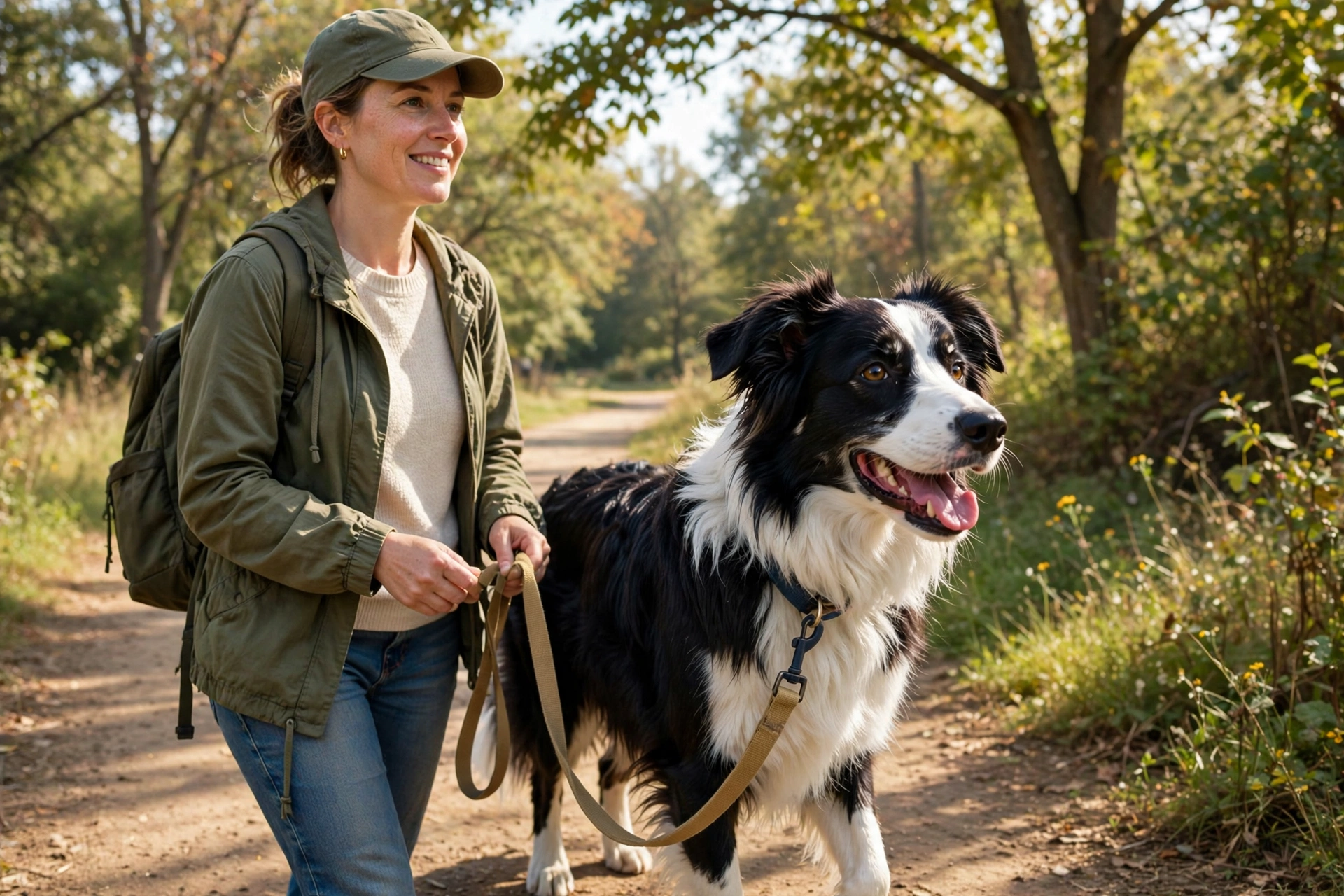
Walking your dog should be one of the best parts of your day — not an arm-yanking battle from the front door to the corner and back. If your dog treats every walk like a sled race, you’re far from alone. In fact, pulling is one of the most common complaints dog owners bring to trainers, and it can turn daily exercise into something you quietly start to dread.
The good news: pulling is almost never a character flaw in your dog. It’s a skills gap — yours and theirs — and it’s one of the most trainable behaviors in a dog’s repertoire. You don’t need brute strength, special gadgets, or a “dominance” mindset. What you need is a humane setup, a clear method, and a couple of weeks of consistency. This guide walks you through exactly that.
Direct answer: To stop your dog pulling on the leash, train loose-leash walking with positive reinforcement: reward your dog when the leash is slack, stop when they pull, and resume only when the leash loosens. Use a front-clip harness while they learn, practice in short sessions in calm areas, and add distractions gradually. Most dogs improve within two to four weeks.
Why Does My Dog Pull on the Leash?
Your dog isn’t trying to dominate you, be stubborn, or “disrespect” the leash. Pulling happens for a simple reason: it works.
Every time your dog pulls forward and you follow, the pulling gets rewarded — your dog arrives at the interesting smell, the other dog, or the park. Dogs repeat whatever pays off. Pulling also feeds on a built-in reflex trainers call the opposition reflex: the natural urge to pull harder against anything that pushes or pulls on the body. That instinct is why hauling a dog back by the collar often just makes them pull more.
Understanding this changes the whole game. You’re not fighting your dog’s personality — you’re dealing with a reinforced habit plus a physical reflex. And habits can be replaced with new ones, which is exactly what loose-leash training does.
Here’s what typically drives the pulling:
- Excitement about the world. Walks are the highlight of a dog’s day. Smells, squirrels, people, and other dogs are all magnetic — especially for young or under-exercised dogs.
- Learned habit. If pulling has always gotten them where they want to go, they’ve had no reason to walk any other way.
- The opposition reflex. Pressure on the neck or body triggers an automatic push-back response. This is why jerking the leash is counterproductive.
- Pace mismatch. Dogs naturally walk faster than humans amble. A dog that isn’t mentally and physically tired will forge ahead simply because their cruising speed is higher than yours.
- Under-socialization. Dogs that haven’t practiced being calm around distractions — traffic, bikes, other dogs — explode toward anything novel. If that sounds like your dog, our guide on How to Socialize a Shy Puppy covers the gradual-exposure basics that make walks dramatically easier.
According to a review published in the veterinary journal Veterinary Record (BVA Journals), approximately 90% of dogs exhibit some undesirable behavior, and as many as 82% pull on the lead — so if your dog drags you down the sidewalk, you are squarely in the majority.
What Is the Best Tool to Stop a Dog Pulling?
The right tool makes training easier, but no tool trains the dog for you. Equipment manages pulling while you build the actual skill — loose-leash walking — underneath it. For most dogs, a well-fitted front-clip harness is the best starting point.
Here’s how the common options compare:
| Tool | How it works | Best for | Watch out for |
|---|---|---|---|
| Front-clip harness | Leash attaches at the chest; when the dog pulls, their body turns gently sideways instead of powering forward | Most pullers; the top recommendation for training loose leash | Must be well-fitted so it doesn’t chafe or shift; look for a Y-shape over the chest rather than a strap straight across the shoulders |
| Back-clip harness | Leash attaches between the shoulder blades; comfortable and easy to use | Dogs that already walk politely; everyday wear | Gives you the least leverage against pulling — not a pulling solution |
| Head halter (e.g., headcollar) | Loops over the muzzle and behind the ears; steers the head, and where the head goes the body follows | Very strong or large pullers when an owner needs extra control | Many dogs need gradual conditioning to accept it; avoid with dogs that lunge hard, since a sudden stop can jerk the neck |
| Flat collar | A standard buckle collar around the neck | Dogs that already walk nicely on a loose leash | A strong puller can injure their trachea and throat pulling against it; offers no pulling management at all |
| Martingale collar | Sits loose at rest and tightens slightly when the dog pulls, preventing slip-outs | Escape artists (dogs with narrow heads, like greyhounds) that are flight risks | Not designed for pullers — tightening around the neck of a dog that already pulls risks the same throat injury as a flat collar |
| Prong / choke collars | Work by causing pain or discomfort when the dog pulls | Nothing — these rely on pain as a training tool | Aversive tools that can cause injury, fear, and fallout behaviors like reactivity; professional veterinary and training organizations advise against them |
The evidence favors harnesses over neck-based equipment for safety. A peer-reviewed study published in PeerJ that compared four types of leash-walking equipment (martingale collar, harness, head collar, and prong collar) found that dogs walked on a harness checked in with their handler — looking back at them — more often than dogs on any of the other equipment, a sign of engagement rather than stress.
Bottom line: start with a front-clip, Y-shaped harness and a standard 4-to-6-foot fixed leash. Skip retractable leashes entirely — they keep constant tension on the line, which teaches the dog that pressure on the leash is just how walks feel, the exact opposite of what you want.
How Do I Train My Dog to Walk on a Loose Leash?
This is the core method professional trainers teach, and it works on puppies and adult dogs alike. The principle is beautifully simple: a loose leash keeps the walk moving; a tight leash stops it. Your dog learns that the only way forward is slack in the line.
You’ll need: a front-clip harness, a 4- to 6-foot leash, and a pouch of small, soft, high-value treats (cheese, chicken, or commercial training treats — something your dog finds more exciting than kibble). Keep sessions short: 5 to 10 minutes, once or twice a day.
Step 1: Reward the position you want
- Start indoors or in your yard — somewhere boring with minimal distractions.
- With your dog on leash, stand still. The moment your dog is near you with a slack leash, mark it (“yes!”) and deliver a treat at your side.
- Take a few steps. The instant the leash loosens or your dog glances at you, mark and reward.
- You’re building a simple association: near you + loose leash = good things happen.
Step 2: Be a tree when they pull
- The moment your dog pulls and the leash goes tight, stop walking. Become boring — stand still, say nothing, don’t yank back.
- Wait. Your dog will eventually turn, step back, or glance at you, and the leash will slacken.
- The instant there’s slack, mark it (“yes!”), reward, and move forward again.
This is the heart of the whole program. Pulling used to buy forward motion; now it buys a standstill. Dogs figure this equation out fast — often within a single session.
Step 3: Change direction to reset focus
- If your dog is locked onto something ahead and “be a tree” isn’t breaking through, calmly turn 180 degrees and walk the other way.
- Reward your dog for following the turn.
- Once they’re walking with you again, you can loop back toward the original direction.
Direction changes teach your dog to pay attention to you, not just the horizon. They also burn off some of that forward momentum.
Step 4: Use “penalty yards”
- For dogs that pull relentlessly, add distance as the cost: when they pull, walk backward a few steps before stopping.
- Resume walking only when the leash is loose.
This is a stronger consequence for persistent pullers — every lunge literally costs them ground.
Step 5: Raise the difficulty gradually
- Master the hallway, then the yard, then a quiet street, then the park.
- Add one distraction at a time. If your dog falls apart at a new level, drop back to the last level where they succeeded and rebuild.
- Gradually space out the treats: reward every few steps, then every dozen, then randomly — but keep surprising them occasionally so the behavior stays strong.
Training rules that make or break it
- Never move forward on a tight leash. Not once. Every exception re-teaches the old habit.
- Reward generously early. In week one, you might deliver 30 treats on a short walk. That’s fine — you’re building a habit, not rationing snacks.
- Keep your own leash hand relaxed. A tense, white-knuckled grip telegraphs tension down the line.
- End on a win. Finish each session with an easy success and a treat, so your dog associates training with good feelings.
- Burn energy first. A dog that’s been cooped up all day is a pulling machine. A quick game of fetch or a few minutes of play before leash practice makes an enormous difference. Timing walks well helps too — see Best Time of Day to Walk Your Dog for how schedule and energy levels interact.
- Train when you’re calm. If you’re frustrated, your timing gets sloppy and your dog reads your tension. Skip the session and try tomorrow.
How Long Does It Take to Stop Leash Pulling?
Most dogs show clear improvement within two to four weeks of consistent daily practice, and many puppies pick up the basics in days. Full reliability around heavy distractions — squirrels, off-leash dogs, playgrounds — can take a couple of months.
Factors that speed things up: starting young (though adult dogs learn just as well), consistency from everyone in the household, and realistic expectations for your dog’s age and energy level.
And if you just brought a new dog into a multi-dog home, remember that excitement levels are running high for everyone — our guide to How to Introduce a New Puppy to an Older Dog can help settle the household dynamics that spill over onto walks.
What Should I Avoid When Training Loose-Leash Walking?
Some common approaches feel intuitive but actively sabotage your progress:
- Yanking or “correcting” with the leash. Triggers the opposition reflex and teaches your dog that walks involve pain and conflict — which builds anxiety, not manners.
- Retractable leashes. They maintain constant tension and extend unpredictably, rewarding pulling and making it nearly impossible to teach what “loose” feels like.
- Choke chains and prong collars. They suppress pulling through pain and fear, and can cause tracheal damage, neck injuries, and increased reactivity or aggression. The behavior often returns the moment the device comes off — because nothing was actually learned.
- Walking a dog that’s bursting with energy. An unexercised dog can’t learn. Play, fetch, or a flirt pole session before training walks pays for itself many times over.
- Too much, too soon. Taking a dog that’s only practiced in the hallway straight to a busy farmers market is setting them up to fail. Build distraction levels gradually.
- Inconsistent rules. Letting the dog pull “just this once” because you’re in a hurry resets the lesson.
When Should I Get Professional Help?
Most pulling responds to the method above, but call in a certified professional dog trainer (look for CPDT-KA credentials or a veterinary behaviorist referral) if:
- Your dog lunges, barks, or growls intensely at people or dogs on walks — that may be reactivity or fear-based aggression, not simple pulling.
- Your dog’s pulling is so strong you’re at risk of being pulled over or injured.
- You’ve trained consistently for 6 to 8 weeks with no improvement.
- Your dog shows signs of pain when pulling — coughing, gagging, limping, or reluctance to walk. These warrant a vet visit first; a harness change alone may not be enough.
When in doubt, ask your vet. They can rule out pain or orthopedic issues that make pulling worse, and refer you to a qualified trainer who uses humane, science-based methods.
Frequently Asked Questions
Will a harness stop my dog from pulling on its own?
A front-clip harness reduces the mechanics of pulling by redirecting your dog’s momentum, which makes walks immediately more manageable. But it doesn’t teach loose-leash walking by itself — many dogs learn to pull through a harness too. Think of it as training wheels: it keeps you safe while the training does the real work.
Is it too late to train my adult or senior dog to stop pulling?
Not at all. Dogs learn at any age. Adult dogs may need more repetitions to unlearn an established pulling habit, but the same reward-based method works — in fact, older dogs often have better impulse control than puppies, which can make training smoother.
Should I use treats forever on walks?
No. Treats are a teaching tool, not a permanent bribe. Once your dog reliably walks on a loose leash, gradually thin out the food rewards and replace them with real-life rewards: praise, a chance to sniff, or permission to greet a friend. Keep an occasional surprise treat in the rotation so the behavior stays strong long-term.
Why does my dog walk perfectly in training but pull on real walks?
Because the environment changed. Dogs don’t generalize well — “loose leash in the hallway” doesn’t automatically mean “loose leash past the squirrel park.” The fix is to rebuild the skill at each new difficulty level: shorter sessions, higher-value treats, more distance from distractions, and patience. Drop back a level whenever your dog struggles.
The Bottom Line
Stopping leash pulling comes down to one clear rule your dog can understand: pulling stops the walk, and a loose leash keeps it going. Pair that rule with a comfortable front-clip harness, generous rewards for the right choice, and short daily sessions — and most dogs transform from sled dog to walking companion within weeks.
Walks are meant to be the best part of both your days. With a little patience and the right method, they will be again.
[…] fitted harness is often the more comfortable interim solution than a collar — our guide on how to stop your dog pulling on the leash walks through training methods that fix the root […]
[…] face cannot simultaneously launch at a stranger. Loose-leash skills help here too — our guide to stopping your dog pulling on the leash uses the same principle of rewarding the behavior you want instead of fighting the one you […]
[…] This is one reason a harness is often a better choice for dogs that pull — see our guide to stopping your dog pulling on the leash for the training side of that […]