

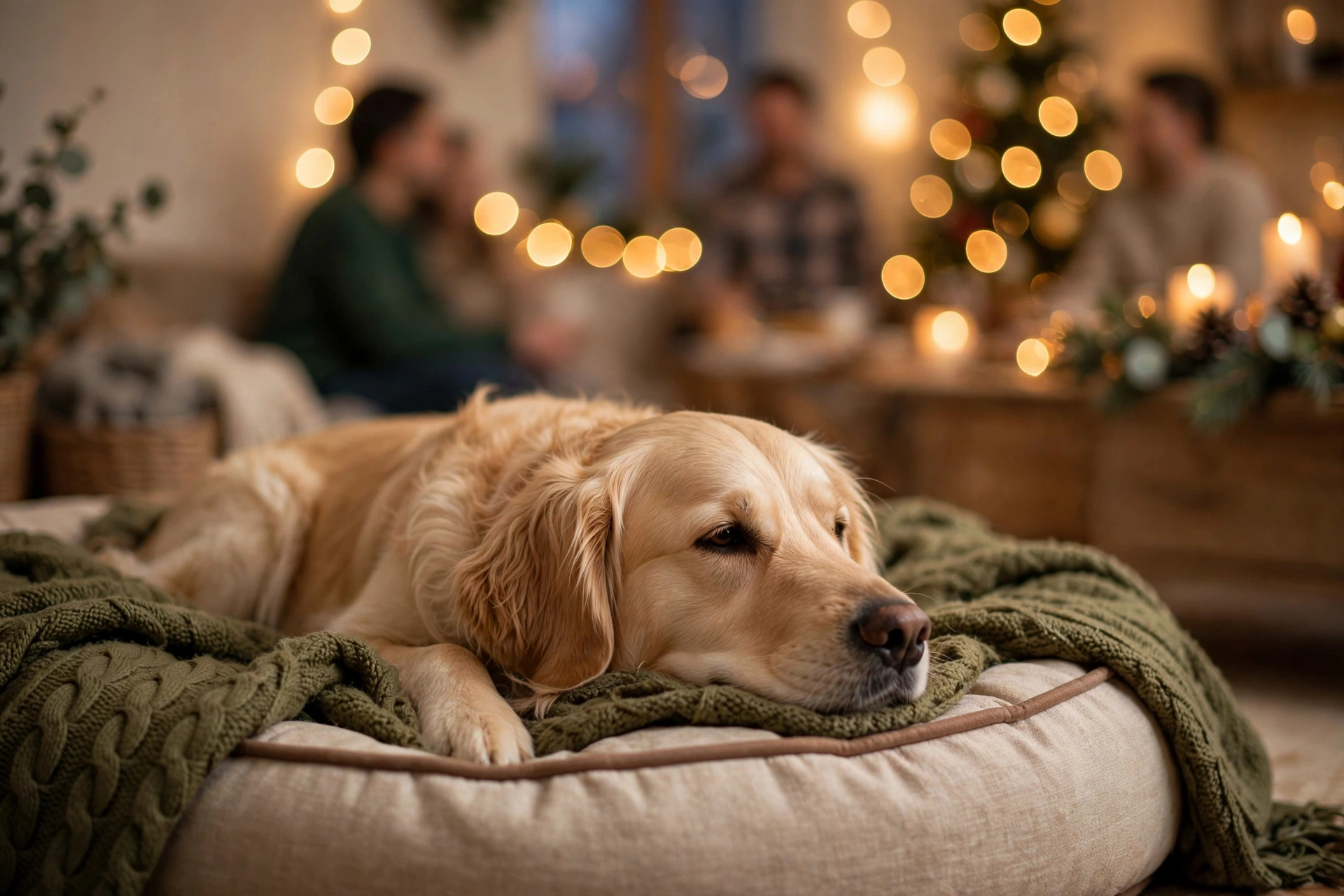
The doorbell rings, the house fills with people, and your dog’s whole world turns upside down. Holiday guests mean new smells, loud voices, unfamiliar shoes to sniff, and a parade of hands reaching out to pet. Some dogs love the attention. Many others find it overwhelming, and a stressed dog at a holiday gathering is how accidents happen: bolted doors, snapped tempers, stolen turkey, and a pet hiding under the bed for hours.
The good news is that most holiday stress is preventable. With a little preparation before the guests arrive, a quiet retreat space your dog can choose, and a few ground rules for visitors, your dog can get through the holidays comfortably, and so can you.
Direct answer: Keep your dog calm with holiday guests by sticking to its normal feeding, walk, and bathroom routine, setting up a quiet retreat room with bed, water, and toys before guests arrive, and managing the front door with a leash or baby gate so the dog cannot bolt. Brief guests: no table scraps, and never disturb a resting dog.
Why do holiday guests stress dogs out?
Because everything your dog relies on changes at once. Dogs are creatures of routine, same walk time, same feeding time, same quiet house, and a holiday gathering breaks every one of those patterns simultaneously. The American Animal Hospital Association (AAHA) notes that holidays disrupt pets routines with guests, noise, decorations, and new foods, and that disruption is a major source of stress.
Add the specific triggers: the doorbell ringing repeatedly, strangers entering the dog territory, children who move fast and grab, food smells everywhere, and well-meaning guests who chase a retreating dog to pet it. Any one of these is manageable. All of them together, for hours, is a lot, especially for shy, older, or rescue dogs.
Understanding this matters because it changes the goal. You are not trying to make your dog love the party. You are trying to make the party survivable and low-stress, with a real choice to opt out.
How do I prepare my dog before guests arrive?
Start with the single most important rule: keep the normal routine. Feed at the usual time. Walk at the usual time. Bathroom breaks at the usual time. AAHA specifically recommends maintaining your pet normal feeding, exercise, and bathroom routine through the holidays, because routine is one of the strongest anchors a dog has when everything else is unfamiliar.
Take the dog for its normal walk before guests arrive. This is not about tiring the dog out so it stays calm, exercise does not guarantee calm, and an exhausted dog can be just as reactive. The point is that the walk happened, the routine held, and the dog got its usual outlet before the house filled up.
Then set up the retreat space before anyone arrives, not after the dog is already stressed. Choose a quiet interior room away from the front door and the kitchen. Put the dog bed or crate there, fresh water, a few familiar toys, and a blanket that smells like home. Leave the door open so the dog can come and go. A retreat only works if it is the dog choice; a dog locked in a strange room is not calmer, just trapped.
If your dog is crate-trained, the crate in that quiet room, door open, cozy inside, is an excellent retreat. Our crate training basics guide covers how to build that positive association well before the holidays.
What should the quiet retreat room include?
Think of it as a small comfort kit. AAHA recommends a quiet room with the dog bed, toys, water, and a blanket, plus calming music or white noise to muffle party sounds. Here is a simple checklist:
- Bed or crate – the dog own, familiar-smelling spot, door open
- Fresh water – a full bowl, refreshed during the party
- Familiar toys – a chew or puzzle toy for settling, nothing new and noisy
- A blanket – something that smells like you or the dog usual sleeping spot
- Calming background sound – soft music or white noise at low volume to mask doorbell and voices
- A sign on the door – Dog resting, please do not disturb, stops well-meaning guests from opening it
Check on the dog quietly every 30-45 minutes. A calm check-in, a soft word, a fresh water top-up, is enough. Do not drag a hiding dog out to say hello. If the dog chose the retreat, the retreat is working.
How do I manage arrivals and the front door?
Arrivals are the highest-risk moment of the whole gathering. The door opens, people stream in, and a dog that slips past legs is suddenly loose in the street, often at night, in the cold, among unfamiliar cars. AAHA advises preventing door escapes with a secure room or baby gates, and keeping ID tags and microchip details current.
Pick one of these before the first guest arrives:
- Baby gate across the hallway, so the dog can watch arrivals from a safe distance without reaching the door
- Leash on for the first 10-15 minutes, held by a calm family member, until the initial rush is over
- Retreat room with the door closed for the arrival window only, opened again once everyone is inside and settled
If your dog is a known bolter, use two layers, gate and leash, during arrivals. And confirm the ID tag is on the collar and the microchip registration is up to date before the holidays. A dog that escapes during a party is much harder to recover if its tags are outdated.
What should I tell my guests?
Brief your guests early, ideally in the invitation or the group chat, not in a frantic whisper as someone slips the dog a turkey bone. Keep it short and friendly. Three rules cover most problems:
- No table scraps. Even small amounts of holiday food can be dangerous. Many guests have no idea that onions, garlic, grapes, chocolate, and xylitol are toxic to dogs, or that fatty skin and gravy can trigger pancreatitis. Point guests to our what to do if your dog eats chocolate guide if they want to see how serious holiday food accidents can get, or simply say, Please do not feed the dog anything; we have treats for him.
- Do not disturb a resting or hiding dog. If the dog has gone to its room, leave it there. Do not follow it, coax it out, or let children crawl into its space. A dog that is left alone when it retreats learns that retreating works, and will use it instead of snapping.
- Supervise children. Kids should not chase, hug, pick up, or pull at the dog, and should not be left alone with it. Teach kids to let the dog come to them, and to stand still like a tree if the dog jumps up.
Set out a small bowl of dog-safe treats so guests who want to give the dog something have a safe option. Our 3 easy homemade dog treat recipes are a good make-ahead choice.
What are the signs my dog is stressed?
Learn to read the signals so you can intervene early, before stress becomes a snap or a bolt. According to AAHA, common signs of stress in pets include:
| Signal | What it looks like |
|---|---|
| Hiding | Retreating under furniture, into another room, refusing to come out |
| Pacing | Restless walking, unable to settle, circling |
| Excessive barking or vocalizing | Barking far more than usual, whining, howling |
| Panting | Heavy panting when it is not hot and the dog has not exercised |
| Restlessness | Fidgeting, shifting positions, following you from room to room |
| Behavior changes | Sudden clinginess, growling, snapping, or loss of appetite |
Two behaviors are not stress signs, even though people often lump them in. Counter-surfing, stealing food off counters, is food-seeking, not anxiety; it means the food is too accessible. Bolting or door-dashing is an escape risk, not an emotion; it means the door management failed. Treat each one for what it is: secure the food, secure the door.
If you spot stress signs, do not punish them. Scolding a frightened dog makes the fear worse and can push it toward aggression. Instead, calmly guide the dog to its retreat room, close the door, and let it decompress. Shorten the exposure next time, a dog that coped for one hour does not automatically cope for four.
When should I talk to my vet about holiday anxiety?
If your dog anxiety around visitors is significant, shaking, drooling, destructive behavior, escape attempts, or distress that lasts long after guests leave, talk to your veterinarian before the holiday, not during it. AAHA advises discussing anxiety management with your vet ahead of time so you have a plan in place.
The vet can help you figure out whether the anxiety is situational or part of a broader pattern, and discuss management options appropriate for your dog. Do not give your dog sedatives, calming supplements, or anyone else medication on your own, dosing, interactions, and suitability are a vet call, and some products that are safe for people are dangerous for dogs.
For dogs with mild nervousness, the combination in this post, routine, retreat, door management, and guest rules, is usually enough. For dogs with real anxiety, a vet conversation is the responsible next step. When in doubt, ask your vet.
Frequently asked questions
Should I keep my dog in a separate room the whole party?
Not necessarily. Many dogs are happy to join the gathering for part of the time and retreat when they have had enough. Let the dog choose. Keep the retreat room open and accessible all day, and only close it during the arrival rush or if the dog is showing stress signs.
Is it okay to comfort my dog if it is scared?
Yes. Comforting a frightened dog does not reinforce fear, fear is an emotion, not a behavior your dog is choosing. Speak calmly, stay nearby, and let the dog lean on you if it wants to. Do not chase a retreating dog, and do not punish fearful behavior.
Can I give my dog a calming treat or supplement before guests arrive?
Only if your vet has recommended it for your dog. Supplements and calming products vary widely in quality and safety, and some contain ingredients that are not appropriate for every dog. If your dog needs more than routine and retreat space, get veterinary advice before the holiday.
What if my dog is aggressive with guests?
Do not test it at a holiday party. Keep the dog in its retreat room with the door closed, walk it separately, and talk to your vet or a certified professional trainer about a behavior plan well before the next gathering. A holiday party with strangers is the worst possible setting to work on aggression.
The bottom line
A calm holiday dog is not a lucky accident, it is the result of a routine that held, a quiet room that was ready, a door that was managed, and guests who knew the rules. Prepare those four things before the
first doorbell rings, watch for stress signs, and let your dog opt out whenever it wants. When in doubt, ask your vet, and enjoy the holiday knowing your dog is comfortable too.