

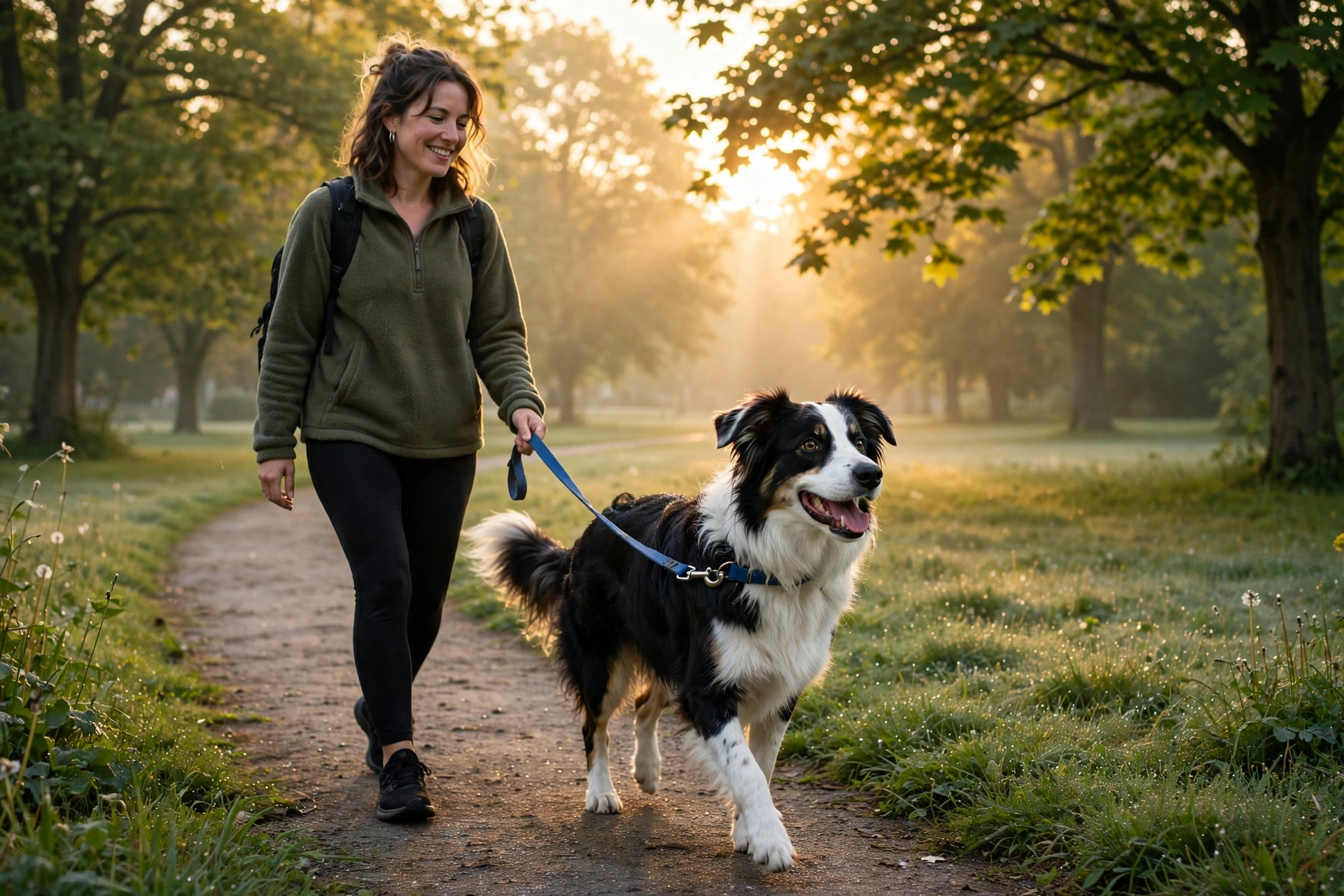
You grab the leash and your dog does the happy dance — but is now actually the right time? Morning walks sound ideal, but some days the schedule only allows a midday break or an evening stroll. Picking the best time of day to walk your dog is not just about convenience. It affects your dog’s safety, energy levels, and even how well they sleep at night.
In this guide, we break down the pros and cons of morning, midday, and evening walks, so you can build a routine that works for both of you.
Direct answer: For most dogs, the best time of day to walk your dog is early morning or evening, when temperatures are cooler and pavement is safe for paws. Midday walks work in mild weather but are risky in heat. A healthy adult dog generally needs at least one to two walks daily, with the exact schedule adjusted for breed, age, and season.
Is it better to walk your dog in the morning or evening?
Morning wins for most dogs — but evening is a close second. Both avoid the heat of the day, which is the single biggest safety factor in choosing when to walk.
An early morning walk takes advantage of cooler air, empty sidewalks, and your dog’s natural energy. Dogs are crepuscular animals, meaning they are most active at dawn and dusk. A 6:30 AM walk taps right into that natural rhythm. Morning walks also tend to be calmer: fewer cars, fewer off-leash dogs, and fewer distractions for reactive pups.
Evening walks, around sunset or after dinner, share most of the same benefits. The pavement has started cooling, the air is milder, and it is a great way for both of you to decompress after a long day. For dogs who are left alone while their owners work, an evening walk doubles as quality bonding time.
The tiebreaker is your dog’s behavior. If your dog wakes up bursting with energy and bounces off the walls until noon, prioritize the morning walk. If they are groggy in the morning and wired at 8 PM, lean into the evening. Watch your dog for a week and you will see which walk they seem to enjoy more.
Are midday walks safe for dogs?
Midday walks are fine in mild weather, but they are the riskiest option in heat. If the sun is high and the temperature is climbing, skip it or keep it very short.
The danger is pavement heat. According to Climate Central, an independent nonprofit that researches climate science, asphalt surfaces can reach 125°F in direct sun even when the air temperature is only 77°F. At those temperatures, a dog’s paw pads — which are not much thicker than human skin — can suffer burns in as little as 60 seconds.
That is why the 7-second rule matters: press the back of your hand against the pavement and hold it for seven seconds. If it is too hot for your hand, it is too hot for your dog’s paws. Midday walks also carry a higher risk of heatstroke, especially for puppies, seniors, and flat-faced breeds.
Midday walks do have real upsides, though. They are a lifeline for dogs home alone during the workday, breaking up the boredom that can lead to chewing, whining, or other destructive habits. If you hire a dog walker, midday is usually the slot. Just follow these precautions:
- Stick to grass, dirt trails, or shaded routes — avoid asphalt and concrete.
- Bring water for both of you, and offer it before you head out.
- Keep the walk short and slow; save the vigorous exercise for morning or evening.
- Watch for signs of overheating: heavy panting, drooling, bright red gums, or lagging behind.
Morning vs Midday vs Evening Walks: A Quick Comparison
| Factor | Morning walk | Midday walk | Evening walk |
|---|---|---|---|
| Heat & pavement safety | Excellent — coolest temperatures | Risky in warm weather; check pavement | Good — surfaces cooling down |
| Dog’s energy level | High — matches natural dawn activity | Medium — may be sluggish in heat | High — second natural energy peak |
| Distraction level | Low — quiet streets, fewer dogs | Medium — more foot traffic | Medium — busier sidewalks |
| Convenience | Hard if you are not a morning person | Best for dog walkers and work breaks | Easiest to fit into most schedules |
| Safety (visibility) | Good after sunrise | Excellent — full daylight | Use caution after dark; add lights |
| Behavior benefit | Sets a calm tone for the whole day | Breaks up alone time | Helps your dog settle for the night |
How does weather and season change the best walk time?
Season changes the math. In summer, morning and evening are not just preferences — they are safety requirements. Walk before 9 AM or after 7 PM when the sun is low, and treat the 7-second pavement test as non-negotiable. On extremely hot days, consider skipping the walk entirely in favor of indoor play or a sniff-based puzzle game. The ASPCA’s summer safety guidance is clear: when temperatures are very high, do not let dogs linger on hot asphalt, and keep walks during these times to a minimum.
Winter flips the concern to daylight and cold. In the darkest months, a midday walk may actually be the safest and most pleasant option — you get warmth, light, and better visibility. If you walk before sunrise or after sunset in winter, wear reflective gear and put a reflective vest or LED collar on your dog. Cars cannot see what they cannot see.
Spring and fall are the easy seasons. Temperatures are forgiving, daylight stretches out, and any time of day works. This is when you can experiment — try shifting your routine and see which time your dog seems to prefer.
What about breed and age — do puppies, seniors, and flat-faced breeds need different schedules?
Yes. Breed and age reshape the ideal walk schedule more than almost anything else.
Puppies have developing joints and short attention spans, so they do better with multiple short walks throughout the day rather than one long one. Three 10-15 minute walks — morning, midday, and evening — beats a single hour-long march. Puppies are also more sensitive to hot pavement, so keep midday outings on grass.
Senior dogs often deal with arthritis, reduced stamina, or vision problems. Shorter, gentler walks in mild temperatures are kindest — a soft mid-morning or early evening stroll on grass or dirt is easier on stiff joints than pounding pavement. Swimming or sniff walks are excellent low-impact alternatives.
Brachycephalic breeds — pugs, bulldogs, boxers, and other flat-faced dogs — overheat much faster than other breeds because their short airways make panting less efficient. For these dogs, midday walks in warm weather should be avoided entirely. Stick to dawn or late evening, keep walks short, and always carry water. If your flat-faced dog is panting heavily within minutes, head home.
High-energy breeds like border collies, huskies, and retrievers often need both a morning and an evening walk to stay sane. Skipping one usually means a restless, destructive dog at home.
How often and how long should you walk your dog?
Most healthy adult dogs need at least one walk per day, and two is better. A brisk walk of 15 to 30 minutes per day is adequate for most dogs, according to the American Veterinary Medical Association — while bigger or more active breeds may need up to an hour or more of vigorous activity daily.
Use this as a starting framework, then adjust:
- Assess your dog’s baseline. After a 30-minute walk, is your dog calm and settled, or still buzzing? Adjust duration up or down accordingly.
- Split it if needed. Two 20-minute walks usually beat one 40-minute walk for behavior, since they break up the day.
- Build up gradually. If your dog is new to exercise, overweight, or recovering, start with 15-minute outings and add time over a few weeks.
- Watch for over-exercise signs. Excessive panting that does not settle, limping, reluctance to continue, or a dog who crashes and seems stiff the next day all mean you went too far.
Keep in mind that walks are not the only exercise. Fetch, tug, flirt poles, and swimming all count — and on days when the weather makes walking unsafe, indoor games keep the routine alive.
Should you walk your dog before or after meals?
Walk first, feed after — or wait. This is a safety rule worth memorizing.
Exercising right after a big meal increases the risk of bloat (gastric dilatation-volvulus), a life-threatening emergency especially common in large, deep-chested breeds like Great Danes, German Shepherds, and Standard Poodles. The safest approach: wait at least 30 minutes after a meal before a walk, or walk first and feed afterward.
A practical routine looks like this: morning walk at 7 AM, breakfast at 7:45 AM; evening walk at 6 PM, dinner at 6:45 PM. If your schedule forces a walk soon after eating, keep it slow and short — a gentle sniff stroll, not a jog. When in doubt, ask your vet about your dog’s specific bloat risk.
Sniff walks vs exercise walks — does the type of walk matter?
It matters a lot, and it should change how you think about scheduling. Not every walk needs to be exercise.
An exercise walk is about movement: brisk pace, steady rhythm, cardiovascular benefit. This is the walk that burns energy and keeps weight off. It works best in the morning or evening when it is cool enough to keep a pace.
A sniff walk is about the brain. Your dog leads, stops, sniffs, investigates, and decides where to go. It looks lazy, but it is mentally exhausting in the best way — 15 minutes of intense sniffing can tire a dog out as much as a much longer march. Sniff walks are perfect for midday (short and slow), for seniors, and for reactive dogs who need calm over cardio.
The best weekly schedule mixes both: a few brisk exercise walks plus a few decompression sniff walks. Dogs who get only exercise walks and no sniffing freedom often develop leash frustration — they learn the walk is about the human’s agenda, not theirs.
Frequently Asked Questions
Is it OK to walk my dog only once a day?
Yes, if the walk is long enough and your dog is otherwise healthy. One solid 30-45 minute walk works for many low-to-medium energy adult dogs, especially paired with some backyard or indoor play. High-energy breeds and dogs left alone all day usually need more. Watch your dog’s behavior — a well-exercised dog settles; an under-exercised one does not.
What time is too hot to walk a dog?
There is no single magic number, because pavement temperature matters more than air temperature. As a rule of thumb, if the air temperature is above 85°F, be very cautious, and always do the 7-second hand test on the pavement. When the air is 77°F, asphalt can already hit 125°F according to Climate Central — hot enough to burn paws in about a minute.
Is it bad to walk your dog late at night?
Not for the dog — dogs actually enjoy cool, quiet night walks. The concerns are human safety and visibility: stick to well-lit routes, wear reflective gear, and use a lighted or reflective leash and collar. Note that dogs who get a late, exciting walk may have trouble settling afterward, which can contribute to restlessness at night.
Should I walk my dog in the rain?
Light rain is fine and some dogs love it — just towel them off afterward and watch for cold in short-coated breeds. Skip walks in heavy storms, thunder, or flooding, and remember that wet pavement can still be slippery. If rain cancels the walk, swap in indoor training games or puzzle feeders so your dog still gets their stimulation.
The bottom line
There is no single best time of day to walk your dog — but there is a best time for your dog. Early morning and evening are the safest defaults in warm weather, midday works when it is cool, and your dog’s breed, age, energy, and your schedule fill in the rest. The perfect walk routine is one you will actually stick with: a tired, happy dog does not care what time the clock says. When in doubt, ask your vet — they can tailor the plan to your dog’s health and fitness level.
[…] fluids fast through panting and evaporation. Hot-weather hydration deserves extra attention — timing your walk for the cooler part of the day makes a real […]