

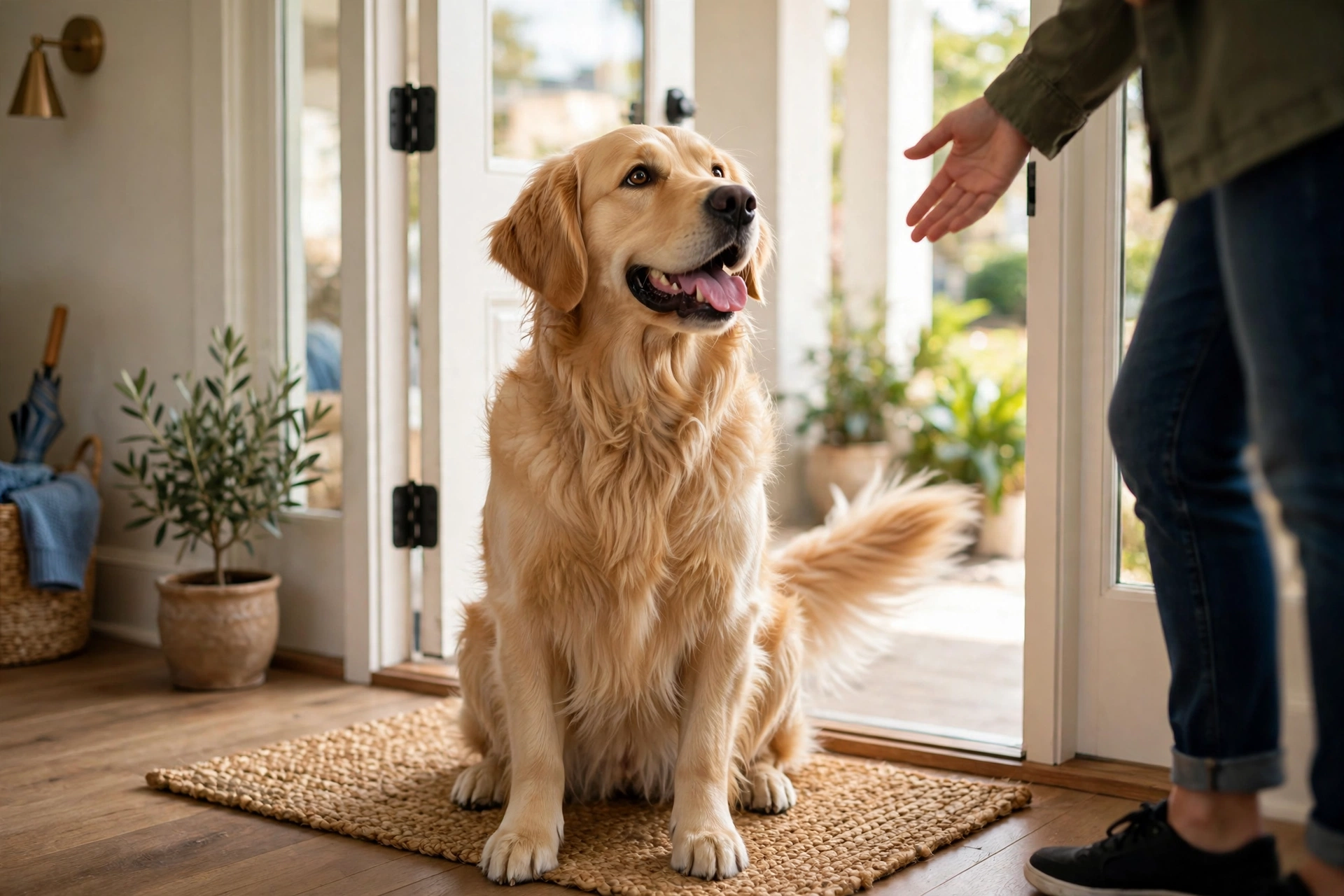
Few things are more embarrassing than a dog that launches itself at every guest who walks through your front door. Your dog means it as a greeting — but to a visitor in clean clothes, a child, or an older relative, a 60-pound dog landing on their chest does not feel friendly. The good news is that jumping is one of the most fixable dog behaviors there is. It just takes consistency, because almost every human your dog has ever met has accidentally been rewarding it.
Direct answer: To stop your dog jumping on people, teach an incompatible behavior — sitting calmly for greetings, or keeping all four paws on the floor — and withdraw all attention the instant jumping starts. Reward calm greetings every time, and get every person in the household to follow the same rules.
Why Does My Dog Jump on People?
Your dog jumps on people because jumping works — and because it is a natural greeting behavior. Dogs greet each other face to face, and when a dog meets a person, the interesting part (your face) is up high. Jumping is simply the fastest way for a dog to get closer to it.
The deeper reason jumping persists is reinforcement. According to the American Kennel Club (AKC), jumping is a behavior dogs learn because people reward it, often without realizing. When a puppy jumps up, people laugh, pet the puppy, talk to it in a happy voice, and push it down — all of which the puppy reads as attention. The puppy learns that jumping gets a reaction, and the behavior sticks.
Adult dogs jump for a few overlapping reasons:
- Excitement. Greetings are the highest-arousal moment of a dog’s day. A dog already wound up by the doorbell or a returning family member jumps because it cannot contain the excitement.
- Attention. If jumping has ever earned petting, eye contact, talking, or even being pushed away, the dog has learned that jumping is a reliable way to get noticed.
- Greeting instinct. Dogs naturally want to sniff and lick faces. Jumping is a practical attempt to reach a human face.
- Habit. A behavior rehearsed hundreds of times becomes automatic. Many adult dogs jump not because they are making a decision, but because jumping is simply what they have always done when someone arrives.
Understanding this matters because it changes the fix. Your dog is not being dominant, defiant, or “bad.” Jumping is a trained behavior — trained accidentally by humans — and it can be untrained the same way: by changing what jumping earns.
Why Does Pushing My Dog Off Make Jumping Worse?
Because to your dog, pushing is attention. This is the single most common mistake in jumping training, and the AKC flags it explicitly: pushing a dog off, grabbing its paws, or shouting at it usually reinforces the jumping rather than stopping it.
It feels counterintuitive. From the human side, pushing a dog away is clearly a rejection. But dogs do not read it that way. Dogs communicate with their bodies, and physical contact — even contact meant as a correction — is a form of engagement. When you push a jumping dog, the dog experiences hands on its body, eye contact, and your full attention at the exact moment it jumped. That is a reward, not a punishment.
The same logic applies to shouting “no” or kneeing the dog in the chest: loud voices add energy to an already excited dog, and kneeing risks injury and damages trust. The AKC’s guidance is clear: no punishment methods for jumping — no kneeing, no alpha rolls, no shouting.
The rule that replaces all of these is simple: jumping earns nothing. No eye contact, no talking, no touching, no pushing. Calm behavior earns everything. That contrast — zero attention for jumping, generous attention for four paws on the floor — is what actually changes the behavior.
How Do I Stop My Dog From Jumping on People?
You stop jumping by combining management (preventing practice) with training (teaching a better greeting). Both halves matter. Training alone is slow if your dog gets to rehearse jumping on every visitor in between sessions, and management alone never teaches the dog what to do instead.
Step 1: Manage the environment so jumping cannot be rehearsed
While training is underway, set your dog up to succeed. A baby gate, a leash, or a “place” cue when guests arrive prevents the dog from practicing the old behavior while it is still learning the new one. This is not cheating — it is how training works. Every unrewarded jump your dog practices is a repetition that strengthens the habit.
Practical management options:
- Put the dog behind a baby gate when guests arrive, and let it join the group once it is calm.
- Keep the dog on a leash during arrivals so you can calmly prevent jumping without grabbing or pushing.
- Send the dog to its crate or “place” (bed/mat) when the doorbell rings, and release it once the excitement has passed.
- For dogs that jump on walks, keep enough distance from other people that the dog stays under threshold and can still respond to you.
Step 2: Teach an incompatible behavior
A dog cannot jump and sit at the same time. That is the core of the training: teach a behavior that is physically incompatible with jumping, and make that behavior the dog’s new greeting ritual. The two best options are:
- Sit for greetings. Ask for a sit before any greeting happens. The guest only approaches and pets the dog while the dog is sitting. If the dog breaks the sit and jumps, the guest calmly turns away and the greeting stops.
- “Four on the floor.” Reward the dog for keeping all four paws on the ground. The moment all four feet are down and the dog is calm, mark it (“yes!”) and deliver a treat low — place the treat on the floor rather than handing it from above, so the dog is rewarded for staying down instead of reaching up.
Start training with family members in low-distraction settings before trying it with real guests. Short, frequent sessions beat long ones: a few minutes, several times a day, with plenty of rewards for calm behavior.
Step 3: Withdraw attention the instant jumping starts
When the dog jumps, become boring immediately. Turn sideways, fold your arms, look up, and say nothing. Wait for four paws on the floor, then calmly reward. If the dog keeps jumping, walk away for a few seconds, then return and try again. Say any cue (“off”) once, calmly — repeating it teaches the dog to ignore the first several repetitions. Reward the instant the dog chooses correctly, so it can connect the reward to the calm behavior.
Step 4: Practice with helpers
Once your dog can greet family members calmly, recruit helpers. Ask a friend to arrive, knock, and enter exactly like a guest. If the dog jumps, the helper turns away and leaves. If the dog stays down, the helper greets calmly. Repeat with different people, in different places, until calm greetings are the default.
Step 5: Get everyone on the same rules
This is where most jumping training fails. If one family member allows jumping (“oh, I don’t mind!”) while everyone else enforces calm greetings, the dog learns that jumping sometimes pays off — and a behavior that sometimes pays off is the hardest kind to extinguish. Everyone in the household, plus regular visitors, must follow the same rules: no greeting while jumping, calm greetings rewarded every time.
What Should Guests Do When My Dog Jumps?
Guests should do nothing — and that is the hardest instruction to give. The natural human reaction to a jumping dog is to pet it, push it, laugh, or shout. All four reward the jump. The correct guest protocol is:
- Turn away. If the dog jumps, the guest turns sideways or away, folds their arms, and looks up. No eye contact, no talking, no touching.
- Wait for four on the floor. The guest stays boring until the dog’s feet are on the ground and the dog is calm.
- Greet low and calm. The guest greets the dog with calm petting at the dog’s level — a scratch on the chest or side, not excited pats on the head — while the dog stays down.
- Withdraw again if jumping restarts. If the dog jumps mid-greeting, the guest turns away again. The greeting only continues while the dog is calm.
Two practical tips make this work. First, tell guests the plan before they arrive, not while a dog is bouncing off them — a one-sentence text (“We’re training her not to jump, so please ignore her if she jumps and pet her once she’s calm”) prevents awkwardness. Second, give guests an easy alternative: tossing a treat on the floor rewards four-on-the-floor without the guest having to manage timing.
Children need a simpler version: stand still like a tree, fold your arms, look at the sky, and call an adult. A child who runs, screams, or flails becomes a chase target for an excited dog, so the “tree” game is worth rehearsing before guests arrive.
How Do I Stop My Dog Jumping on People on Walks?
On walks, jumping is usually aimed at strangers — and strangers are the hardest people to control, because most will happily pet a jumping dog. The strategy is management plus a trained alternative:
- Keep distance. If your dog cannot pass a person without jumping, you are too close. Cross the street, step off the path, or create distance until your dog can stay calm and respond to you.
- Use a “watch me” cue. Train a solid eye-contact cue at home first, then use it as strangers approach. A dog watching your face cannot simultaneously launch at a stranger. Loose-leash skills help here too — our guide to stopping your dog pulling on the leash uses the same principle of rewarding the behavior you want instead of fighting the one you don’t.
- Ask strangers to wait. “She’s in training — please don’t pet her unless she’s sitting” is a perfectly normal thing to say. Most people respect it.
- Do not let strangers undo the training. A stranger who invites jumping (“it’s OK, I love dogs!”) has just paid your dog for the exact behavior you are trying to stop. It is fine to be politely firm: “Sorry, we’re training — please ignore her.”
- Never let the dog rehearse off-leash greetings until greetings are reliable. A dog that runs up to strangers off-leash and jumps is practicing the behavior at full speed. Keep the leash on until calm greetings are solid on-leash.
If your dog’s jumping on walks comes with barking and lunging at other dogs rather than friendly greeting attempts, that is a different problem — reactivity, not greeting excitement. Our guide to crate training basics covers the calm-settle skills that help reactive dogs too, but a dog that barks and lunges on leash may need a certified trainer’s help.
What If My Dog Jumps on Children?
Jumping on children needs urgency, because a dog that knocks a child down can cause real injury — and a frightened child can make a dog more aroused. The training is the same, but the management must be stricter: never leave a jumping dog unsupervised with children (leash, gate, or another room until greetings are reliable), teach children the “tree” game, and reward the dog heavily for calm behavior around children. If your dog jumps on children and also shows fear, anxiety, or aggression around them — stiff body, hard staring, growling, snapping — stop training on your own and get professional help. That is no longer a manners problem; it is a safety problem.
How Long Does It Take to Stop Jumping?
There is no fixed timeline, and any source that promises “jumping gone in seven days” is selling something. How long it takes depends on how long the dog has been rehearsing the behavior, how consistent everyone is, and how exciting the dog finds greetings. A puppy that has jumped a dozen times may learn a new greeting in a week or two. An adult dog that has jumped on every visitor for five years will take longer — weeks to months of consistent practice.
One pattern to expect: the behavior often gets worse before it gets better. When a previously rewarded behavior suddenly stops paying off, dogs typically try harder first — jumping higher, more often, more frantically — before giving up. Trainers call this an extinction burst. It feels like failure, but it is actually a sign the training is working. If you hold the line and keep rewarding calm behavior, the burst fades. If you give in during the burst, you have just taught the dog that jumping harder is what finally works.
When Should I Get Professional Help?
Most jumping is a straightforward training problem you can solve at home. Get a certified trainer or veterinary behaviorist involved if:
- The dog’s jumping comes with aggression — growling, snapping, or biting during greetings.
- The dog is so aroused it cannot take treats, respond to cues, or settle at all around people.
- Jumping is paired with fear or anxiety — cowering, trembling, or panic when people approach.
- The behavior is getting worse despite weeks of consistent training.
- You have children or vulnerable adults in the home and the jumping is a safety risk now, not just a nuisance.
Look for a trainer who uses positive-reinforcement methods and can demonstrate the greeting protocol with your dog. Avoid anyone who recommends punishment-based fixes for jumping — the AKC’s guidance and the evidence both point the same way: punishment for jumping risks fear, aggression, and a damaged relationship with your dog, without teaching the calm greeting you actually want.
Frequently Asked Questions
Should I say “down” or “off” when my dog jumps?
Either word works — what matters is consistency. “Off” is often clearer because “down” usually means “lie down” in obedience training, and using one word for two behaviors confuses dogs. Pick one cue, say it once, calmly, and use it every time.
My dog only jumps on certain people. Why?
Because those people reward it. Dogs are excellent at reading individuals: the person who coos, pets, and laughs when jumped on will get jumped on, while the person who turns away will not. If Grandma allows jumping, your dog will jump on Grandma — and on anyone who resembles a soft target. Brief every regular visitor on the same rules.
Is jumping a dominance behavior?
No. Jumping is not about dominance, rank, or trying to be “alpha.” It is a natural greeting behavior that humans accidentally reinforce with attention. The dominance explanation is outdated — it pushes owners toward punishment, which makes jumping worse.
Can an old dog learn to stop jumping?
Yes. Older dogs can learn new behaviors just as puppies can — it simply takes longer if the jumping habit has had years to strengthen. Use gates and leashes to prevent rehearsal, keep sessions short and positive, and be patient with the extinction burst. Age is not a barrier to learning; consistency is what decides the outcome.
The Bottom Line
Your dog jumps on people because jumping has always worked. Change what jumping earns — nothing — and change what calm greetings earn — everything — and the behavior changes. Manage the environment so the old habit cannot be rehearsed, teach a sit or four-on-the-floor greeting, get every person in the household on the same page, and hold the line through the extinction burst. It will not happen overnight, but a dog that greets guests with four paws on the floor and a wagging tail is a goal well within reach.