

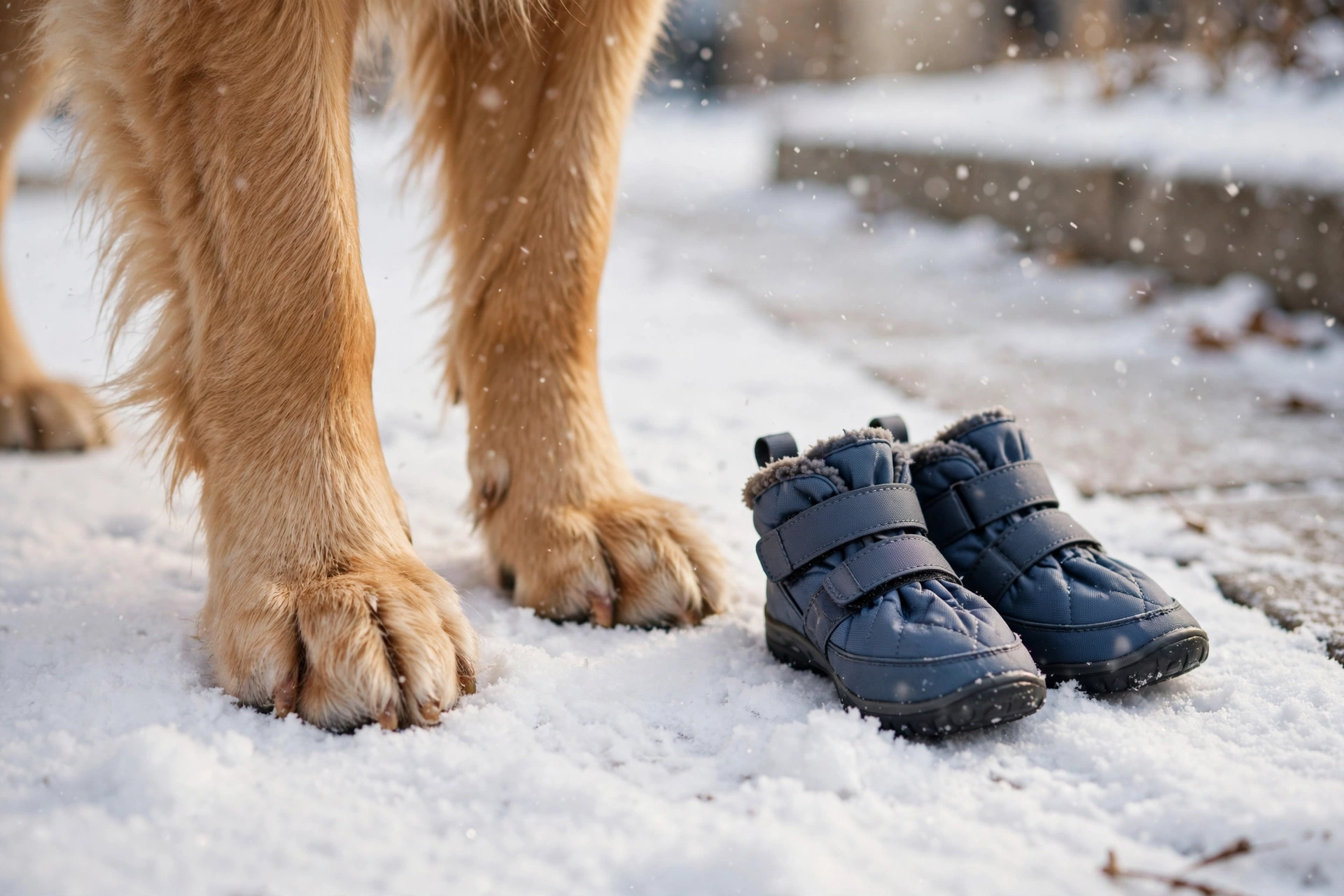
Winter is hard on your dog’s paws. Every walk means cold ground, ice, snow packed between the toes, and, worst of all, the salt and chemical de-icers spread on sidewalks and driveways. Those chemicals irritate paw pads, and when your dog comes home and licks its paws clean, the chemicals get ingested too. Add cracked pads, ice balls clumping in the fur between the toes, and the very real danger of antifreeze in driveways, and paws need more attention in winter than at any other time of year.
The good news is that winter paw care is mostly simple habit: a quick routine before and after every walk, the right protection for your dog’s paws, and knowing which hazards are genuinely dangerous. It takes about two minutes per walk, and it prevents the cracked pads, limping, and emergency vet visits that winter brings. When in doubt, ask your vet.
Direct answer: Wash and dry your dog’s paws and stomach after winter walks to remove salt and de-icing chemicals, check between the toes for cracks and redness, and use booties or paw protectant before walks. Shorten walks in extreme cold, never leave a dog off-leash on snow or ice, and clean up antifreeze spills at once, small amounts can be fatal.
What does winter actually do to my dog’s paws?
A dog’s paw pads are tough, but they are not invincible. Cold air dries them out, just as it dries out human skin. Repeated wetting and drying, snow, slush, puddles, then warm indoor air, causes the pads to crack. Ice and rough frozen ground can cut or abrade them. And the chemicals spread to melt ice are a double problem: they irritate the skin on contact, and they are toxic if a dog licks them off its paws during grooming.
Signs that winter is getting to your dog’s paws include:
- Limping or lifting a paw during or after a walk, often the first sign of a cracked pad, a cut, or something stuck between the toes.
- Licking or chewing the paws more than usual, especially right after coming inside. Some licking is normal grooming, but persistent licking can mean irritation from salt or chemicals. Our why does my dog lick their paws guide covers the full range of causes if licking continues beyond winter.
- Cracked, dry, or flaking pads that feel rough or look like they are splitting.
- Redness between the toes, which can mean irritation from salt or a developing infection.
- Ice balls, clumps of snow and ice packed into the fur between the toes, which are painful to walk on.
Checking the paws after every winter walk takes thirty seconds and catches all of these early. Make it part of the coming-home routine, the same way you take off your own coat.
What should I do after every winter walk?
Wash and dry. That is the whole routine, but the ASPCA’s cold-weather guidance is specific: wash the feet and stomach, do not just wipe them. A quick wipe with a dry towel removes some surface salt, but it leaves chemical residue in the crevices between the toes and on the pads. Washing with lukewarm water removes it properly.
Here is the routine:
- Wash the paws and stomach. Use lukewarm water, not hot, which can sting cracked pads, in a shallow basin, or use a gentle spray in the tub. Wash between every toe, where salt and sand lodge.
- Check while you wash. Feel each pad for cracks, cuts, or swelling, and look between the toes for redness, ice, or foreign objects. Catching a small crack early means a few days of paw balm; ignoring it means a limping dog and possibly a vet visit.
- Dry thoroughly. Pat the paws dry with a towel, including between the toes, and dry the stomach and legs too. Dogs left damp after a winter walk get chilled, and moisture between the toes encourages irritation.
- Bring a towel on long walks. If you are out for a long walk and your dog starts lifting its paws, showing stinging or irritation, a towel lets you clean the paws mid-walk rather than waiting until you get home.
Do this after every walk, not just the long ones. A five-minute trip to the corner on a salted sidewalk is enough to coat the paws in chemicals.
How do I protect my dog’s paws before a walk?
Prevention before the walk is easier than treatment after it. Two options cover most dogs:
- Paw protectant or petroleum jelly. Massaging a thin layer of petroleum jelly or a commercial paw balm into the pads before a walk creates a barrier that reduces salt and ice contact. It is cheap, it works for dogs that will not tolerate booties, and it also moisturizes pads that are already dry. Reapply for every walk, it wears off.
- Dog booties. Booties give the most complete protection: they keep salt, sand, and ice-melt chemicals off the paws entirely, and they stop sand and salt from lodging between the toes. They also give grip on ice. The trade-off is that many dogs hate them at first. Introduce booties indoors, in short sessions with treats, before ever wearing them outside. Fit matters: a bootie that is too loose comes off, and one that is too tight restricts circulation.
Whichever you choose, also trim the fur between the toes. Long fur between the toes collects snow, which compacts into painful ice balls that pull on the skin with every step. A quick trim with blunt-tipped scissors, or ask your groomer to do it at the next visit, stops ice balls from forming. If you do find ice balls after a walk, melt them off with lukewarm water rather than pulling them out, which can tear the fur and skin.
Around your own home, use pet-friendly ice melts on your paths and driveway where possible, and avoid the harshest chemical de-icers. Your dog walks on whatever you spread.
How do I know if it is too cold to walk my dog?
The simplest rule comes from the ASPCA: if it is too cold for you, it is too cold for your pet. Shorten walks in extreme cold, and in severe weather, bitter wind chill, blizzard conditions, ice storms, let dogs out only to relieve themselves and then come straight back in.
There is no single temperature that is safe for every dog. A thick-coated husky and a short-coated greyhound have very different cold tolerance, and puppies, seniors, and dogs with thin coats or health conditions feel the cold sooner. Watch the dog, not the thermometer: shivering, lifting paws, whining, slowing down, or trying to turn for home are all signals that the walk should end. A dog coat helps short-coated breeds on cold days, but it does not replace shortening the walk.
Two winter walking rules that are easy to forget:
- Never let your dog off-leash on snow or ice. Dogs lose their scent trail in snow, and a dog that bolts after a squirrel in a blizzard can be lost in minutes. The ASPCA notes that more dogs are lost in the winter than in any other season, snow covers familiar smells, and dogs can wander far before they realize they are lost. Keep the leash on, and keep ID tags on the collar even on familiar routes.
- Watch for ice, not just cold. A slip on an icy sidewalk can injure a dog’s legs or back just as it can injure yours. Stick to cleared, gritted paths where possible, and slow down on icy patches.
| Winter hazard | What it does | What to do |
|---|---|---|
| Road salt / de-icer | Irritates pads, toxic if licked off | Wash paws after every walk; booties or paw balm |
| Ice balls between toes | Painful, pulls fur and skin | Trim toe fur; melt off with lukewarm water |
| Cracked pads | Limping, pain, infection risk | Paw balm, shorter walks, vet if deep or bleeding |
| Extreme cold | Hypothermia, frostbite on ears/paws | Shorten walks; severe weather = out and back only |
| Antifreeze | Lethal if ingested | Clean spills at once; store out of reach |
Why is antifreeze so dangerous for dogs?
Antifreeze deserves its own section, because it is one of the most lethal hazards in a winter driveway. Ethylene-glycol antifreeze, the most common type, has a sweet taste that attracts dogs, and even small amounts can be fatal. A dog that laps up a puddle of antifreeze from a driveway or garage floor can be in life-threatening danger within hours, and the early symptoms (wobbliness, vomiting, increased thirst) are easy to mistake for something milder.
Protect your dog with three habits:
- Clean up any spill immediately. If you top up your car’s coolant, wipe up every drop, and check the ground under the car for drips. A small puddle is enough to kill a dog.
- Store antifreeze containers out of reach, sealed, in a closed cabinet or high shelf, never on the garage floor where a dog can nose at them.
- Consider switching to a propylene-glycol product, which is marketed as less toxic. It is not harmless, but it is significantly less dangerous than ethylene-glycol antifreeze if a small amount is ingested.
If you suspect your dog has ingested antifreeze, even a small amount, treat it as an emergency. Call your veterinarian or the ASPCA Poison Control hotline at 888-426-4435 immediately. Do not wait for symptoms. With antifreeze, hours matter, and early treatment is the difference between a scare and a tragedy.
How should I bathe and groom my dog in winter?
Winter changes the grooming routine too. Bathe your dog as little as possible during cold spells, over-bathing strips the essential oils from the skin and coat, leaving the skin dry, flaky, and more vulnerable to cracking. When you do bathe, use a dog-safe shampoo, rinse fully, and dry the dog thoroughly before going outside, a damp dog in cold air gets chilled fast, and wet fur loses its insulating power.
That is not a reason to skip grooming. Regular brushing matters more in winter, not less: it removes dead fur, distributes the skin’s natural oils, and keeps the coat in the condition that insulates best. If you are unsure how often to bathe, our how often should you bathe your dog guide breaks it down by coat type and lifestyle.
And remember that paw care is part of grooming. Check the nails too, dogs that walk less on hard summer ground in winter may need more frequent nail trims, since soft snow does not wear nails down. Our how to trim your dog’s nails without stress guide covers the technique if you trim at home.
What if my dog’s paws are already cracked or sore?
Minor dryness and small surface cracks respond well to consistent paw balm and shorter walks on cleared paths. Give the paws a few days of gentle treatment, wash, dry, balm, and keep the dog off heavily salted sidewalks while they heal.
See your vet promptly if you notice any of the following:
- Deep cracks or bleeding pads, or cracks that are not improving after a few days of care.
- Swelling, heat, or pus around a pad or between the toes, signs of infection.
- Persistent limping or refusal to put weight on a paw.
- Licking that becomes obsessive, or licking paired with redness, swelling, or a bad smell.
- Any suspected antifreeze ingestion, emergency, not a wait-and-see.
When in doubt, ask your vet. Paw problems that look minor can hide infections or foreign objects, and a vet visit early is far cheaper and kinder than one after the problem has had a week to worsen.
Frequently asked questions
Do dogs really need booties in winter?
Not every dog, but many benefit. Booties are worth it for dogs that walk on heavily salted sidewalks, dogs with cracked or sensitive pads, and dogs that develop ice balls between the toes. If your dog tolerates them, they are the most complete paw protection available. If not, paw balm plus a wash-and-dry routine after every walk is a good alternative.
Can I use Vaseline on my dog’s paws?
Yes, plain petroleum jelly massaged into the pads before a walk is a widely recommended barrier against salt and ice, and it moisturizes dry pads. Use a thin layer, and expect to reapply for every walk. Do not use scented lotions, medicated creams, or anything with xylitol or essential oils on your dog’s paws.
Is road salt poisonous to dogs?
Road salt and de-icing chemicals irritate paw pads on contact, and they can be toxic if a dog licks a significant amount off its paws, that is why washing paws after every walk matters. Do not panic over a single lick, but do not let your dog graze on salted sidewalks either. The greater danger in a driveway is antifreeze, which can be fatal in small amounts.
How do I stop ice balls forming between my dog’s toes?
Trim the fur between the toes short, use booties on snowy walks, and stick to cleared paths. If ice balls do form, melt them off with lukewarm water, never pull them out, which tears the fur and skin. A thin layer of paw balm before the walk also reduces how much snow sticks.
The bottom line
Winter paw care is a two-minute habit: protect the paws before the walk with booties or balm, wash and dry them after every walk, trim the fur between the toes, and keep antifreeze out of reach. Shorten walks when it is bitterly cold, keep the leash on in snow, and check the pads after every outing. When in doubt, ask your vet, and enjoy the winter walks.