

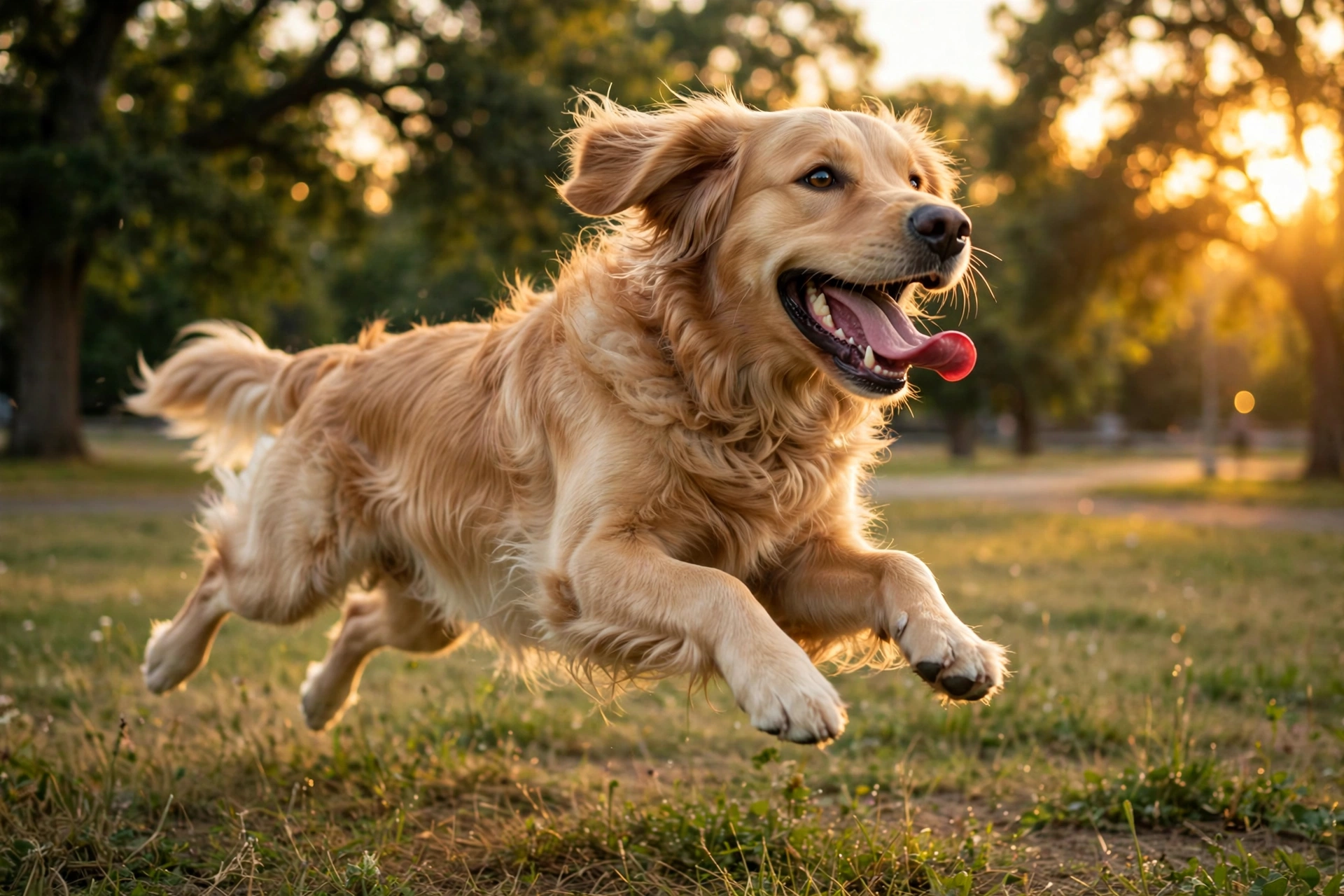
Dogs can’t tell us they’re happy in words, but they tell us constantly — with their tails, their eyes, their ears, and the way they throw themselves onto their backs in the middle of the living room. Learning to read these signals is one of the most useful skills a dog owner can build, because the same body language cues also reveal the opposite: stress, fear, or pain.
Your dog doesn’t need grand gestures to be happy. Most of the time, happiness looks like relaxation — a loose, wiggly dog that chooses to be near you and moves through life without tension. Here’s how to spot the ten clearest signs that your dog is living their best life.
Direct answer: A happy dog shows a relaxed, wiggly body with loose movements, a wagging tail held at a natural angle, soft eyes without visible whites, and a slightly open mouth with no facial tension. Happy dogs also play bow, flop onto their sides, seek out your company, and greet you with enthusiastic full-body wiggles — all signs that they feel safe, comfortable, and well cared for.
What Does a Relaxed, Happy Dog Body Look Like?
A happy dog has very loose body language with no tension anywhere. According to Dr. Kate Anderson, a veterinary behaviorist at Cornell University’s Duffield Institute for Animal Behavior, “happy dogs should have very loose body language. They shouldn’t have any tension. Their ears shouldn’t be pulled back. You shouldn’t see the whites of their eyes.” She adds that if your dog’s movements are loose and they “look like noodles,” that’s a strong sign of contentment.
Dr. Kristi Flynn, a primary care veterinarian at the University of Minnesota’s College of Veterinary Medicine, notes that a content dog’s weight is evenly distributed on all four limbs rather than leaning away or holding a paw up. She describes a classic picture: a dog lying out in the yard in the sun, stretched on their side, completely relaxed.
With that relaxed baseline in mind, here are the ten signs, grouped by what your dog is showing you.
Sign 1: The Full-Body Wiggle and Loose Tail Wag
When your dog’s whole rear end gets involved in the wag — the famous wiggle-butt — that’s joy, not just arousal. A happy wag tends to be broad and loose, with the tail held at a natural angle for the breed and the movement flowing through the hips and body.
Research adds nuance: in a study by researchers at the University of Bari and the University of Trieste, published in Current Biology, dogs wagged their tails more to the right when seeing their owner (a positive stimulus) and more to the left when facing a large, unfamiliar dog. Dogs watching other dogs also responded with faster heart rates when they saw left-biased wagging. For owners, the practical takeaway is simple: a broad, loose wag aimed at you is one of the clearest happiness signals there is. A stiff, fast, high wag — tail flagging straight up with a rigid body — is excitement or arousal, not necessarily happiness, so always read the tail with the rest of the body.
Sign 2: Soft Eyes and a Relaxed Face
A happy dog’s eyes look soft and squinty rather than round and staring. The ASPCA’s canine body language guide describes it well: a relaxed dog will often squint so the eyes become almond-shaped with no white showing at all. Round eyes with lots of visible white — sometimes called “whale eye” — and dilated pupils are signs of stress or fear, not happiness.
The mouth matters too. A content dog typically has a slightly open mouth with no facial or mouth tension, and the corners may turn up slightly — the look some owners call a “smile.” In contrast, a tense dog keeps the mouth closed and may pull the lips back at the corners. Frequent lip licking or yawning when the dog isn’t tired can be early stress signals rather than happiness.
Sign 3: Relaxed Ears in Their Natural Position
Ears held in their natural, neutral position — not pinned back, not pricked hard forward — signal a dog at ease. As the ASPCA guide notes, when a dog is relaxed, the ears sit slightly back or out to the sides, and they tense forward only as arousal rises.
The exact position depends on your dog’s ear type. Even floppy-eared dogs move the base of their ears forward and back, so look at the base rather than the tip. If ears are flat against the head, that’s more often fear or appeasement, not happiness. And if you’re handling your dog’s ears regularly — for example when you clean your dog’s ears safely — a dog that accepts it calmly with relaxed ears is generally a comfortable, trusting dog.
Sign 4: The Play Bow
The play bow — front legs stretched flat on the ground, rear end up in the air, tail wagging — is one of the most unambiguous invitations in dog body language. It means “I want to play, and I’m having fun.” Dogs use it to kick off games with other dogs and with people.
A dog that frequently play-bows at you is a dog that feels safe enough to be silly. It often shows up during the best moments of a walk or right before a game of fetch. Repeated play bows during play also serve as a meta-signal: “Everything after this is still a game,” which is why dogs play-bow mid-wrestle to keep things friendly.
Sign 5: They Roll Over and Flop Onto Their Side
A dog that flops onto their side or back near you — exposing the belly — is showing deep trust. In the wild, the belly is the most vulnerable part of the body; a dog only exposes it where they feel completely safe. That mid-day nap on their side in a patch of sunlight, all four legs sprawled, is one of the most reliable happiness indicators there is.
Context matters. A dog rolling over with a loose, wiggly body is happy and relaxed. A dog rolling over with a stiff body, tucked tail, and ears back during a confrontation may be showing appeasement instead. Read the softness: loose and floppy means joy; tense and frozen means something else.
Sign 6: They Seek Out Your Company
A dog that consistently chooses to be near you — following you from room to room, leaning against your leg, or resting with their head on your foot — is showing contentment. They have the whole house available to them, and they keep ending up next to you.
This voluntary closeness is one of the strongest happiness signals because it reflects choice. Independent dogs may express it more subtly than velcro breeds, but the pattern is the same: the dog seeks proximity without signs of anxiety, like pacing or whining when you leave the room. Happy dogs want to share their space with their favorite person.
Sign 7: The Enthusiastic Greeting
When you walk through the door — even after a five-minute errand — and your dog greets you like you’ve returned from a year at sea, that’s happiness. The greeting usually combines several signs at once: loose full-body wiggling, a wagging tail, soft excited eyes, and sometimes little whines or “talking.”
What makes this a reliable sign is the consistency. A dog that greets you with excitement day after day is a dog whose world is organized around the people they love. If a normally enthusiastic dog suddenly stops greeting you, that’s worth paying attention to — changes in greeting behavior can be an early flag that something is off, physically or emotionally.
Sign 8: A Healthy Appetite and Calm, Regular Sleeping
Basic needs are the foundation of happiness. Dr. Anderson points out that happiness starts with welfare — the five freedoms of animal welfare, including freedom from hunger, thirst, discomfort, pain, and fear. A dog that eats readily and sleeps deeply and comfortably is a dog whose fundamental needs are being met.
Sleep is an underrated happiness signal. A dog that can fall into a deep sleep — twitching through dream cycles, completely unguarded — feels safe. An anxious dog sleeps lightly, stays on alert, and may pace instead of settling. If your dog sleeps soundly in their usual spots, that’s contentment in action.
Sign 9: They Initiate Play and Zoomies
Dogs that feel good play. Whether it’s the evening zoomies around the backyard, bringing you a toy unprompted, or starting a game with another dog, playfulness is a core happiness behavior. Play requires surplus energy and a sense of safety — stressed or unwell dogs typically withdraw from play first.
Watch for self-initiated play especially. A dog that brings you a ball, tosses a toy for themselves, or does the classic zoomie circuit is choosing fun because they feel good. It’s also a great sign during and after activities: a dog that finishes a walk and still wants to wrestle with a toy is a dog with a full cup.
Sign 10: Calm, Curious Body Language on Walks and at Home
A happy dog moves through the world with relaxed curiosity: sniffing on walks, exploring new things without freezing or bolting, greeting familiar people and dogs with loose body language. Their baseline is calm engagement rather than hypervigilance.
This is the sign that ties everything together. Happiness in dogs isn’t a constant state of excitement — it’s mostly calm contentment punctuated by joyful bursts. A dog that can relax at home, explore confidently outside, and bounce back quickly from small startles is showing the emotional resilience of a well-adjusted, happy animal.
Happy vs. Stressed: Reading the Difference
The same parts of the body tell both stories. Here’s a quick side-by-side so you can tell which one you’re seeing:
| Body part | Happy | Stressed or fearful |
|---|---|---|
| Eyes | Soft, squinty, almond-shaped | Round, staring, whites showing (“whale eye”) |
| Mouth | Slightly open, relaxed, corners up | Closed tight, lips pulled back, rapid panting |
| Ears | Neutral, natural position | Pinned flat back or pricked hard forward |
| Tail | Loose wag at natural angle | Tucked tight, or stiff high wag with rigid body |
| Body | Loose, wiggly, “like noodles” | Stiff, frozen, leaning away, cowering |
| Movement | Relaxed, playful, curious | Pacing, hiding, freezing, bolting |
Learning this table is the real payoff of knowing the happiness signs: you also learn to spot trouble early. Repeated stress signals — like persistent paw licking, lip licking, or yawning when not tired — can indicate anxiety or a medical issue, and they deserve attention rather than reassurance alone.
What If You’re Not Seeing These Signs?
Some dogs are naturally more reserved, and breed and age matter. Senior dogs may play less but still show happiness through relaxed sleeping, appetite, and quiet closeness. A newly adopted dog may need weeks to feel safe enough to show their full personality — the “3-3-3 rule” of rescue adjustment (three days to decompress, three weeks to settle in, three months to feel at home) exists for a reason.
What matters is change from your dog’s personal baseline. A normally wiggly dog that goes flat and withdrawn, or a good eater that suddenly won’t touch dinner, is telling you something. Keep daily routines consistent — regular feeding times, walks, and sleep — because predictability is one of the biggest contributors to canine contentment. And when in doubt, ask your vet: a sudden behavior change can be the first sign of pain or illness.
FAQs
Can a wagging tail ever mean something other than happiness?
Yes. Tail wagging signals arousal, and arousal isn’t always positive — a stiff, high, fast wag with a rigid body can mean excitement, anxiety, or even a warning. The Bari/Trieste research found dogs wag more to the left when facing threatening stimuli. Always read the tail together with the eyes, ears, mouth, and overall body tension.
Do dogs smile when they’re happy?
Some dogs do show what the ASPCA calls a “submissive grin” — lips lifted to show the front teeth, but paired with a lowered head, wagging tail, flattened ears, and soft squinty eyes. It’s an appeasement or greeting gesture, not aggression. Context and the rest of the body tell you whether it’s a friendly grin or a warning.
How do I know if my senior dog is still happy if they don’t play anymore?
Look at the quieter signs: relaxed sleeping, a good appetite, seeking your company, and soft, calm body language. Happiness in older dogs often looks like contentment rather than exuberance. What matters most is whether their behavior has changed from their own baseline — a sudden drop in interest in food, walks, or affection warrants a vet check.
Does my dog need to show all 10 signs to be happy?
No. No dog shows all ten at once, and individual dogs express happiness differently — some are exuberant greeters, others are quiet cuddlers. Look for an overall pattern: loose body language, normal eating and sleeping, and a willingness to engage with you and the world. A few consistent signs are plenty.
The Bottom Line
A happy dog is, more than anything, a relaxed dog — loose body, soft eyes, easy movements, and a genuine desire to be near you. You don’t need a perfect checklist; you need to know your own dog’s baseline and notice when it changes.
Spend a few minutes each day really watching your dog, and you’ll start catching the small stuff: the sigh when they settle against you, the half-second play bow before dinner, the way their whole body wiggles when you pick up the leash. Those moments are your dog’s way of saying everything is right in their world. And keeping it that way is mostly about the basics — good food, regular exercise, a predictable routine, and your company. If something ever feels off, talk to your vet sooner rather than later. When in doubt, ask your vet.
[…] for: Training rewards — they’re small, smelly (in a good way), and easy to break in half. Dogs learn fastest with high-value rewards, and these […]
[…] looks like. If you know your dog’s usual energy, appetite, and habits — see our guide on 10 signs your dog is happy — you will spot abnormal restlessness, panting, or stomach upset much […]
[…] you want to understand what a content, well-rested dog looks like when awake, our guide to 10 signs your dog is happy describes the alert, engaged behavior you should see during waking […]