
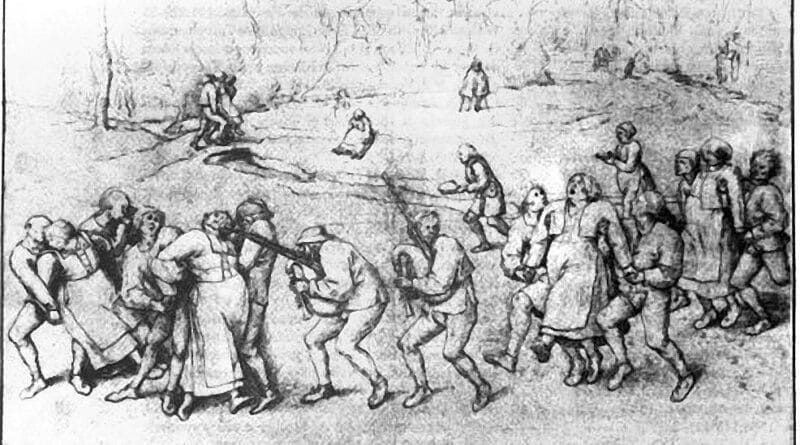
The Strasbourg Dancing Plague of 1518
In July 1518, the city of Strasbourg was struck by the dancing plague—a bizarre medical crisis where hundreds of people danced uncontrollably for weeks.
A City in Convulsion
Strasbourg’s city authorities were baffled and turned to local physicians for advice. Rejecting astrological or religious explanations, the doctors diagnosed the dancers with “hot blood” and recommended that the victims keep dancing to cure themselves. The city constructed wooden stages, hired musicians, and paid professional dancers to guide the crowds. This only accelerated the epidemic. The dancing plague finally subsided in September, leaving behind hundreds of dead and a historical mystery that would puzzle historians and medical professionals for centuries.
Modern Diagnosis: Hysteria or Fungus?
Modern historians believe the dancing plague was a mass psychogenic illness—a collective delusion triggered by extreme stress. In 1518, Strasbourg was suffering from severe famine, disease epidemics, and religious conflict, creating a powder keg of psychological tension. Under such conditions, a single individual’s hysterical reaction can trigger a chain reaction in a vulnerable population. An older theory blamed ergot poisoning, a toxic fungus that grows on damp rye and causes convulsions and hallucinations. However, ergotism restricts blood flow to the limbs, which would make it physically impossible for victims to dance for days on end, leaving mass hysteria as the most likely culprit.
The Mass Psychogenic Stress in 1518
The year 1518 was a time of extreme hardship for the citizens of Strasbourg. The region had suffered from consecutive crop failures, leading to widespread famine and malnutrition. Additionally, outbreaks of smallpox, syphilis, and leprosy had devastated the population, creating a climate of intense fear and anxiety. Historians believe that this extreme psychological stress triggered a mass psychogenic illness, where the collective anxiety manifested as physical convulsions and dancing. The victims were not dancing out of joy, but were trapped in a hysterical state of mind, driven by the intense social and environmental pressures of their time.
Medical History of Ergot Poisoning and Spasms
An alternative explanation for the dancing plague is ergotism, a form of poisoning caused by eating bread made from rye contaminated with the ergot fungus (Claviceps purpurea). Ergot contains alkaloids that are chemically related to LSD, which can cause severe hallucinations, muscle spasms, and convulsions. However, ergotism also restricts blood flow to the limbs, causing gangrene and severe pain. Medical historians argue that individuals suffering from ergotism would have been physically unable to dance for days on end, as their limbs would have been too painful and damaged, supporting the mass hysteria theory as the primary cause of the plague.
The Role of Saint Vitus’ Dance
During the medieval era, compulsive dancing was frequently associated with Saint Vitus, the patron saint of dancers and entertainers. According to German folklore, Saint Vitus could punish sinners by forcing them to dance uncontrollably. In 1518, many of the Strasbourg dancers believed they had been cursed by Saint Vitus, which fueled their anxiety and reinforced their compulsive behavior. The city authorities even sent some of the dancers to a shrine dedicated to Saint Vitus in the nearby hills, where they were given red shoes and led in prayer, which reportedly helped cure some of the victims by resolving their psychological guilt.
The Social Impact of the Strasbourg Plague
The dancing plague had a profound impact on the social and political life of Strasbourg. The event disrupted the city’s economy, as markets were closed and public gatherings were banned to prevent the spread of the hysteria. The failure of the city’s physicians to cure the dancers weakened public trust in medical authorities and led to a resurgence of religious devotion and superstition. The dancing plague of 1518 remains the most famous and well-documented of several similar outbreaks that occurred across Europe during the Middle Ages, illustrating the power of collective fear to shape human behavior.
Psychological Delusions in Modern Times
While the Strasbourg dancing plague seems like a relic of a superstitious past, mass psychogenic illnesses continue to occur in modern times. In the 20th and 21st centuries, outbreaks of unexplained physical symptoms—such as twitching, fainting, and laughter—have been documented in schools, factories, and communities worldwide, often triggered by stress, environmental anxiety, or social media rumors. By studying the Strasbourg outbreak of 1518, modern psychologists and neurologists can learn how stress-induced hysteria spreads through human populations and develop better strategies for managing collective delusions in the digital age.
Saint Vitus and Religious Devotion in Strasbourg
The connection to Saint Vitus highlights the deep influence of medieval religion on mental health. In 1518, Strasbourg’s citizens believed the dancing plague was a divine punishment sent by Saint Vitus, a belief that created a feedback loop of fear and guilt. To appease the saint, the city sent many of the afflicted on a pilgrimage to a local shrine in Saverne, where they were given red leather shoes and led in prayers of forgiveness. This ritual healing helped cure many of the dancers by providing a psychological resolution to their guilt, showing that in an era before modern psychology, religious rituals were the only tool available to manage severe mass psychogenic stress.
The Legacy of Strasbourg’s Compulsive Dancers
Strasbourg’s dancing plague of 1518 remains a haunting reminder of the fragile nature of the human mind under extreme societal pressure. The city has preserved municipal documents from the era, which are displayed in local historical museums as a testament to the resilience of the community during a period of famine and fear. Today, the event is studied not only by historians, but also by public health professionals and sociologists seeking to understand how behavioral contagions spread through communities, leaving Frau Troffea and her followers as a classic case study in the intersection of psychology, culture, and social history.
FAQ
Did the dancing plague really happen?
Yes. The dancing plague is well-documented in 16th-century municipal records, medical notes, cathedral sermons, and local chronicles in Strasbourg, confirming that hundreds of people danced in the streets for weeks.
What is ergotism, and could it have caused the plague?
Ergotism is poisoning caused by eating rye contaminated with ergot fungus. While it can cause hallucinations and muscle spasms, it also cuts off circulation to the limbs. Affected people would be unable to dance or stand for long periods.
How does mass psychogenic illness explain the dancing?
Mass psychogenic illness occurs when severe stress, fear, or trauma triggers physical symptoms in a group of people. In 1518, Strasbourg was facing starvation and epidemics, creating extreme anxiety that manifested as compulsive dancing.