
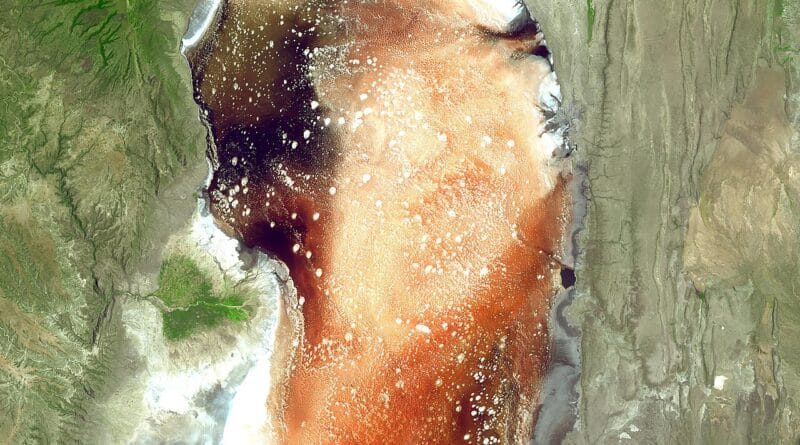
Lake Natron: The Blood-Red Lake That Mummifies Animals Into Stone
In northern Tanzania, near the Kenyan border, lies Lake Natron—a shallow, blood-red body of water that looks like it belongs on another planet.
The Caustic Crucible
To understand how this happens, you have to look at the surrounding geology. Lake Natron sits in the shadow of Ol Doinyo Lengai, an active volcano unlike any other on Earth. Instead of silica-rich lava, Ol Doinyo Lengai erupts natrocarbonatite, a rare, cold lava rich in sodium and potassium carbonates. Rainwater washes these volcanic minerals down into the lake basin. Because Lake Natron has no outlet, the water can only escape through evaporation. Over thousands of years, this has left behind a highly concentrated soup of minerals, creating one of the most alkaline environments in the world.
The water’s pH regularly reaches between 10.5 and 12. For context, that is similar to household bleach or ammonia. If you were to dip your hand in, you would feel a soapy sensation as the alkaline water begins to dissolve the natural oils on your skin. Keep it there longer, and the chemical burns would begin. The water is also scorching, with temperatures in the shallow pools reaching up to 60 degrees Celsius (140 degrees Fahrenheit). It is a lethal combination for almost any creature that wanders into the wrong part of the lake.
How the Mummies Are Made
The myth of a “Medusa lake” that instantly turns animals to stone is common, but the chemical reality is more gradual. The lake is rich in a mineral called natron—a natural mixture of sodium carbonate decahydrate and sodium bicarbonate. This is the exact same substance the ancient Egyptians used to preserve their pharaohs. When an animal drowns or dies in Lake Natron, the high salt content extracts moisture from the body, drying out the soft tissues before bacteria can cause decay. At the same time, calcium and sodium carbonate minerals in the water deposit onto the skeleton and feathers, coating them in a hard, chalky crust.
The haunting images that made the lake famous were captured by photographer Nick Brandt. He found these calcified carcasses on the shore during a dry spell. The birds and bats were so perfectly preserved that they looked like statues. Brandt took the mummified remains and placed them on branches and in lifelike poses, creating a dark, gothic gallery of the lake’s victims. The animals didn’t freeze in mid-flight when they hit the water; they died, sank, became mummified, and were later exposed by the receding shoreline.
But why do so many birds die in the lake in the first place? The answer lies in the lake’s extreme stillness and mineral concentration. The water’s surface acts as a perfect, unbroken mirror, reflecting the African sky. Birds flying overhead are tricked by the reflection, failing to realize they are descending toward water until it is too late. They crash into the caustic lake at high speeds, and the shock, combined with the heat and chemicals, quickly drowns them.
An Unexpected Sanctuary
Despite its hostile reputation, Lake Natron is not a dead zone. In fact, it is the single most important breeding ground in East Africa for the lesser flamingo. Nearly two million of these pink birds—representing three-quarters of the global population—gather here every year to mate and raise their chicks. The extreme environment is their greatest defense. The caustic water creates a natural barrier that prevents predators like hyenas, jackals, and lions from reaching the mud islands where the flamingos build their nests.
The flamingos have evolved specialized adaptations to thrive in this chemical cauldron. Their legs are covered in tough, leathery skin that protects them from the alkaline water. They also have specialized salt glands in their nasal cavities that filter out the excess salt from their food and drinking water. They feed on spirulina, a red-pigmented cyanobacteria that thrives in the warm, alkaline waters. It is this abundant food source that gives the flamingos their signature pink color. The red color of the lake itself is caused by these halophilic (salt-loving) microorganisms, which bloom in the shallow water and paint the volcanic basin in shades of crimson and orange.
Why This Extreme Oasis Matters
Lake Natron is more than just a biological oddity. It is a living laboratory for astrobiologists studying how life might survive on other planets. The conditions here are remarkably similar to the ancient lakes that once existed on Mars and the subsurface oceans of icy moons like Enceladus. The microorganisms that thrive in this caustic soup show us that life is incredibly resilient, capable of finding a way to exist in the most hostile environments imaginable.
But this fragile ecosystem is under threat. Industrial plans to mine soda ash from the lake have been proposed, which would disrupt the nesting grounds of the lesser flamingo. If the lake’s delicate balance is upset, it could trigger a collapse of the flamingo population across the entire continent. Protecting this bizarre, blood-red lake is not just about preserving a natural wonder; it is about protecting a critical sanctuary for one of Africa’s most iconic birds.
FAQ
Does Lake Natron turn animals to stone instantly?
No, the lake does not turn animals to stone the moment they touch the water. Instead, when animals drown in the highly alkaline water, the sodium carbonate minerals act as a preservative, slowly drying out and calcifying the carcasses over time until they become hardened mummies.
Can humans swim in Lake Natron?
Swimming in Lake Natron is highly dangerous and not recommended. The water has a pH similar to bleach, which can cause severe chemical burns on human skin, and the temperatures in the shallow parts of the lake can reach up to 60 degrees Celsius (140 degrees Fahrenheit).
Why do flamingos nesting in the lake survive?
Lesser flamingos have evolved leathery skin on their legs that resists the corrosive, alkaline water, allowing them to wade safely. They also use the caustic lake as a barrier, building their nests on isolated mud flats where predators cannot reach them.