
Why Roman Concrete Outlasts Ours by Thousands of Years
If you visit the ruins of ancient Rome, you will find massive domes, aqueducts, and coastal harbors built of Roman concrete that look almost exactly as they did two thousand years ago.
The Volcanic Formula of Pozzolana
The Roman formula consisted of volcanic ash, lime, and volcanic rock. The key ingredient was a specific volcanic ash called pozzolana, harvested from the region near Mount Vesuvius. When mixed with water and lime, this ash triggered a hot chemical reaction that bound the aggregate together. But the real magic happened long after the concrete set. When seawater seeped into the microscopic cracks of Roman marine structures, it reacted with the mineral crystals in the pozzolana ash, growing a rare mineral called aluminous tobermorite.
The chemical reaction between seawater and pozzolana ash is unique because it is active rather than passive. In modern concrete, moisture ingress is the primary cause of decay, as water dissolves the binding agents and rusts the internal steel rebars. In contrast, the Roman formula welcomed seawater. The alkaline minerals in the water triggered the crystallization of tobermorite and phillipsite, which grew inside the microscopic voids of the concrete, binding the structure together even tighter than when it was first poured.
The Self-Healing Domes of Rome
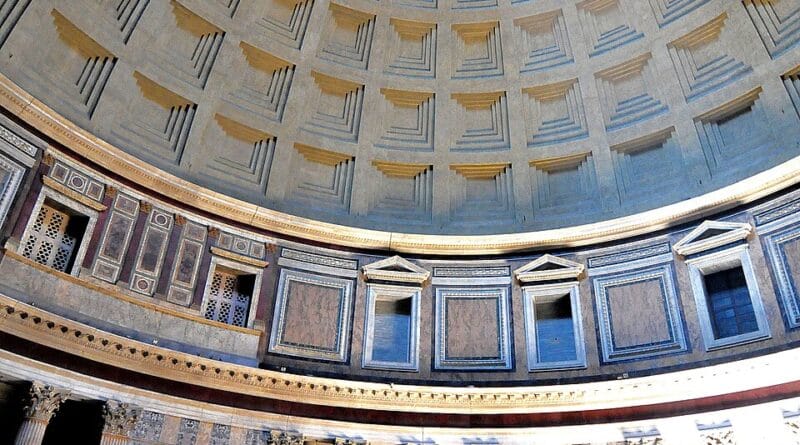
The Pantheon’s massive dome stands as the ultimate testament to the durability of Roman concrete. Spanning 43.3 meters (142 feet) in diameter, it contains no steel reinforcement. Under modern construction standards, such a structure would collapse under its own weight within days. The Romans achieved this feat by layering the concrete with increasingly lighter volcanic aggregates, like tufa and pumice, as they built upward. This graduated design reduced the overall weight of the dome while maintaining its strength.
Furthermore, the self-healing properties of the concrete protected the dome from the seismic activity common in the Italian peninsula. When micro-fractures formed due to earth tremors, the calcium-rich minerals within the concrete dissolved and recrystallized inside the cracks, sealing them before they could expand into major structural failures. This active self-repair mechanism allowed Roman structures to withstand centuries of weathering, earthquakes, and neglect.
Volcanic Chemistry and Long-term Curing
The secret lies in what geologists call the “pozzolanic reaction.” When volcanic ash reacts with calcium hydroxide (lime), it forms calcium-silicate-hydrate binders. Over decades, as saltwater filters through the material, it dissolves the mineral remains of volcanic crystals and replaces them with interlacing tobermorite plates. This process increases the density of the concrete over time, making it impermeable to water. The Romans created a concrete that behaves like a living rock, growing stronger with age and environmental exposure.
Modern Replications and Green Concrete
Understanding the self-healing chemistry of the Romans has profound implications for modern construction. The production of Portland cement is one of the leading contributors to global carbon emissions, accounting for nearly eight percent of the world’s total. By developing new concrete formulas that incorporate volcanic ash and mimic the Roman self-healing process, scientists hope to build structures that last for centuries without requiring frequent repairs, significantly reducing the carbon footprint of global infrastructure projects.
In addition, replacing modern cement with volcanic ash mixtures would reduce the energy required during the manufacturing process. Portland cement must be fired at extremely high temperatures, whereas pozzolanic concrete relies on natural, volcanic compounds that are pre-cured by geothermal activity. By adopting these ancient techniques, the modern construction industry could drastically lower its resource consumption and build coastal barriers, docks, and foundations that survive rising ocean levels for generations to come.
The Structural Mechanics of Aqueducts
Roman aqueducts are among the most impressive engineering feats of the ancient world, spanning hundreds of miles to deliver water to major cities. The durability of these structures relies entirely on the unique volcanic concrete used in their foundations and arches. Unlike modern concrete, which crack and leak under the constant flow of pressurized water, Roman concrete formed a waterproof barrier that actually self-healed when leaks did occur. As water seeped through micro-cracks, it dissolved the unhydrated lime within the mixture, carrying it into the cracks where it recrystallized as calcium carbonate, effectively sealing the leak from within and maintaining the structural integrity of the aqueducts for centuries.
The Marine Hardening of Ancient Docks
The durability of Roman concrete is particularly evident in their marine harbors and docks, such as the port of Pozzuoli. These structures have been submerged in seawater for over two thousand years, yet they show no signs of erosion. Modern marine concrete structures begin to degrade within fifty years due to the corrosive action of chloride ions in saltwater. The Roman concrete, however, relies on the active crystallization of phillipsite and tobermorite, which grow when exposed to seawater, making the concrete denser and stronger over time. This active crystallization process represents a model for modern coastal defense structures, such as seawalls and breakwaters, which face increasing erosion due to climate change.
Ancient Marine Engineering and Harbor Infrastructure
The scale of Roman coastal engineering is unparalleled in antiquity. Roman builders constructed ports that could accommodate heavy merchant fleets from Egypt, Spain, and North Africa. In ports like Portus near Rome, massive concrete pylons were built by lowering wooden cofferdams into the open sea, pumping out the water, and pouring the hot volcanic ash mixture directly into the seabed. The resulting concrete structures formed massive artificial breakwaters that have survived the battering of waves and seismic shifts for two millennia. Modern analysis reveals that the mineral growth within these submerged structures continues to fill the gaps, making them increasingly impermeable to sea currents, a property that modern cement engineers can only dream of replicating in coastal protection walls.
Volcanic Quarries and the Supply Chain
The production of this high-quality concrete required a sophisticated logistical network. The primary volcanic ash, pulvis puteolanus, was mined from quarries around the Bay of Naples, particularly near Puteoli. From there, it was loaded onto merchant vessels and shipped across the Mediterranean to construction sites in France, Spain, and Greece. The Roman state controlled these quarries, prioritizing ash supplies for critical infrastructure projects like aqueducts, harbors, and major temples. This centralized distribution network highlights that Roman concrete was not just a local discovery, but a key component of imperial infrastructure planning and architectural strategy.
FAQ
What is the main difference between Roman concrete and modern concrete?
Roman concrete uses volcanic ash (pozzolana) and lime, which allows it to chemically react with water over time. Modern concrete uses Portland cement, which is prone to cracking and erosion when exposed to moisture and salt.
How does Roman concrete heal itself?
When seawater enters small cracks in Roman concrete, it reacts with the volcanic minerals to form new crystals like tobermorite. These crystals grow and fill in the cracks, reinforcing the concrete structure from within.
Why is the Pantheon dome so significant?
The Pantheon dome is the largest unreinforced concrete dome in the world. It has survived intact for nearly 2,000 years without steel reinforcement, showcasing the durability and unique properties of the Roman concrete formula.