
Inside the Voynich Manuscript: The Unbreakable Medieval Code
In 1912, an antique book dealer named Wilfrid Voynich purchased a strange, handwritten manuscript known today as the Voynich Manuscript.
Linguistic Paradoxes and Structure
Some researchers believe the manuscript is a highly sophisticated hoax designed to look like a valuable alchemical text. But linguistic analysis of the text shows it follows the natural patterns and structures of real languages, such as Zipf’s Law, which dictates word frequency. The text was written quickly and fluidly by someone who knew the language, without the pauses, corrections, or hesitation marks typical of someone writing a fake cipher. This suggests that the script is either a real, forgotten language or a cipher that is far more complex than anything else from the medieval era.
Linguists have noted that “Voynichese”—the nickname given to the manuscript’s language—exhibits a high degree of order. Words are formed from a set of characters that resemble Latin letters, but they follow strict spelling rules. Certain letters only appear at the beginning of words, others only in the middle, and some only at the end. This structure is rare in simple ciphers but common in natural languages. Furthermore, the text lacks any punctuation, suggesting that it was written in a continuous stream of thought or represents a phonetic transcription of an unwritten tongue.
The Mystical Botanical and Astrological Sections
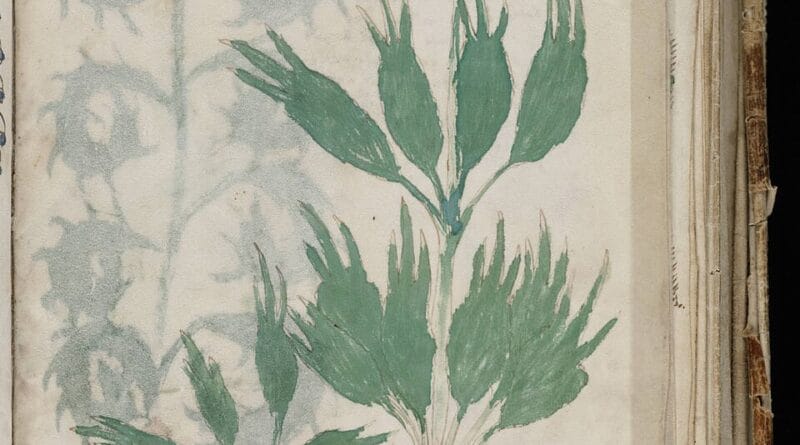
The manuscript is divided into several sections based on the illustrations. The botanical section contains drawings of plants that appear to be composites of different species—such as the roots of one plant attached to the leaves of another and the flowers of a third. The astrological section features circular diagrams with zodiac symbols, suns, and moons, surrounded by rings of text. Perhaps the strangest is the pharmaceutical section, which depicts jars and containers alongside roots and leaves, suggesting the book may have been a medical or herbal guide used by a medieval physician or alchemist.
A History of Mysterious Owners
The manuscript’s path through history is as strange as its contents. The earliest recorded owner was Georg Baresch, an alchemist in Prague who lived in the early 17th century. Baresch sent copies of the script to a Jesuit scholar in Rome, asking for help in translating it. Upon Baresch’s death, the manuscript passed to his friend Jan Marci, the rector of Charles University in Prague. Marci sent the book to Athanasius Kircher, a famous Jesuit polymath, hoping he could decode it. Kircher failed, and the manuscript was stored in the library of the Collegio Romano, where it sat forgotten for nearly three centuries until Wilfrid Voynich uncovered it in 1912.
Competing Theories and Modern AI Analysis
Over the years, theories have ranged from the book being a medieval guide to women’s health written in a phonetic shorthand, to an early botanical manual from the Aztec empire. Artificial intelligence systems have recently been used to analyze the text, suggesting connections to Hebrew or Arabic ciphers, but a complete translation remains elusive. Until someone can decode its strange botanical and astrological sections, the Voynich Manuscript stands as a tantalizing window into a medieval world of lost knowledge.
Modern cryptanalysts have applied machine learning models to the text, attempting to match its character frequency with known languages. Some AI algorithms concluded that the manuscript is written in an anagrammed form of an early Romance language, while others point toward a phonetic spelling of medieval Turkish. However, none of these models have succeeded in translating a single complete sentence that makes sense in context. The manuscript remains a fortress of code, holding its secrets tight against both human minds and silicon processors.
Athanasius Kircher and the Vatican Archives
The manuscript’s connection to Athanasius Kircher is one of the most intriguing chapters of its history. Kircher was a 17th-century Jesuit priest and polymath who claimed to have decoded Egyptian hieroglyphs and created a universal language. When Jan Marci, the rector of Charles University, sent the manuscript to Kircher in 1666, he hoped Kircher’s mystical and linguistic expertise would finally unlock the book’s secrets. Kircher, however, was unable to translate the text and left no record of his attempts, leading some to suspect he realized the manuscript was a hoax or a dangerous alchemical text that should remain hidden. The manuscript was subsequently stored in the archives of the Collegio Romano, where it remained hidden from the public until Wilfrid Voynich purchased it in 1912.
AI Models and the Decrypting Race
In recent years, the race to decode the Voynich Manuscript has shifted to artificial intelligence and machine learning. Computer scientists have trained neural networks on the manuscript’s text, comparing its character patterns and word structures to hundreds of known languages. Some AI models have suggested that the manuscript is written in a proto-Romance language using a phonetic spelling system, while others point toward a complex anagram cipher of medieval Hebrew. However, none of these AI-generated translations have produced a coherent narrative, leading some to conclude that the text may be a form of glossolalia or a highly sophisticated alchemical shorthand designed to prevent unauthorized readers from accessing its contents.
The Emperor’s Collection in Prague
Before passing to Georg Baresch, the manuscript is believed to have been owned by Rudolph II, the Holy Roman Emperor who ruled from Prague in the late 16th century. Rudolph was obsessed with the occult, alchemy, and natural curiosities, spending fortunes to collect rare and mysterious objects. It is recorded that he purchased the manuscript for 600 gold ducats—an immense sum at the time—believing it was the work of the English philosopher Roger Bacon. Rudolph’s interest in the manuscript helped establish its reputation as a major treasure of alchemical lore, drawing the attention of court alchemists and scholars who sought to extract its secrets, and setting off a chain of ownership that preserved the manuscript through centuries of war and political instability in Europe.
Modern Cryptographic Analysis and Ciphers
In the mid-20th century, the manuscript was studied by the Voynich Study Group, consisting of world-class cryptographers, computer scientists, and linguists. They discovered that the text does not use simple substitution ciphers, where one letter is swapped for another. Instead, it appears to use a codebook system or a multi-alphabet cipher that changes with every line or page. Some theorists suggest that the text is written in an artificial language designed specifically to hide botanical and medical knowledge from the Church, which frequently prosecuted alchemists and herbalists for heresy. This theory aligns with the medieval context, where coded writing was a common defense against persecution, leaving the Voynich Manuscript as the most complex example of this protective art.
FAQ
What is the Voynich Manuscript?
The Voynich Manuscript is a handwritten illustrated codex from the early 15th century, written in an entirely unknown script and language. It is named after Wilfrid Voynich, the book dealer who rediscovered it in 1912.
Why is the manuscript so difficult to decode?
The script uses a unique alphabet that does not resemble any known writing system, and there are no translation keys or bilingual texts available. Additionally, the illustrations depict unknown botanical and astrological subjects.
Is the Voynich Manuscript a hoax?
While some argue it is a medieval hoax, statistical analysis reveals the text behaves like a natural language, showing organized structures and word-frequency patterns that would have been virtually impossible to fake in the 15th century.