
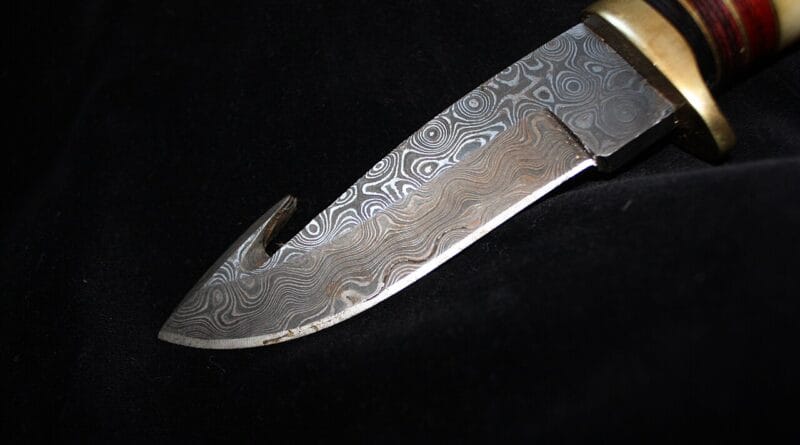
The Lost Recipe of Damascus Steel
During the medieval Crusades, European knights returned from the battlefields of the Levant with terrifying stories of Damascus steel—a legendary metal that possessed near-supernatural qualities.
The Legendary Origins of Indian Wootz Steel
The true origin of Damascus steel does not lie in the city of Damascus itself, but rather in the ancient foundries of southern India and Sri Lanka. Blacksmiths in these regions produced a unique crucible steel known as “wootz.” Wootz steel was forged by melting high-carbon iron with wood, leaves, and specific minerals inside sealed clay crucibles. The resulting ingots were packed with carbon and, crucially, contained trace levels of impurities like vanadium, tungsten, chromium, and manganese. These ingots were then shipped along trade routes to Damascus, Syria, where local armorers forged them into the final blades.
The forging process in Damascus was incredibly complex and required extreme precision. Master smiths worked the steel under strict temperature controls, heating and hammering it repeatedly. If the smith heated the wootz ingot even slightly above the critical temperature, the carbon structure would dissolve, the beautiful water-like pattern would vanish, and the steel would become brittle. The process was a closely guarded secret passed down through generations of apprentices. When the Indian iron ore mines began to run dry in the early 1700s, the precise mineral composition of the wootz steel changed. The blacksmiths in Damascus could no longer obtain the raw material with the correct trace impurities, and the art of forging true Damascus steel collapsed into history.
The Battlefields of the Levant
In the hands of Muslim warriors, Damascus swords became a symbol of military dominance. Western chroniclers noted with dread how these blades could shear through the steel helmets and mail armor of European crusaders with a single blow. The secret was not just the sharpness of the edge, but the flexibility of the core. European swords of the era were heavy, rigid, and prone to shattering under heavy impacts. In contrast, a Damascus blade could absorb massive shocks, bending slightly before returning to its original straight shape. This combination of hardness and elasticity made it the most prized weapon of the medieval world, often gifted as royal treasures between kings and sultans.
Furthermore, the manufacturing process involved unique cooling and quenching methods. It is rumored that the bladesmiths quenched the hot steel in the blood of slaves or by rushing them through the air on horseback to cool them rapidly. While these accounts may contain elements of legend, they highlight the extreme mystique that surrounded the production of these weapons. In reality, the bladesmiths utilized the specific ambient temperatures and local minerals during the quenching process to preserve the carbon structures within the steel, ensuring the edge remained hard while the core retained its flexibility.
Decoding the Nanotechnology
For generations, scientists tried to reverse-engineer the steel using modern chemistry, but the mystery was only solved in 2006. A team of German researchers at the Technical University of Dresden analyzed a 17th-century Damascus saber under a transmission electron microscope. What they found shocked the scientific community: the blade was packed with carbon nanotubes and cementite (iron carbide) nanowires. These microscopic tubes and wires formed a supportive matrix within the steel, giving the blade its legendary combination of high tensile strength and flexible elasticity.
The ancient blacksmiths were practicing a form of molecular manipulation without ever knowing it. The trace impurities of vanadium and tungsten in the Indian wootz acted as catalysts, prompting the carbon from the burned wood to align into hollow tubes during the complex heating and hammering cycles. These carbon nanotubes protected the sharp cementite crystals from breaking under stress, allowing the blade to bend without snapping. Without the exact mineral profile of the wootz ore and the highly specific heat-treating techniques of the Damascus smiths, the carbon nanotubes could not form. This explains why modern attempts using standard pattern welding—simply folding different steel alloys together—only create cosmetic surface patterns without replicating the molecular strength of the original weapons.
The Chemistry of Wootz and Crucibles
To understand the crucible process, one must examine how wootz steel was made. Indian ironworkers placed magnetite ore along with carbon-rich bamboo and leaves of the Auriculata plant in small clay pots. The pots were sealed and placed in a furnace for days, reaching temperatures exceeding 1,200 degrees Celsius. In this environment, the iron absorbed carbon from the plant matter, creating a high-carbon alloy. The slow cooling of the crucibles allowed the carbon to separate into bands of cementite, laying the groundwork for the micro-structures that Damascus bladesmiths would later hammer out into waves. This complex metallurgical chain shows that the technology was not a single discovery, but a vast network of regional knowledge and trade.
Modern Replications and Materials Science
Today, Damascus steel remains a major research topic in material science. Understanding how ancient craftsmen achieved such advanced structures with simple tools could lead to new methods for producing ultra-strong metal alloys. Blacksmiths and materials scientists continue to search for deposits of iron ore that mimic the original wootz mineral signature, hoping to fully revive the ancient art. Until then, the surviving Damascus blades housed in museums around the world stand as silent proof that advanced technology is not always a modern invention.
The Crusader Chronicles and Western Steel
European crusaders who encountered Damascus steel blades were struck by the stark difference in manufacturing quality. Western swords of the era were typically heavy, broad, and blunt, designed to act as hacking clubs rather than precision cutting tools. They were made from iron and steel alloys that contained massive amounts of carbon slag and impurities, which made them brittle and prone to breaking during prolonged combat. When clashed against the fine, high-carbon Damascus blades, Western weapons often shattered or bent, leaving their wielders defenseless. The legend of the Levant blades spread through the knightly orders, creating a mythical reputation that persisted in Europe for centuries, long after the trade routes to the East had closed and the original bladesmithing techniques had been lost.
The Legacy of Nanotubes in Modern Industry
The discovery of carbon nanotubes in ancient Damascus steel has revolutionized the way materials scientists think about historical metallurgy. It proves that advanced structures can be synthesized through complex, natural thermal cycles without the need for modern clean-rooms or computerized equipment. By studying the precise cooling and hammering schedules of the ancient Syrian smiths, modern engineers are trying to develop new methods for growing carbon nanotubes within bulk metal matrices. This research could lead to the production of lightweight, high-strength structural steels for use in aerospace engineering, bridge construction, and military armor, bringing a lost medieval technology back to the cutting edge of modern industry.
FAQ
What made Damascus steel blades so special?
Damascus steel blades were renowned for their remarkable sharpness, flexibility, and strength. They featured distinctive wavy patterns on their surface and were reportedly capable of slicing through iron objects without losing their edge.
Why was the recipe for Damascus steel lost?
The recipe was lost primarily because the specific raw material—wootz steel ingots imported from India—became unavailable when the mines ran dry in the 18th century. Blacksmiths could no longer produce the steel with the necessary mineral composition.
How does modern pattern-welded steel differ?
Modern pattern-welded steel folds different types of metal together to create similar wavy surface designs. However, it lacks the carbon nanotube structure and molecular-level strength found in genuine ancient Damascus steel.