
The Darvaza Gas Crater: Inside the Burning Gates of Hell That Won’t Go Out
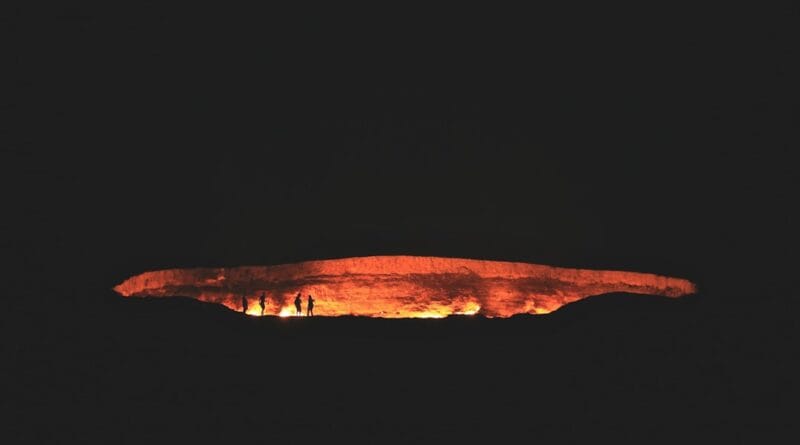
In the middle of the Karakum Desert in Turkmenistan, a massive pit of fire has been burning for over fifty years. This feature, known as the Darvaza gas crater or the “Gates of Hell,” is a collapsed sinkhole filled with natural gas that was lit by Soviet engineers in 1971. They expected the fire to burn out in a few weeks, but today, the 230-foot-wide crater continues to glow in the desert night, becoming a symbol of human engineering errors and geological mystery.
The Soviet Drill and the Collapse
The history of the crater begins during the Cold War. In 1971, Soviet geologists arrived in the Karakum Desert, which covers most of Turkmenistan, to search for oil and gas reserves. The region is rich in hydrocarbons, and the team set up a drilling rig near the small village of Darvaza. As the drill bit penetrated deep into the ground, it struck a massive, pressurized underground cavern filled with natural gas. The weight of the drilling rig was too much for the hollow cavern roof to support, and the ground collapsed, swallowing the rig and the camp into a deep pit.
The collapse was caused by a sudden loss of pressure balance. Soviet engineers were using standard rotary drilling rigs that relied on heavy drilling mud to counterbalance the geological pressure of the subterranean formations. When the drill breached the roof of the massive gas cavern, the pressurized methane gas blew the drilling mud out of the borehole in a violent blowout. Without the weight of the mud column to hold the cavern walls in place, the loose, sandy soil of the desert floor began to slide into the hole, causing a massive cave-in that swallowed the entire rig and the geologists’ tents.
No lives were lost in the collapse, but the disaster created a major problem. The newly formed sinkhole was leaking vast quantities of methane gas into the atmosphere. Methane is highly flammable and toxic to humans and animals. Fearing that the gas would drift toward the village of Darvaza and poison the residents, the geologists decided to take action. They calculated that if they lit the gas on fire, the fuel source would burn off in a few weeks, sealing the leak safely. They threw a flare into the pit, expecting a quick end to the crisis.
That was in 1971. The geologists severely underestimated the size of the natural gas field beneath the desert floor. The pocket they tapped was not an isolated pocket, but a gateway to a massive, deep gas reservoir that had been pressurized for millions of years. The fire has burned continuously ever since, fed by a steady supply of gas rising from the depths of the Earth. The quick fix became a permanent fire, turning a remote desert sinkhole into one of the most famous tourist attractions in central Asia.
The Physics of a Burning Pit
To understand why the crater keeps burning, you have to look at its dimensions and the geology of the Karakum Desert. The Darvaza gas crater is about 230 feet (seventy meters) wide and ninety-eight feet (thirty meters) deep. The fire does not burn as a single flame; it consists of hundreds of individual fires burning along the sides and bottom of the pit, where gas escapes through cracks in the rock. At the center of the crater, temperatures can exceed 1,800 degrees Fahrenheit (1,000 degrees Celsius).
The extreme heat has modified the surrounding rock and sand. Over decades, the intense thermal energy has baked the clay and sand of the crater walls, turning them into crude, vitrified glass in some areas. The air above the crater is in constant motion, as the hot air rises rapidly, drawing in cooler air from the surrounding desert and creating a continuous wind tunnel effect. The glow from the fire is so bright that it can be seen from miles away, illuminating the desert sky like a permanent sunrise.
Extinguishing the fire is incredibly difficult. Because the gas is rising from a massive, pressurized reservoir, simply dumping sand or water into the pit would not work. The gas would continue to migrate through the loose sand, escaping into the air and creating an invisible, highly explosive gas cloud that could ignite at any moment. To seal the crater, engineers would have to drill bypass wells to intercept the gas flow deep underground and divert it away from the sinkhole, a highly complex and expensive project that has never been attempted.
George Kourounis and the Descent
For decades, the interior of the crater remained a mystery, as the extreme heat and toxic fumes prevented anyone from getting close. But in 2013, a Canadian explorer and storm chaser named George Kourounis became the first person to descend to the bottom of the Gates of Hell. Funded by the National Geographic Society, Kourounis spent eighteen months preparing for the dive, designing a specialized harness and a heat-reflective suit made of Kevlar and aluminized fabric, equipped with a self-contained breathing apparatus.
The physical preparation for the descent was grueling. Kourounis practiced descending and ascending ropes while wearing the heavy, insulated fire suit inside a specialized heat chamber, which simulated the physical limits of heat stroke and carbon monoxide buildup. He had to learn to manage his breathing under extreme physical stress, as a panic attack at the bottom of the crater could cause him to exhaust his oxygen supply in minutes. He also had to practice fast rope escapes to ensure he could be pulled out quickly if the wind shifted and pushed the flames toward his descent line.
Kourounis was lowered into the burning pit on a fire-resistant rope, spending about fifteen minutes walking on the crater floor. He described the experience as stepping onto another planet, surrounded by a deafening roar like a jet engine and a wall of heat that made breathing difficult. Despite the hostile environment, Kourounis collected soil samples from the bottom of the crater, hoping to find signs of life that could survive in such extreme conditions.
When scientists analyzed the samples, they made a shocking discovery. The soil was home to several species of extremophile bacteria that were thriving in the hot, methane-rich environment. These bacteria were not found in the surrounding desert; they had adapted specifically to the unique chemistry of the burning crater, using the methane and sulfur as energy sources. The discovery proved that life can adapt to the most hostile environments on Earth, providing valuable clues for scientists searching for life on other planets, such as Venus or Mars.
The Battle for Turkmenistan’s Gas
While the crater has become a popular tourist destination, it represents a major economic loss for Turkmenistan, which holds some of the largest natural gas reserves in the world. The burning crater wastes millions of cubic feet of gas every year, gas that could be captured and exported to generate revenue. In addition, the fire raises environmental concerns, releasing greenhouse gases into the atmosphere and affecting the health of the residents of the nearby town of Darvaza.
In 2022, the President of Turkmenistan ordered experts to find a way to extinguish the fire. He ordered the government to consult international scientists and search for solutions to cap the leaking gas field. However, finding a solution remains an engineering challenge. The crater remains a reminder of the unintended consequences of human environmental manipulation, showing that once we unleash the forces of the Earth, they can be incredibly difficult to control, burning in the desert as a monument to our limits.
Frequently Asked Questions
How did the Darvaza gas crater start?
The crater was created in 1971 when a Soviet drilling rig collapsed into an underground natural gas cavern. Soviet geologists set the escaping methane gas on fire, expecting it to burn out in a few weeks, but the fire has burned continuously ever since.
Can the Darvaza gas crater be put out?
While the government has ordered experts to find a way to extinguish the fire, doing so is highly difficult. Sealing the crater requires complex and expensive drilling projects to intercept and divert the pressurized gas flow deep underground.
Who went to the bottom of the Darvaza gas crater?
In 2013, Canadian explorer George Kourounis became the first person to descend to the bottom of the crater, wearing a custom heat-reflective suit to collect soil samples for scientific analysis.