

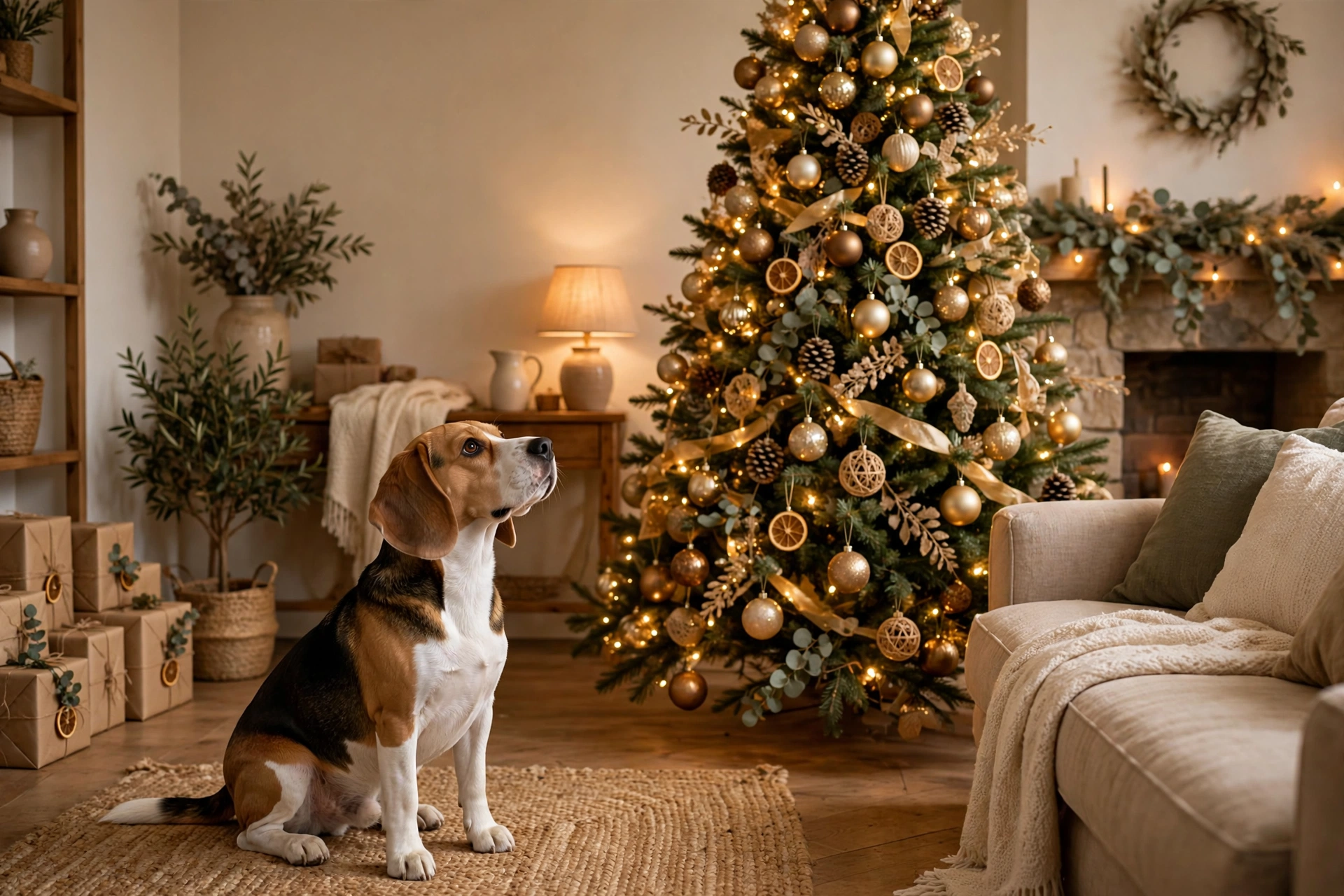
The Christmas tree goes up, the lights go on, and your dog curiosity goes into overdrive. To you it is a holiday centerpiece. To your dog it is a brand-new indoor tree loaded with shiny things to bat, chew, and swallow, standing in a bowl of water, wrapped in cords, and surrounded by plants that can be toxic. Every December, emergency vets see dogs that swallowed tinsel, chewed light cords, or ate a piece of a glass ornament.
None of that means you have to skip the tree. It means setting it up with a dog in mind: anchored, with the dangerous decorations out of reach, cords hidden, and the toxic plants placed where paws cannot get them. A few setup decisions made on decorating day prevent the emergencies.
Direct answer: Keep your Christmas tree dog-safe by anchoring it to a wall or ceiling with fishing line, keeping tinsel, ribbon, glass ornaments, and food ornaments off lower branches, taping down light cords, and covering the tree-water reservoir. Keep poinsettia, mistletoe, holly, lilies, and amaryllis out of reach. If your dog swallows string, contact your vet, never pull a string out.
How do I secure the Christmas tree so my dog can not knock it over?
Anchor it. Dogs jump up to investigate ornaments, lean against the trunk, and chase cats around the base, and a falling tree can crush, trap, or terrify a dog, not to mention scattering broken glass ornaments across the floor.
Use fishing line or strong cord to tie the trunk to a wall hook or the ceiling. Fishing line is nearly invisible and strong enough to hold the tree steady if a medium or large dog crashes into it. For a real tree, use a heavy, wide-based stand that cannot tip easily, and check the stand bolts after setup.
Place the tree in a corner or against a wall rather than in the middle of the room, it is harder to knock over from behind, and you can block one or two sides with furniture. If you have a puppy or a very determined dog, a decorative fireplace screen or a low baby gate around the tree base adds a useful barrier without ruining the look.
Also think about what is under the tree. Never place wrapped food gifts, chocolate, or edible treats under the tree where a dog can nose into them. Dogs have an excellent sense of smell, and a chocolate-filled gift box under the tree is a poisoning waiting to happen. Our what to do if your dog eats chocolate guide covers exactly how dangerous that scenario is.
Which Christmas decorations are dangerous for dogs?
Many traditional decorations are hazards precisely because they are attractive to dogs: shiny, dangly, chewy, or edible-looking. The biggest risks:
- Tinsel, ribbon, yarn, and string. These are the most dangerous decorations in the house. A dog that swallows tinsel or ribbon can develop a linear foreign body, the string anchors at one end while the intestines keep moving, sawing through the gut wall. This is a surgical emergency. Keep tinsel and ribbon off the tree entirely if you have a dog, and never leave gift-wrapping ribbon lying around.
- Glass ornaments. They shatter into sharp fragments that can cut the mouth, throat, and gastrointestinal tract, and larger pieces can cause blockages. Use shatterproof ornaments, and keep any glass ornaments on the top third of the tree.
- Ornament hooks. Metal hooks can be swallowed or hook a lip or tongue. Use short ribbon loops or twist ties instead.
- Food ornaments. Candy canes, popcorn strings, gingerbread ornaments, and chocolate ornaments are all edible to a dog, and many are toxic. Keep food decorations off the tree entirely.
- Salt-dough ornaments. These homemade ornaments are extremely salty, and salt can be fatal to dogs. The U.S. Food and Drug Administration (FDA) warns that as little as about 1.5 teaspoons of salt can be fatal to a 10-pound pet. Keep salt-dough ornaments high, or skip them if you have a dog.
- Small ornaments and toy parts. Dogs swallow small decorations whole. That is not a minor risk: according to pet-insurance claims data reported by Pumpkin, toys alone make up 20 percent of all foreign-object accidents in dogs, and swallowed toy parts carry an average vet bill of about 2,500 dollars for dogs.
| Decoration | Risk | What to do instead |
|---|---|---|
| Tinsel / ribbon / string | Linear GI obstruction, surgery | Skip tinsel; use garlands, no dangling string |
| Glass ornaments | Cuts, choking, blockage | Shatterproof ornaments; glass only on top third |
| Metal ornament hooks | Swallowing, mouth injury | Short ribbon loops or twist ties |
| Food / chocolate ornaments | Poisoning (chocolate, xylitol, sugar) | No food on the tree; keep gifts off the floor under it |
| Salt-dough ornaments | Salt poisoning | Hang high or skip entirely |
| Small ornaments / toy parts | Swallowing, 2,500 dollar average vet bill (Pumpkin) | Large, shatterproof ornaments; supervise play |
What about Christmas lights and electrical cords?
Chewing an electrical cord can cause electrocution, oral burns, and shock, and dogs chew cords because they dangle, they are at mouth height, and puppies chew everything. Treat light cords as a chewing hazard from day one.
Tape light cords down along the baseboard or behind furniture, use cord covers, and run cords where your dog does not walk. Unplug lights when you leave the house or go to bed, do not leave a lit, corded tree running with an unsupervised dog. Battery-operated LED lights reduce the risk further, since there is no mains cord to chew.
If you catch your dog chewing a cord, interrupt calmly, redirect to a chew toy, and check the mouth for burns or drooling. If the dog shows burns, drooling, or breathing difficulty after contact with a cord, contact your vet right away.
Which holiday plants are toxic to dogs?
Holiday plants are everywhere in December, on the mantel, on the table, and under the tree, and they are not all equally dangerous. Here is how they actually compare:
| Plant | Toxicity to dogs | Symptoms if eaten |
|---|---|---|
| Poinsettia | Mild irritant | Drooling, vomiting, diarrhea |
| Mistletoe | Moderate; severe toxicity uncommon | Vomiting, diarrhea, low blood pressure in large amounts |
| Holly (berries and leaves) | Moderate | Drooling, vomiting, diarrhea |
| Amaryllis (bulbs especially) | Moderate | Vomiting, diarrhea, abdominal pain |
| Lilies | Dangerous, can cause kidney failure | Vomiting, lethargy, loss of appetite (especially dangerous for cats) |
Poinsettia has a reputation far worse than the reality, it irritates the mouth and stomach, but it is rarely life-threatening. Lilies are the opposite: a genuine emergency, particularly in homes with cats, where even small exposures can cause kidney failure. Mistletoe severe toxicity is uncommon and usually requires large amounts, but it is still not something to leave within reach.
The practical rule is simple: keep every holiday plant out of reach, on high shelves, in hanging planters, or behind a closed door. If you are unsure whether a plant is safe, check with your vet or the ASPCA plant list before bringing it home. When in doubt, ask your vet.
What about the tree water and pine needles?
A real tree brings two hazards people forget: the water in the stand, and the needles it sheds.
Tree water sits stagnant for days, and many people add fertilizer or preservatives to it. That water grows bacteria and contains chemicals that can cause vomiting and diarrhea if a dog drinks it. Cover the reservoir with a tree skirt tucked tightly around the trunk, a piece of foil, or a purpose-made tree-water cover, and check that the cover stays in place after the dog investigates it.
Pine needles drop constantly. They are sharp, and swallowed needles can puncture the intestines. Vacuum or sweep fallen needles daily, and keep the lowest branches high enough that a dog cannot easily pull needles off. If you have a dog that eats anything on the floor, an artificial tree eliminates both the needle problem and the tree-water problem in one move.
What should I do if my dog swallows a decoration?
Act fast, and follow two rules:
- If you see string, ribbon, or tinsel hanging from your dog mouth or rear, do NOT pull it out. The string may be wrapped around something inside, and pulling can saw through the intestinal wall. Cut it short if you can do so safely, then get to the vet.
- Contact your vet immediately if your dog swallows string, a toy part, an ornament, a plant, or anything sharp. Do not wait for symptoms. Early treatment is far simpler, and far cheaper, than emergency surgery for a blockage.
Watch for warning signs after any suspected swallowing: vomiting, retching, drooling, loss of appetite, abdominal pain or swelling, straining to defecate, or lethargy. These warrant an urgent vet visit. Keep the ASPCA Poison Control number, 888-426-4435, saved in your phone before the holidays.
How can my dog still enjoy the holidays safely?
Dog-proofing the tree is not about making Christmas joyless for your dog. It is about swapping hazards for safe fun:
- Give the dog its own space. A crate training basics guide retreat with a chew toy keeps a curious dog happily occupied while you decorate.
- Hang a few dog-safe ornaments, large, unbreakable, non-toxic ones on the lowest branches, so the tree is interesting without being dangerous.
- Offer holiday treats the safe way. Instead of food ornaments, make a batch of dog-safe treats from our 3 easy homemade dog treat recipes and give them as rewards during the festivities.
- Keep the routine. Walks, feeding, and play at the usual times keep your dog grounded while the house transforms around it.
Frequently asked questions
Are artificial trees safer than real trees for dogs?
Generally, yes. Artificial trees eliminate pine needles, tree water, and sap, and they are often sturdier. They still need anchoring, and their branches and ornaments carry the same decoration hazards, so the rest of this guide still applies.
Is poinsettia really poisonous to dogs?
It is mildly toxic, it irritates the mouth and stomach, causing drooling, vomiting, and diarrhea, but it is rarely life-threatening. It is still worth keeping out of reach, especially for puppies and dogs that chew everything.
Can my dog drink the Christmas tree water?
No. Tree water can contain fertilizer, preservatives, and stagnant bacteria that cause vomiting and diarrhea. Cover the reservoir so your dog cannot reach it.
What if my dog eats tinsel?
Do not pull it out, and do not wait to see if it passes. Call your vet immediately. Tinsel can cause a linear foreign-body obstruction that requires emergency surgery, and early treatment makes a big difference.
The bottom line
A dog-safe Christmas tree is a tree that is anchored, decorated with shatterproof ornaments above nose height, free of tinsel and food decorations, with its cords taped down, its water covered, and its toxic plants out of reach. Set it up that way once, and you can enjoy the whole season without a panicked trip to the emergency vet. When in doubt, ask your vet.