
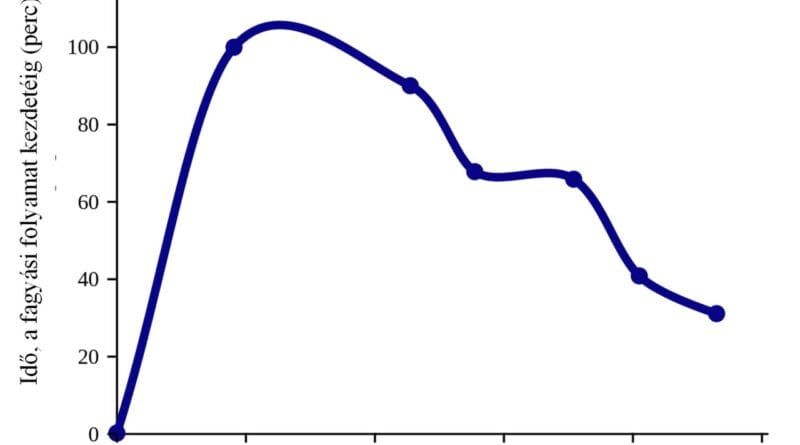
The Mpemba Effect: Why Hot Water Can Freeze Faster Than Cold Water
If you place two identical containers of water in a freezer—one hot and one cold—common sense says the cold freezes first, but a physics paradox known as The Mpemba Effect proves otherwise.
The Ice Cream Discovery
In 1963, Erasto Mpemba was making ice cream at school when he noticed that his hot mixture froze faster than the cold mixtures of his classmates. When he asked his physics teacher about it, he was ridiculed. But Mpemba persisted, eventually convincing a university professor to run tests. The results confirmed the phenomenon, yet decades later, scientists still debate the exact physical mechanism behind it. Several competing theories exist, including evaporation, dissolved gases, and hydrogen bonding.
The Thermodynamic Debate
One theory suggests that the rapid evaporation of hot water reduces the volume of water left to freeze, while also cooling the remaining liquid. Another focus is on convection currents; hot water creates rapid thermal currents that circulate cold water to the top of the container, accelerating heat loss. Recent studies at the molecular level suggest that the hydrogen bonds between water molecules stretch and store energy when heated, releasing it quickly as they cool, which allows the water to drop in temperature faster. Whatever the cause, the Mpemba Effect shows that even the most basic elements of our daily lives can harbor deep physical mysteries.
Aristotle’s Early Observations on Freezing
The Mpemba Effect is not a modern discovery, but rather a phenomenon that has been noted by scholars for thousands of years. The ancient Greek philosopher Aristotle observed in the fourth century BC that when people wanted to cool water quickly, they would first place it in the sun to heat it. Similarly, the 17th-century English philosopher Francis Bacon and the French mathematician René Descartes noted that pre-heated water froze faster than cold water. However, these early observations were dismissed by modern physicists who believed they violated the laws of thermodynamics, until Erasto Mpemba rediscovered the phenomenon in 1963 and forced the scientific community to re-examine the physics of freezing.
Dissolved Gases and Hydrogen Bond Stretching
Modern theories explaining the Mpemba Effect focus on the molecular behavior of water. One theory suggests that heating water drives out dissolved gases, which alters its thermal conductivity and allows it to cool more rapidly. Another theory, developed by researchers at Nanyang Technological University, focuses on the hydrogen bonds between water molecules. When water is heated, the covalent bonds within the molecules stretch and store energy, which is released quickly as the water cools, accelerating the heat transfer process and allowing the hot water to reach its freezing point faster than cold water.
Convection Currents and Heat Exchange
The behavior of convection currents in cooling water is a key factor in the Mpemba Effect. When hot water is placed in a freezer, the rapid temperature drop at the top of the container creates strong convection currents, with hot water rising to the surface and colder water sinking to the bottom. This circulation accelerates the heat transfer process, as the hot water at the surface radiates energy into the freezer air much faster than still, cold water. Additionally, the cold water lacks these strong currents, causing it to form a layer of ice at the surface that acts as an insulator, slowing down the freezing of the rest of the liquid and allowing the hot water to freeze first.
Supercooling and Ice Nucleation
Another physical explanation involves the process of supercooling, where water remains liquid below its freezing point until a seed crystal initiates ice formation. Cold water is more prone to supercooling, sometimes dropping to minus 2 or 3 degrees Celsius before freezing. Hot water, on the other hand, contains fewer dissolved gases and different mineral alignments, which can facilitate ice nucleation at higher temperatures. Because the hot water starts freezing as soon as it reaches 0 degrees, it can turn into solid ice before the supercooled cold water does, showcasing the complex relationship between molecular structure and phase transitions.
Thermodynamic Laws and Scientific Progress
The ongoing debate over the Mpemba Effect highlights the dynamic nature of scientific progress. For decades, many physicists dismissed the effect as an experimental error or a myth, believing it violated Newton’s law of cooling. However, persistent research and improvements in high-speed photography and molecular modeling have confirmed that the effect is real, forcing scientists to refine their understanding of thermal dynamics. This journey from skepticism to discovery shows that even the most established laws of physics are subject to revision when faced with new, reproducible evidence from the natural world.
Cryopreservation and Industrial Freezing
The practical applications of the Mpemba Effect extend into modern industrial freezing and cryopreservation. In food science, freezing ingredients quickly is critical to preserving cell structure and flavor; slow freezing creates large ice crystals that tear cell walls, leaving food mushy when thawed. By utilizing the principles of the Mpemba Effect—pre-heating liquids to induce convection currents and accelerate heat transfer—industrial food processors can freeze products faster, saving energy and improving food quality. Similarly, researchers in cryobiology are studying how the thermal dynamics of pre-warmed samples might improve the preservation of biological tissues and organs, showing that this historical paradox has real-world value today.
Mpemba’s Scientific Legacy in East Africa
Erasto Mpemba’s journey from a curious high school student to a recognized figure in physics has inspired generations of young scientists in East Africa. After publishing his findings with Dr. Denis Osborne in 1969, Mpemba went on to study wildlife management and worked for the Tanzanian Ministry of Natural Resources and Tourism, eventually becoming an advocate for science education in developing nations. His story highlights the importance of fostering curiosity and critical thinking in young minds, proving that groundbreaking scientific discoveries can come from anywhere, even a high school classroom in rural Tanzania, and that challenging established scientific dogmas is essential for progress.
FAQ
What is the Mpemba Effect?
The Mpemba Effect is the physical phenomenon where warm water freezes faster than cold water under similar conditions. It represents a classic puzzle in thermodynamics.
Who discovered the Mpemba Effect?
It was named after Erasto Mpemba, a Tanzanian high school student who observed it in 1963. However, ancient scholars like Aristotle and Francis Bacon had also noted similar behavior centuries earlier.
What are the leading explanations for the effect?
The primary theories include the rapid evaporation of hot water (reducing volume), faster heat transfer via strong convection currents, and molecular-level energy release from stretched hydrogen bonds in heated water.