
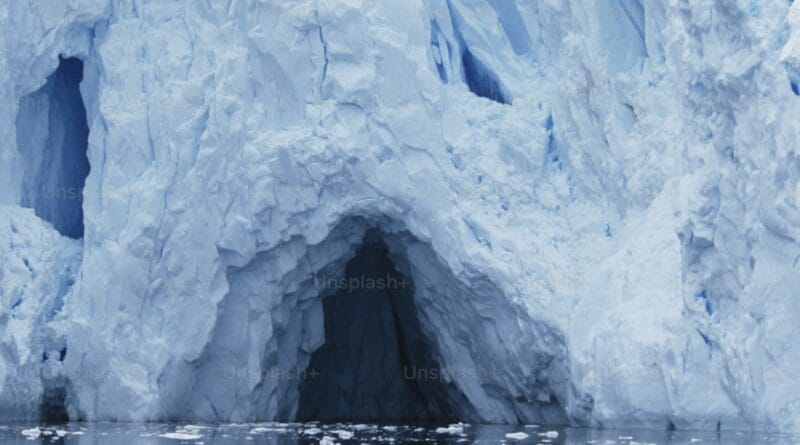
The Blood Falls of Antarctica: The Bleeding Glacier That Confused Scientists for Decades
On a desolate glacier in East Antarctica, a slow stream of deep, blood-red liquid flows from the ice, staining the white valley floor. For over a century, this feature, known as Blood Falls, baffled explorers and scientists who struggled to explain how a glacier could bleed. The truth behind the crimson water turned out to be even stranger, involving an ancient, subterranean lake trapped beneath the ice for millions of years, home to a unique ecosystem that survives in absolute isolation.
The Discovery in the Dry Valleys
The feature was first discovered in 1911 by an Australian geologist named Griffith Taylor during the British Antarctic Expedition, led by Robert Falcon Scott. Taylor was exploring a remote region of East Antarctica known as the McMurdo Dry Valleys. Unlike most of the continent, the Dry Valleys are free of snow and ice, kept clear by dry, high-speed winds that sweep down from the polar plateau. It is one of the coldest, driest, and most wind-swept environments on the planet, resembling the surface of Mars more than Earth.
Taylor was leading the Western Journey team, a small group of explorers tasked with mapping the geological structures of the Victoria Land region. They hauled heavy sledges across the rugged terrain, battling frostbite, blinding blizzards, and winds that could blow a man off his feet. As Taylor was mapping the snout of the glacier that now bears his name, he spotted a shocking sight. A five-story waterfall of deep red liquid was oozing from a crack in the ice, pouring into the frozen Lake Bonney below. The red stain stretched across the white ice and the dark gravel of the valley floor, looking like a fresh wound. Taylor was stunned by the sight. He collected samples and, upon examining them, suggested that the red color was caused by a type of red microalgae living inside the ice. This theory remained the accepted explanation for decades, as the extreme difficulty of conducting research in Antarctica prevented further study.
It was not until the late 20th century that scientists returned to Taylor Glacier with modern analytical tools. When they analyzed the chemical composition of the water, they found no trace of red algae. The red color was not biological; it was chemical. The water flowing from the glacier was a highly saline brine, packed with dissolved iron. The mystery of the algae was solved, but it was replaced by a new question: where was this iron-rich water coming from, and why did it not freeze in the sub-zero temperatures of Antarctica?
The Chemistry of Bleeding Ice
To understand the mechanics of Blood Falls, you have to look at the chemistry of the water. The brine is extremely salty, containing about three times the salt content of normal seawater. This high salinity acts as a natural antifreeze, lowering the freezing point of the water. Even when the temperature inside the glacier drops to fourteen degrees Fahrenheit, the brine remains a liquid. It exists as a network of pressurized channels deep inside the ice, looking for a way to escape.
The iron inside the glacier is dissolved in its ferrous state, known as iron(II). In this state, the iron is soluble and the water is completely clear and transparent. As long as the brine remains trapped inside the glacier, away from the air, it looks like normal water. But the moment the brine forces its way through the cracks and spills onto the surface of the glacier, it contacts the oxygen in the atmosphere. A rapid chemical reaction occurs. The ferrous iron is oxidized into ferric iron, forming ferric hydroxide—which is essentially rust.
This process of oxidation turns the clear water into a deep, rust-red liquid within minutes of exiting the glacier. The water is literally bleeding rust. The red stain on the ice is a deposit of iron oxides that have settled out of the water as it flows over the glacier snout. But this chemistry raised a deeper question. For the water to be so rich in dissolved iron, it must have been in contact with iron-bearing rocks for a very long time in an environment completely devoid of oxygen. Scientists realized that there must be a massive reservoir of ancient water trapped beneath the ice sheet.
The Subglacial Time Capsule
In the 2000s, researchers used ice-penetrating radar to map the interior of Taylor Glacier. They discovered a massive subglacial lake trapped under a quarter-mile of solid ice, about three miles from the snout where Blood Falls emerged. Geological reconstruction showed that this lake was formed around two million years ago, during the Pleistocene epoch. As the Taylor Glacier advanced across the terrain, it trapped a pool of seawater in a deep fjord, sealing it off from the rest of the world.
The subglacial lake remains a liquid not only because of its extreme salt content, but also because of the physics of the ice sheet itself. The weight of a quarter-mile of ice puts immense pressure on the water below, which slightly lowers its freezing point. In addition, the glacier is moving, and the friction of the ice sliding over the bedrock generates geothermal heat that helps keep the lake insulated from the freezing surface temperatures above. It is a closed system, insulated from the atmosphere by a massive barrier of ice.
For two million years, this subglacial pool remained completely isolated. It received no sunlight, no fresh air, and was subjected to immense pressure from the weight of the overlying ice. Over time, the evaporation of the glacier concentrated the salt, turning the pool into a super-saturated brine. The water dissolved iron from the bedrock beneath the glacier, creating the iron-rich chemical signature of the lake. But the most shocking discovery was yet to come. In 2009, geomicrobiologist Jill Mikucki analyzed samples of the brine and found that it was teeming with life.
The lake is home to a unique community of microbes that have survived in total darkness and isolation for millions of years. Because there is no sunlight, they cannot perform photosynthesis. Because there is no oxygen, they cannot breathe like normal organisms. Instead, they have evolved a unique metabolic pathway. They reduce sulfates in the water to get energy, and then use the dissolved iron from the bedrock to oxidize the sulfides back to sulfates, essentially breathing iron. It is a self-sustaining ecosystem that relies entirely on chemical reactions between rocks and water to survive.
A Window into Other Worlds
The existence of life in the subglacial lake of Taylor Glacier has major implications for astrobiology. If microbes can survive in a dark, freezing, oxygen-free brine under a quarter-mile of ice in Antarctica, it suggests that life could exist in similar environments elsewhere in the solar system. Scientists point to Jupiter’s moon Europa and Saturn’s moon Enceladus, both of which possess global oceans of liquid water trapped beneath thick crusts of ice. These moons are subjected to intense radiation and lack surface oxygen, yet their subglacial oceans may host hydrothermal activity and chemical gradients similar to those beneath Taylor Glacier.
Blood Falls serves as a natural laboratory, allowing scientists to study how life might survive on these icy moons without having to send a space probe to drill through miles of extraterrestrial ice. It shows that liquid water and chemical energy are enough to support life, even in the most hostile environments. The bleeding glacier of Antarctica is not just a bizarre geological curiosity; it is a beacon of hope for the search for life in the outer solar system, showing that the dark, cold depths of space may not be as barren as we assume.
Frequently Asked Questions
What causes the red color in Blood Falls?
The red color is caused by iron-rich brine oxidizing when it contacts the air. The dissolved iron in the water reacts with oxygen to form ferric hydroxide, which is essentially rust, turning the clear liquid into a deep blood-red water.
Does Blood Falls freeze?
No, the water in Blood Falls does not freeze even at sub-zero temperatures. The brine contains three times the salt content of normal seawater, which lowers its freezing point and allows it to remain liquid inside the glacier at fourteen degrees Fahrenheit.
Is there life in Blood Falls?
Yes, the subglacial lake that feeds the falls is home to a unique community of microbes. Trapped for two million years without oxygen or sunlight, these organisms survive by using a metabolic pathway that utilizes sulfate and dissolved iron from the bedrock.