
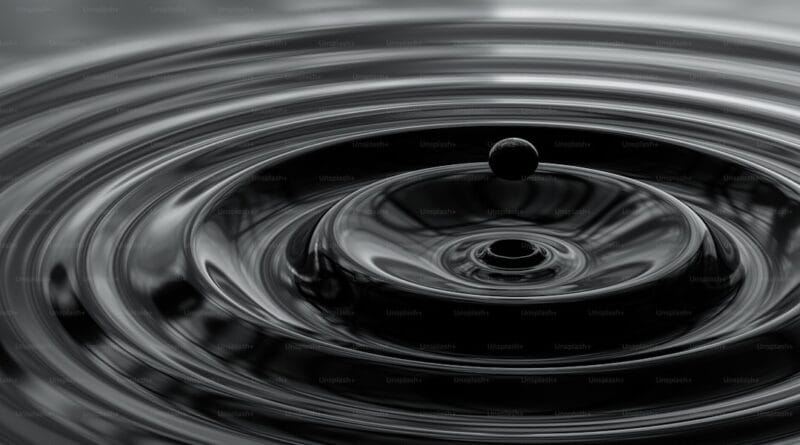
The Leidenfrost Effect: The Physics Trick That Makes Water Hover Over Heat
Pour a drop of water onto a hot frying pan, and it will sizzle and evaporate in a few seconds. But if you make that pan twice as hot, something bizarre happens: the water droplet does not boil; instead, it rolls around intact like a ball of mercury, floating on the surface for several minutes. This phenomenon is known as the Leidenfrost effect, and it represents one of the most counterintuitive tricks of thermodynamics, where extreme heat acts as an insulator rather than a destroyer.
Johann Leidenfrost and the Tract of Water
The history of the effect begins in Germany in 1756. A medical doctor and theologian named Johann Gottlob Leidenfrost published a scientific treatise titled A Tract About Some Qualities of Common Water. In this book, Leidenfrost described an experiment where he heated an iron spoon to a dull red glow and dropped a single globule of water into it. He expected the water to flash into steam instantly. Instead, he observed that the droplet sat on the spoon for over thirty seconds, spinning and moving without boiling.
Leidenfrost noted that the droplet did not actually touch the spoon’s surface. It appeared to float on a silent, invisible cushion. As long as the spoon remained extremely hot, the droplet survived. But as the spoon cooled down, the water suddenly made contact with the metal, hissed violently, and evaporated in a fraction of a second. It was a bizarre observation: a cooler spoon boiled the water faster than a red-hot spoon. Leidenfrost’s work was the first to document this thermal anomaly, which now bears his name.
For centuries, the effect was treated as a physics demonstration, a curiosity shown to students in classrooms. But as the study of thermodynamics advanced, physicists began to realize that the mechanics of the Leidenfrost effect were key to understanding heat transfer in industrial processes. The effect is a balance of phase change, vapor pressure, and thermal insulation that occurs at the boundary where liquids meet extreme heat, defying our basic intuition about how heat behaves.
The Science of the Steam Cushion
To understand the physics, you have to look at the interface between the liquid and the hot surface. When a droplet of water falls onto a pan heated above its boiling point, the bottom of the droplet makes contact with the metal. This bottom layer instantly vaporizes, turning from liquid water into steam. This steam has nowhere to escape immediately, so it forms a thin layer of gas, about 0.1 millimeters thick, trapped between the pan and the rest of the droplet. This layer acts as a barrier, preventing direct contact between the liquid water and the hot iron skillet.
This gas layer is the key to the entire phenomenon. Gas is a very poor conductor of heat compared to liquid or solid metal. The steam layer acts as a highly effective thermal insulator, protecting the rest of the droplet from the heat of the pan. The heat transfer coefficient drops from a high value of over 10,000 Watts per square meter Kelvin (W/m²K) during direct liquid contact down to around 100 W/m²K once the vapor film forms. This hundred-fold reduction in heat transfer rate is what prevents the droplet from boiling, allowing it to survive for minutes instead of seconds. The droplet is suspended on a cushion of its own steam, floating like a miniature hovercraft.
This cushion also eliminates friction. Because the droplet is not touching the solid pan, it experiences almost no resistance to movement. The slightest tilt of the pan, or even a gentle draft of air, will cause the droplet to skitter rapidly across the surface, bouncing off the edges like a pinball. The temperature at which this protective vapor barrier forms is called the Leidenfrost temperature. For water, this temperature is around 379 degrees Fahrenheit (193 degrees Celsius), which is far higher than the boiling point of 212 degrees Fahrenheit.
Nitrogen, Lead, and Human Shields
The Leidenfrost effect is not limited to water; it applies to any liquid placed on a surface that is hot relative to the liquid’s boiling point. A prime example is liquid nitrogen. Liquid nitrogen boils at a temperature of minus 320 degrees Fahrenheit (77 Kelvin). Because room temperature is hundreds of degrees hotter than this boiling point, any table, floor, or human hand acts like a red-hot stove to the nitrogen. When poured onto a table, the liquid nitrogen instantly forms a vapor barrier and skitters around in drops, demonstrating the effect at room temperature.
This leads to one of the most famous and dangerous demonstrations in physics: dipping a hand into liquid nitrogen or molten lead. If a person wets their hand with water and then quickly dips it into a container of molten lead, they can escape without injury. The moisture on the skin instantly vaporizes, creating a temporary steam barrier that insulates the flesh from the molten metal for a fraction of a second. Similarly, physicists have briefly dipped their hands into liquid nitrogen, relying on the nitrogen vapor barrier to protect their skin from frostbite. However, this is a dangerous trick; if the hand is left in the liquid for too long, the vapor barrier collapses, resulting in severe burns.
The same mechanics explain why steelworkers can occasionally touch hot materials or why firewalkers can step on hot coals without getting burned. If the foot is moist with sweat, the moisture can flash into a protective steam layer. But this protection is fleeting; it only lasts as long as there is moisture to vaporize and as long as the contact is brief. If the foot remains on the coal, or if the hand stays in the lead, the heat will break through the barrier, causing catastrophic injury.
From Steam Engines to Nuclear Safety
Modern researchers are using the Leidenfrost effect to develop new technologies. In microfluidics, engineers have designed grooved surfaces that control the direction of the vapor flow beneath a droplet. By directing the steam to escape in one direction, they can create a self-propelled droplet that travels along a path without any external pumps or motors, acting like a tiny steam engine. This could help transport small quantities of chemicals in lab-on-a-chip diagnostic devices.
The effect is also a major concern in nuclear engineering. In a nuclear reactor, water is used to cool the fuel rods, keeping their temperature stable. If the heat generation inside the fuel rods exceeds a critical value, a state called the Departure from Nucleate Boiling (DNB) occurs. The boiling regime transitions from bubble formation directly to a continuous vapor film, wrapping the rod in steam. Because steam is a poor conductor of heat, the fuel rods can no longer transfer their heat to the water, causing their temperature to spike rapidly. This can lead to a catastrophic meltdown of the fuel rods, making the prevention of the Leidenfrost state a matter of critical nuclear safety.
Whether it is used to design tiny microfluidic engines or to prevent nuclear disasters, the Leidenfrost effect remains a powerful demonstration of the laws of thermodynamics. It shows that in the world of physics, extreme conditions can produce results that defy our everyday experience, turning a destructive force like heat into a shield that preserves and protects.
Frequently Asked Questions
What temperature does the Leidenfrost effect happen?
For water, the effect occurs at the Leidenfrost temperature of approximately 379 degrees Fahrenheit (193 degrees Celsius) on a metal surface, which is significantly higher than water’s boiling point of 212 degrees Fahrenheit.
Why does the Leidenfrost effect prevent boiling?
The effect prevents rapid boiling because the bottom layer of the liquid instantly vaporizes upon contact with the hot surface, creating a thin cushion of steam that acts as a thermal insulator, slowing the transfer of heat to the rest of the droplet.
Can you dip your hand in liquid nitrogen due to the Leidenfrost effect?
Yes, a person can briefly dip a dry hand into liquid nitrogen because the temperature difference creates an instant vapor barrier of nitrogen gas around the skin. However, if the hand remains submerged for more than a split second, the barrier collapses, causing severe frostbite.