
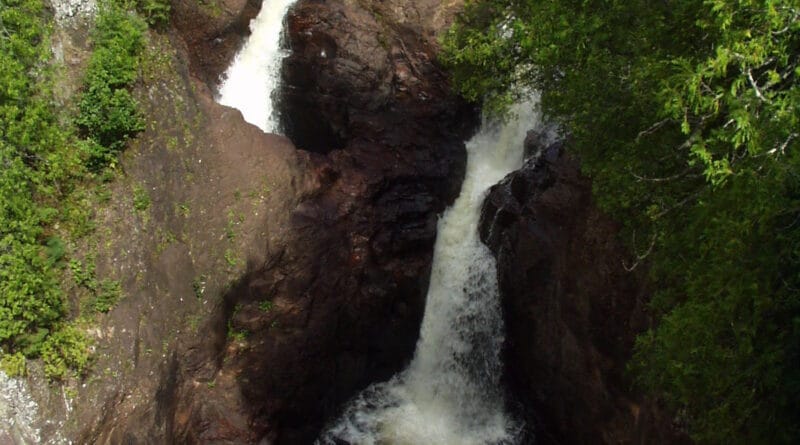
Devils Kettle Falls: The Waterfall That Swallows Half a River
In Judge C.R. Magney State Park on Minnesota’s North Shore, the Brule River plunges into a deep volcanic pothole known as the Devils Kettle and disappears.
Urban Legends and Geology
The mystery spawned wild urban legends. Some believed the water flowed through an underground cavern system directly into the depths of Lake Superior. Others joked that the pothole was a portal to another dimension. Geologists, however, knew that large underground caverns cannot exist in volcanic rocks like rhyolite and basalt, which are too hard and lack the soluble limestone needed to form caves. In 2017, hydrologists from the Minnesota Department of Natural Resources decided to solve the mystery using modern flow measurements.
Solving the Math
They measured the volume of water flowing above the falls and compared it to the volume of water flowing hundreds of feet below the kettle. The measurements were almost identical, proving that all the water that enters the kettle must rejoin the main river shortly below the falls. Geologists believe the water travels through a short, subterranean channel before pouring back into the riverbed underwater, where the churning currents trap debris. While the math is settled, the exact path of this hidden tunnel remains unmapped, leaving a trace of mystery at the bottom of the kettle.
The Volcanic Hydrological Formations
The unique geology of the Brule River basin was formed by volcanic activity over one billion years ago during the Midcontinent Rift. The region is rich in basalt and rhyolite, hard volcanic rocks that resist erosion and form dramatic cliffs and waterfalls. Devil’s Kettle Falls is carved into a massive rhyolite formation, where the churning water has ground a deep pothole into the rock over thousands of years. Because these volcanic rocks do not contain soluble minerals like limestone, the formation of large underground cave systems is geologically impossible, which puzzled scientists who could not explain how half the river could disappear without a major subterranean network.
The 2017 DNR Hydrology Experiment Details
The mystery of the Devil’s Kettle was finally solved in 2017 by hydrologist Jeff Green and his team from the Minnesota Department of Natural Resources. The team utilized highly sensitive flow meters to measure the volume of the Brule River at several points. They measured the flow rate above the waterfall, finding it to be 123 cubic feet per second. They then measured the flow rate below the kettle, which was also 123 cubic feet per second, proving that no water was being lost to deep underground caverns. This confirmed that the water simply flows through a short, subterranean channel in the rhyolite rock and re-enters the main riverbed just below the pool, where the churning white water conceals the outlet.
The Geological History of the Brule River
The Brule River basin is a geologically active area that has been shaped by glaciers, volcanoes, and water erosion over millions of years. During the last ice age, massive glaciers carved deep valleys into the volcanic rhyolite bedrock, creating the rugged landscape of Minnesota’s North Shore. When the glaciers melted, they formed the Brule River, which carved its way through the volcanic rock, creating a series of waterfalls and gorges. The Devil’s Kettle is the most famous of these formations, showcasing the power of water erosion to drill deep potholes into the hardest volcanic rocks on Earth, creating a natural wonder that continues to capture the imagination of visitors.
The Search for the Subterranean Channel
Although the 2017 flow tests proved that the water re-enters the river below the falls, the exact path of the subterranean channel remains unmapped. Hydrologists have attempted to send remote cameras down the kettle, but the powerful, churning currents and sharp volcanic rocks destroy the equipment before it can capture any images. Some geologists believe the channel is a simple vertical tube that connects to a horizontal crack in the rhyolite rock, while others suggest it may be a network of smaller fractures that distribute the water before it exits underwater. Mapping this hidden passage represents the final challenge for researchers studying the Devil’s Kettle.
Environmental Protection and Tourism
The popularity of the Devil’s Kettle has made Judge C.R. Magney State Park a major destination for ecotourism, drawing thousands of hikers every year. To protect the fragile volcanic formations and ensure visitor safety, the Minnesota Department of Natural Resources has constructed wooden boardwalks and viewing platforms around the falls. Visitors are strictly prohibited from throwing objects into the kettle, as this can block the subterranean channel and disrupt the local river ecosystem. By preserving this unique geological wonder, the park ensures that future generations of scientists and hikers can experience the mystery of the vanishing river.
The Impact on Minnesota Park Conservation
The resolving of the Devil’s Kettle mystery has not diminished the public’s fascination with Judge C.R. Magney State Park. The park has seen a significant increase in visitors, which requires continuous conservation efforts by local rangers to protect the surrounding boreal forest and water quality of the Brule River. The Minnesota Department of Natural Resources utilizes the Devil’s Kettle as an educational tool, teaching visitors about the unique rift valley geology of Lake Superior’s North Shore. Park managers emphasize that the true mystery is now one of conservation: protecting this unique geological formation from the impacts of human footprint and climate change, ensuring it remains pristine for future generations of hikers.
The Legends of the Ojibwe Tribe
Long before European settlers and modern geologists arrived on the shores of Lake Superior, the local Ojibwe (Anishinaabe) tribe held the Brule River and the Devil’s Kettle in high spiritual regard. Tribal stories spoke of the waterfall as a place of powerful natural spirits, where the physical world connected directly to the spirit realm. The mysterious vanishing of the river’s western branch was seen as proof of the land’s deep, sacred power, and the area was treated with great respect. These indigenous perspectives remind us that before science decodes the physical mechanisms of natural wonders, they serve as focal points for human culture, storytelling, and a deep, spiritual connection to the environment.
FAQ
Has anyone ever gone down the Devil’s Kettle?
No. Going down the Devil’s Kettle is extremely dangerous and would be fatal. The water plunging into the narrow, volcanic pothole creates powerful, crushing forces and holds debris underwater, making recovery impossible.
Did the dye or GPS tracker tests ever work?
No, early attempts using dyes, ping-pong balls, and trackers failed because the intense underwater currents and churning rocks at the bottom of the kettle destroyed the devices or held the dye dispersed under the riverbed.
Where does the water actually go?
Modern flow tests proved that the water flows through a short underground tunnel and drains back into the main Brule River just a few yards downstream from the waterfall, directly beneath the surface of the river.